Hi, what do you want to do?





Other
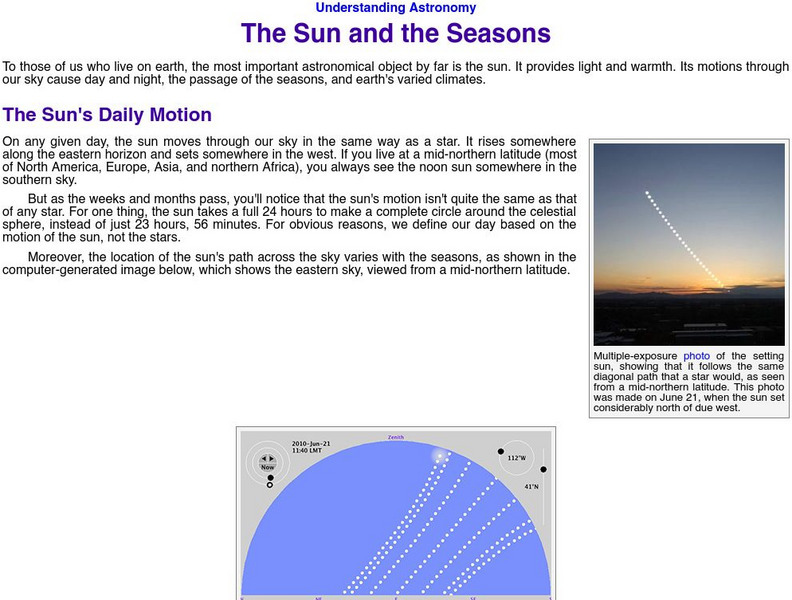
Weber State University: The Sun and the Seasons
To those of us who live on earth, the most important astronomical object by far is the sun. This article explains how the motion of the sun through our sky cause day and night, the passage of the seasons, and earth's varied climates.

Alabama Learning Exchange
Alex: The Sun and the Earth
The students will understand the relationship between the Earth and the sun and how this relationship affects observable phenomena on Earth, such as the seasons. The activity will help students learn about these concepts and will...

Texas Education Agency
Texas Gateway: The Sun Is the Center of the Solar System
See what you know about the solar system by taking this brief interactive quiz and learning module.
Annenberg Foundation
Annenberg Learner: Planet Earth
A series of seven instructional, hour-long videos presenting Earth-science topics such as plate tectonics, oceans, climate changes, natural resources, the Sun, and the future of our planet. Closed captioning option provided for each video.
Science Education Resource Center at Carleton College
Serc: Tracking the Sun: Observing the Path of the Sun Throughout the Year
Over the course of the school year, students collect weekly data about the sun's position at a specific time of day, resulting in creating a figure "8" that shows the path of the sun called an analemma.
![Noaa: National Weather Service: The Sun and Its Effect on the Earth [Pdf] Website](https://statictemp.lp.lexp.cloud/images/attachment_defaults/resource/large/FPO-knovation.png "Noaa: National Weather Service: The Sun and Its Effect on the Earth [Pdf] Website")
NOAA
Noaa: National Weather Service: The Sun and Its Effect on the Earth [Pdf]
The Space Environment Center (SEC) put together a slide show for use by teachers on Space weather. Begin with discussing solar emission and the sun itself. Then end with a summary of climatic effects of space weather, and a note on space...
Smithsonian Institution
Smithsonian Libraries:chasing Venus: Observing the Transits of Venus 1631 2004
An online website, from a historical perspective, of the study of the transit of Venus between the sun and the earth.
Science Buddies
Science Buddies: Tracking Geomagnetic Storms in the Ionosphere
The Sun is the ultimate source of the energy that powers weather systems on Earth. Geomagnetic storms are sun-powered storms in the upper atmosphere, arising from energized particles that are periodically ejected by the Sun. Among other...

TED Talks
Ted: Ted Ed: Reasons for the Seasons
Why do some regions experience full-time heat while others are reckoning with frigid temperatures and snow? And why are the seasons reversed in the two hemispheres? Rebecca Kaplan explains how the shape of the Earth's orbit around the...
PBS
Pbs Learning Media: Giving Rise to the Jet Stream
This interactive activity from NOVA Online uses animation and graphics to offer a detailed explanation of the jet stream. A thorough account is given of the role played by the Sun's heat and Earth's shape and rotation, among other factors.
Utah Education Network
Uen: The Night Sky
Learn about the rotation of the earth, the movement of the moon, and the position of the sun.
Science Education Resource Center at Carleton College
Serc: Investigating Rotation: Why Is There Day and Night?
In this rotation activity, students investigate what causes day and night by participating in a classroom activity. Students will observe, question, and investigate how the relationship between the earth and sun causes day and night.
NASA
Nasa: The Space Place: Orbits 'R' Us
Learn about how Earth orbits the sun and how satellites orbit the Earth. Discover the different types of satellites such as GOES and POES and what they are used to monitor.
Carnegie Mellon University
Telstar: The Sun and Its Energy
The sun's energy is the primary source of energy for all surface phenomena and life on Earth. Combined with the material of the Earth (including the molecules held close by the Earth's gravitational force called the atmosphere), this...
Carnegie Mellon University
The Sun and Its Energy
The sun's energy is the primary source of energy for all surface phenomena and life on Earth. Combined with the material of the Earth (including the molecules held close by the Earth's gravitational force called the atmosphere), this...

E-learning for Kids
E Learning for Kids: Egypt: How Do the Sun, Moon and Earth Revolve Around Each Other?
Omar helps his parents sell things at the market. Join him while he learns about the relationship of the Sun, Moon, and Earth.
NASA
Nasa: The Sun
An introduction to the Sun including its size and distance from the Earth, sunspots, flares and coronal mass ejections.
University Corporation for Atmospheric Research
Ucar: The Sun Earth Connection: Exploring the Dynamic Nature of the Sun
The unit contains lessons and a presentation that allow learners to explore the Sun through images and investigate how magnetism from the Sun interacts with the Earth's magnetic field during space weather events.
University Corporation for Atmospheric Research
Ucar: The Sun Earth Connection: The Magnetic Sun
Learners will build a simple version of a magnetometer and use it to discover the types of areas of the Sun that have very strong magnetic fields. Students will then describe what the types of features associated with the Sun's strongest...
Utah Education Network
Uen: How Big Are Earth, Sun, and Moon?
Understand where the sun is in the solar system and how big the earth, moon, and sun are.
NASA
Nasa: Mysteries of the Sun
Learn about the study of the Sun's influence on the solar system called Heliophysics. This site contains videos on topics like Space Weather, Solar Variability, the Heliosphere, Earth's Magnetosphere, and the Earth's Upper Atmosphere.

E-learning for Kids
E Learning for Kids: Mediterranean Sea: How Long Does It Take for the Earth to Go Around the Sun?
Learn about the Earth's revolution and rotation in this module.

BBC
Bbc Schools: Ks2 Bitesize: Science: Physical Processes: Earth, Sun, and Moon
Help Sarah Jane and her team put the solar system's planets back in order. Following the activity, read more about the sun, the Earth, and its moon, and then take a quick quiz to check for understanding.
Science Buddies
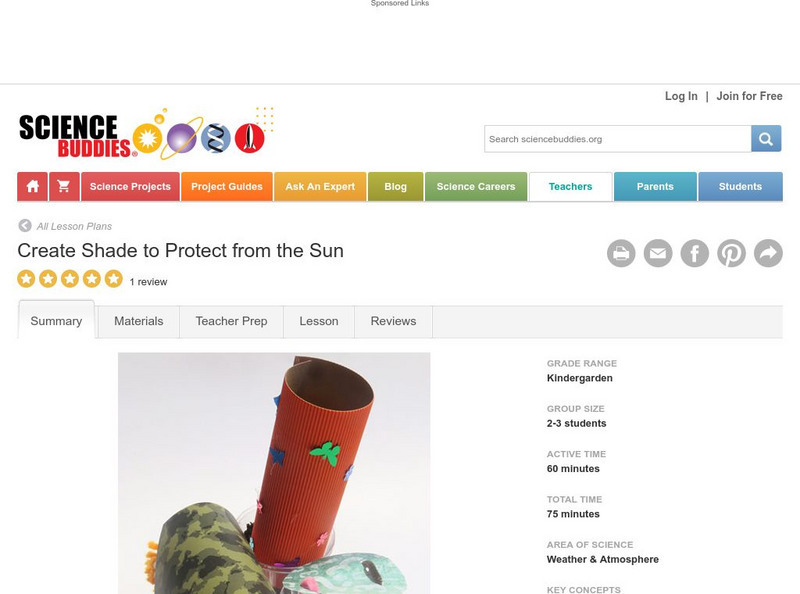
Science Buddies: Create Shade to Protect From the Sun
In this fun activity, students will get creative with craft materials. They will figure out how to protect an "animal" and its territory from getting too hot in the sun. What will they build to keep their animals cool?