Hi, what do you want to do?





Other
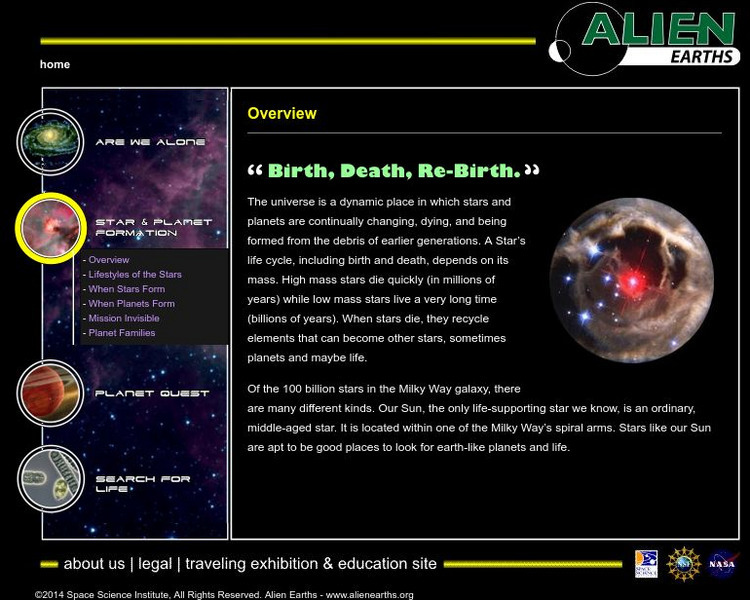
Space Science Institute: Alien Earths: Star and Planet Formation
Learn about the lives of stars, and how stars and planets form. The Interactive activity, 'Planet Families' requires Adobe Flash and cannot be launched.

Enchanted Learning
Enchanted Learning: Zoom Astronomy: All About Space
A fantastic collection of information about the solar system. Includes information on all of the planets, the moon, the sun, asteroids, comets, meteoroids, and stars. Also find puzzles, a dictionary, quizzes, classroom activities, and...
Science Buddies
Science Buddies: Where Did All the Stars Go?
If you live in a big city or urban area it is hard to see many stars at night. In most urban areas only the most brilliant stars, planets and the moon can be seen. This is because of something called light pollution which is the...
National Earth Science Teachers Association
Windows to the Universe: History & People
Biographies of people throughout history who looked at the sky and wondered what was there. Links to a detailed description of the planets and interactive activities.
NASA
Nasa: Image Science Center: Ask the Space Scientist
A NASA scientist, Dr. Sten Odenwald, answers many students' questions. Topics include planets, galaxies, black holes, the origin of the universe, and common misconceptions about space.

Science Buddies
Science Buddies: The Moon and the Stars
When you are in the city, only a few of the brightest stars are visible. But when you are in the country, you can see many more stars than you can count. Sometimes you can even see the bright belt of our galaxy, the Milky Way. In this...
Nine Planets
The Nine Planets: Meteors, Meteorites and Impacts
Very informative and in-depth site about meteors, meteorites and their impacts. This site provides lots of text to inform about meteors, lots of pictures of the different types of meteorites, tables and statistics about meteors and...
University of Virginia
University of Virginia: How the Greeks Used Geometry to Understand the Stars
An article explaining how the Greeks were able to use their science and mathematics to predict where astronomical objects such as the Planets could be found in the nighttime sky even though their underlying premise was that the earth did...
Nine Planets
The Nine Planets: Venus
In-depth information site on Venus, complete with a thorough glossary, links to a wide array of related sites, thumbnail picture files linked to larger images, and even a short audio file from a classic symphony.
Space Telescope Science Institute
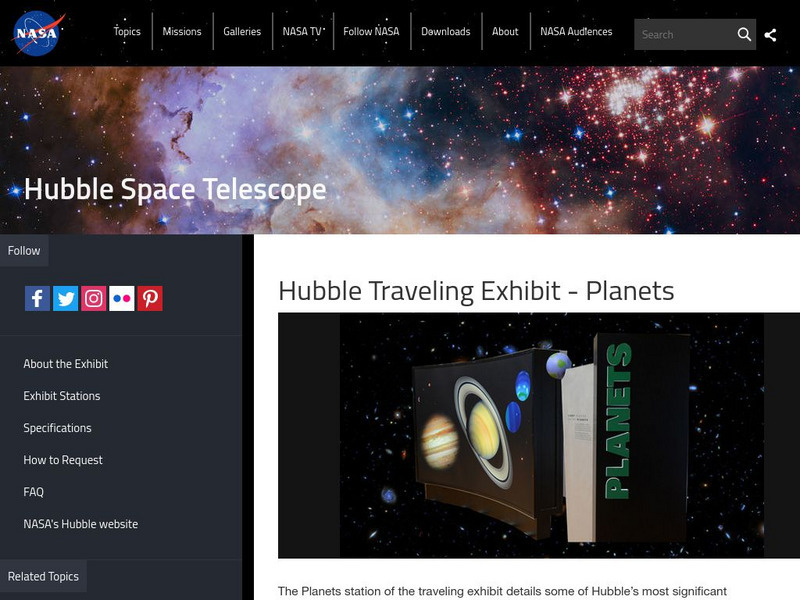
Nasa: Hubble Traveling Exhibit: Planets
At this site from HubbleSite you can learn everything you wanted to know about planets like what is the weather on Mars, what is the black eye on Jupiter? Site also provides links to information on the telescope, the rest of the planets,...
Institute and Museum of the History of Science
Museo Galileo: Multimedia: Video: Astronomical Use of the Plane Astrolabe
Invented in ancient Egypt, the plane astrolabe is a tool used by astronomers and navigators to determine time and identifying positions of the Sun, Moon, stars, and planets. Read text or view the video to understand the details of its...

Other
University of Leicester: The Solar System
Resource explores the solar system, with an in depth discussion of each of the planets and their properties.
TeachEngineering
Teach Engineering: The North (Wall) Star
Celestial navigation is the art and science of finding one's geographic position by means of astronomical observations, particularly by measuring altitudes of celestial objects - sun, moon, planets or stars. This activity starts with a...
NASA
Nasa Star Child: Uranus, Neptune's Twin (Level 1)
Get to know the twin of Neptune with this introduction to Uranus. Listen to the information in an audio file. Features include a printable version of the page, and vocabulary words are linked to a glossary of terms.
NASA
Astronomical Society of the Pacific: Telescope Treasure Hunt
This hands-on astronomy activity lets learners hunt for different objects in the night sky that contribute to stellar and planetary formation, using a Treasure List. They will learn how stars and their planets form and will find objects...
Nine Planets
The Eight Planets: The Sun Solar Wind
This Eight Planets site briefly describes solar wind, a low density stream of charged particles emitted by the Sun. It also provides the basics on the sun's composition and additional sun links.
Utah Education Network
Uen: Where Did the Matter in the Universe Come From?
Young scholars use various articles about how atoms are made and spread throughout the universe starting with the Big Bang. They will study the articles as groups and will then present their information to the class.
Georgia Department of Education
Ga Virtual Learning: A Brief History of Astronomy
In this interactive module students will explore what different ancient cultures believe was an explanation of the stars and planets. They will look at how the work of Nicolas Copernicus revolutionize the world of astronomy and learn how...

Unite for Literacy
Unite for Literacy: Earth and Sky: The Night Sky
Read about the sights you can see in a clear night sky. Book includes audio narration in 16 additional languages with text in English.
Other
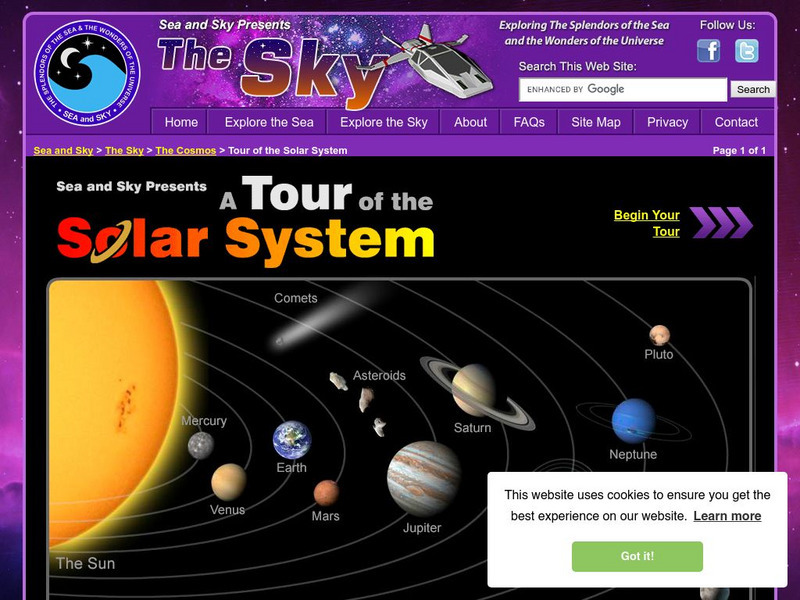
Sea and Sky: A Tour of the Solar System
Take a virtual tour of the solar system starting with detailed information about the sun.
Other
Astromador: Astronomia Para Amadores
This resources focuses exclusively on astronomy. It's packed with historical facts about space exploration, famous people who pioneered the study of stars and planets. It features chronological list of space exploration, current news,...
Kidport
Kidport: Space Science
This complete resource will help students to improve their understand of space exploration. Includes images of the universe, galaxies, stars and planets.
American Museum of Natural History
American Museum of Natural History: O Logy: What Do You Know? Astronomy
Take this ten-question self-scoring quiz to test your knowledge of astronomy facts: age of the universe, why stars and planets are spheres, where other life might exist in the outer space, the Milky Way, and more.

TED Talks
Ted: Ted Ed: The Law of Conservation of Mass
Everything in our universe has mass- from the smallest atom to the largest star. But the amount of mass has remained constant throughout existence even during the birth and death of stars, planets and you. How can the universe grow while...