Hi, what do you want to do?





NASA
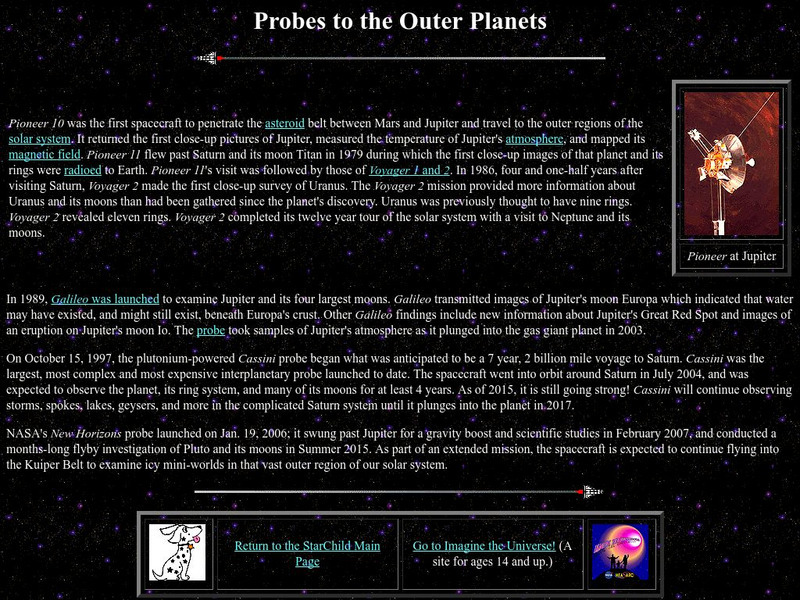
Nasa Star Child: Probes to the Outer Planets (Level 2)
This site has a description of the many probes sent to the outer planets, including pictures and vocabulary words linked to a glossary of terms. Other links on interesting facts and more detailed information are also included.
TeachEngineering
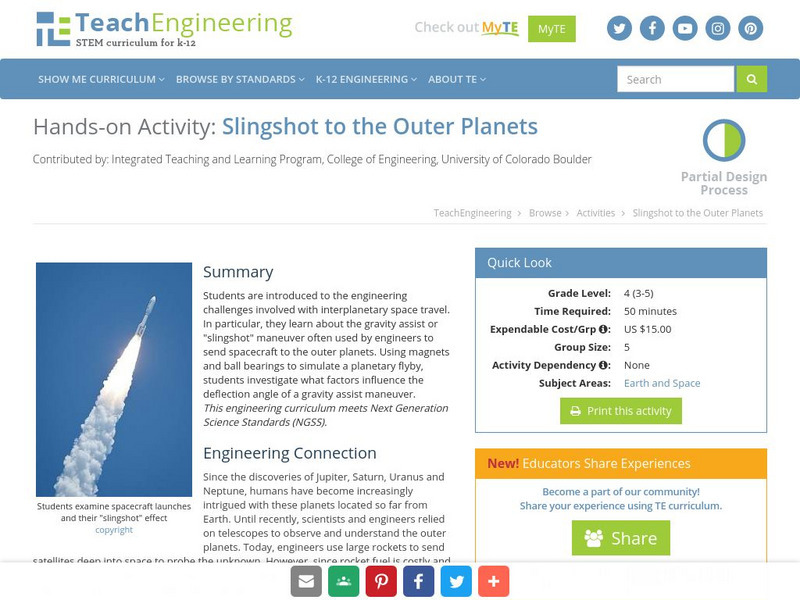
Teach Engineering: Slingshot to the Outer Planets
Students are introduced to the engineering challenges involved with interplanetary space travel. In particular, they learn about the gravity assist or "slingshot" maneuver often used by engineers to send spacecraft to the outer planets....

CK-12 Foundation
Ck 12: Earth Science: Inner Versus Outer Planets Study Guide
An overview of the difference between inner and outer planets of our solar system.

CK-12 Foundation
Ck 12: Earth Science: Inner Versus Outer Planets
[Free Registration/Login may be required to access all resource tools.] Compares the characteristics of inner and outer planets.

TeachEngineering
Teach Engineering: The Outer Planets
Students explore the outermost planets of our solar system: Saturn, Uranus and Neptune. They also learn about characteristics of Pluto and its interactions with Neptune. Students learn a little about the history of space travel as well...

CK-12 Foundation
Ck 12: Earth Science: Inner Versus Outer Planets
[Free Registration/Login may be required to access all resource tools.] Compares the characteristics of inner and outer planets.
Scholastic
Scholastic: Study Jams! Science: Our Solar System: Outer Planets
A slideshow and a short multiple-choice quiz on the four outer planets of our solar system, which include Jupiter, Saturn, Uranus, and Neptune.

Alabama Learning Exchange
Alex: Inner and Outer Planets of the Solar System
In this science instructional activity students will work collaboratively to learn and introduce the eight planets, sizes, characteristics, and their order. They will use size comparisons, research a planet, design a poster and create a...
Enchanted Learning
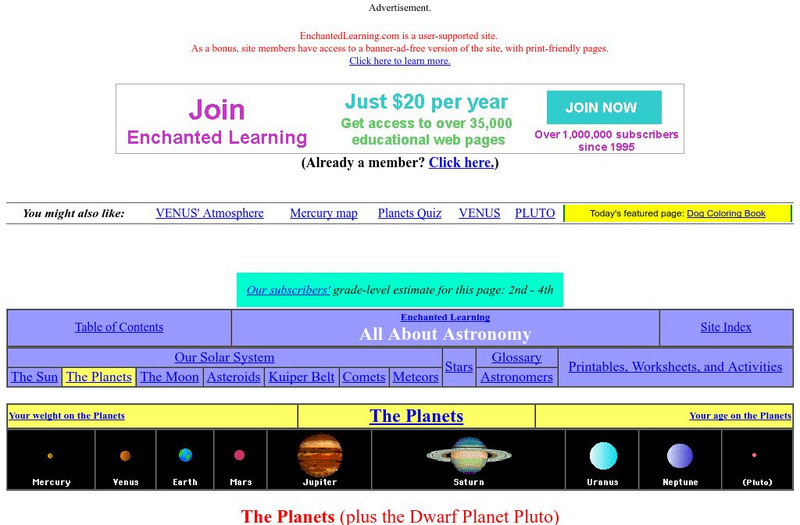
Enchanted Learning: The Planets
This survey of the planets includes all the basics, size, mass, atmosphere, length of day, and the like. It features interactive activities and learning exercises and compares all of the planets in colorful tables.
Nine Planets
The Eight Planets: Earth
Excellent Eight Planets site that provides a vast amount of information about planet Earth. Very comprehensive and complete site.
National Earth Science Teachers Association
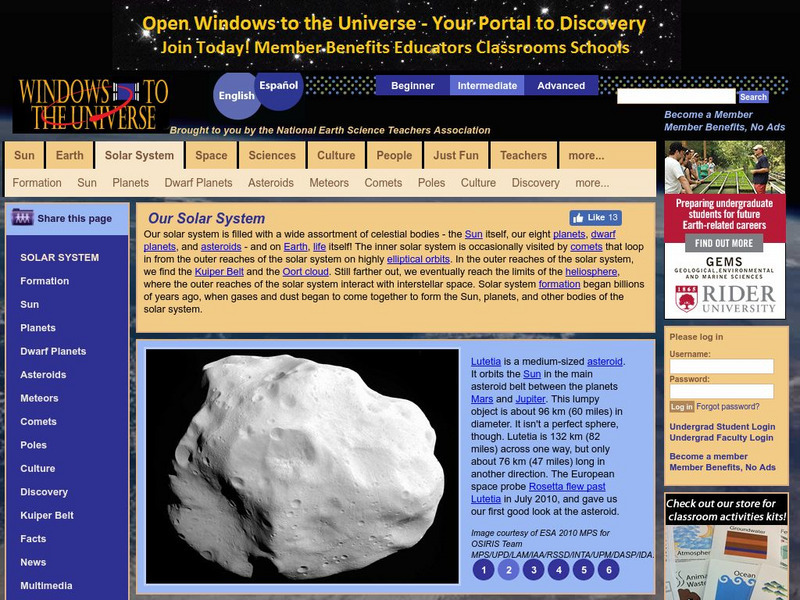
Windows to the Universe: Our Solar System
Our solar system is filled with a wide assortment of celestial bodies - the Sun itself, our eight planets, dwarf planets, and asteroids - and on Earth, life itself! The inner solar system is occasionally visited by comets that loop in...
Scholastic
Scholastic: Study Jams! Science: Our Solar System: Inner Planets
A slideshow and a short multiple-choice quiz on the four inner planets of our solar system, which include Mercury, Venus, Mars, and Earth.

Sophia Learning
Sophia: Space Sciences: Introduction to the Mars Science Laboratory
Created to teach students of the 21st century, SOPHIA is bringing Mars straight to your fingertips. Discover what scientific discoveries are occurring in the rest of the universe with this interactive tutorial.

ClassFlow
Class Flow: Astronomy Planets
[Free Registration/Login Required] The student will be able to compare and contrast the similarities and differences of the planets. The student will be able to name three facts about inner planets and three facts about outer planets.
Washington State University
Washington State University: Ask Dr. Universe: Is Pluto a Planet Again or Not?
Dr. Universe answers this question after talking with WSU's Katie Cooper. Katie is an expert in the geology of Earth and objects in outer space.
NASA
Nasa: A Cold New World
Quaoar, the most recent addition to our solar system, has displayed many planet-like characteristics but has yet to be named "the 10th planet." Learn more about the interesting find here. Many links to various sites on Quaoar and the...
American Museum of Natural History
American Museum of Natural History: O Logy: What Do You Know? Astronomy
Take this ten-question self-scoring quiz to test your knowledge of astronomy facts: age of the universe, why stars and planets are spheres, where other life might exist in the outer space, the Milky Way, and more.

PBS
Pbs Teachers: Math Space Odyssey: How Much Do You Weigh in Outer Space?
Demonstrate the ability to apply the use of decimals, fractions, ratios and proportions to situations based upon given information about planets in the solar system.
NASA
Nasa: The Space Place
This site from the National Aeronautics and Space Administration allows students to explore topics related to planet earth and outer space. A number of games and interactive features are available.
NASA
Nasa: Huge Springtime Storms Hit the Planet Uranus
Describes in detail the devastating storms that occur on Uranus.Also includes an .mpeg movie showing the rings of Uranus up close. (Mar. 29, 1999)

American Institute of Biological Sciences
Action Bioscience: Looking for Life on Mars and Beyond
Learn some of the characteristics of Mars. These characteristics lead some people to believe that life forms may be found on the fourth planet from the Sun.

Children's Museum
Children's Museum of Indianapolis: Cosmic Quest: Space Craft
Travel to other planets and even outer space, and explore various spacecraft. Get a synopsis about each of the featured planetary space probe missions.
NASA
Nasa: La Historia De Hoy: Today's History (Spanish)
Explore the depths of space and science comprehensive information about the meteor showers in 2004, the transit of Venus, virtual reality, and other interesting science history.