Hi, what do you want to do?





CK-12 Foundation
Ck 12: Universal Law of Gravity
[Free Registration/Login may be required to access all resource tools.] In this online tutorial students will learn to describe and calculate how the magnitude of the gravitational force between two objects depends on their masses and...
CK-12 Foundation
Ck 12: Universal Law of Gravity
[Free Registration/Login may be required to access all resource tools.] Using Newton's Law of Gravity and the equations of uniform circular motion, students solve problems involving the force of gravity.
CK-12 Foundation
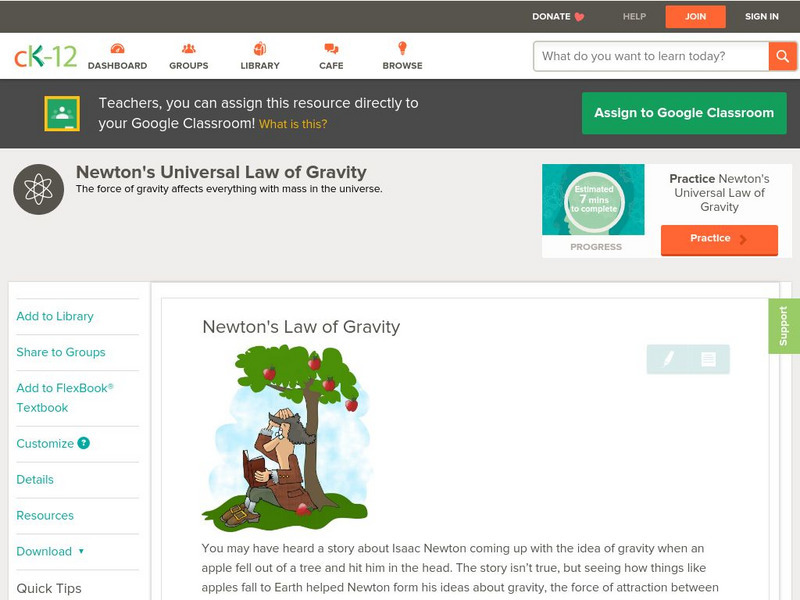
Ck 12: Physical Science: Newton's Law of Gravity
[Free Registration/Login may be required to access all resource tools.] Newton's law of universal gravitation and factors that affect the strength of gravity between two objects.

Physics Classroom
The Physics Classroom: Circular and Satellite Motion: The Value of G
In learning about the Law of Universal Gravitation, students explore the value of G, and understand why this value is so location dependent on Earth.
CK-12 Foundation
Ck 12: Kindergarten Science: What Is Gravity?
[Free Registration/Login may be required to access all resource tools.] Students learn about the Law of Gravity and how it affects planets, objects, animals. and people. Includes a few questions to check for understanding.

TeachEngineering
Teach Engineering: The Science of Swinging
Students learn what a pendulum is and how it works in the context of amusement park rides. While exploring the physics of pendulums, they are also introduced to Newton's first law of motion - about continuous motion and inertia.
Science Buddies
Science Buddies: How Does the Intensity of Light Change With Distance?
How far would you have to travel so that the light of the full sun would provide "daylight" no brighter than twilight on Earth? This project describes a method to verify the inverse square law: how light, sound, electrical signals, and...

Khan Academy
Khan Academy: Newton's Law of Gravitation Review
Review the key concepts, equations, and skills for Newton's law of gravity, including how to find the gravitational field strength.
Physics Classroom
The Physics Classroom: Newton's Law of Universal Gravitation
States the equation of Newton's law of universal gravitation. States the value of G and uses the equation to solve problems.
CK-12 Foundation
Ck 12: Third Grade Science: Physical Science: Gravity
[Free Registration/Login may be required to access all resource tools.] Provides the definition of gravity and how it relates to weight.
CK-12 Foundation
Ck 12: First Grade Science: Gravity
[Free Registration/Login may be required to access all resource tools.] Discusses the force of gravity and how it affects our lives.
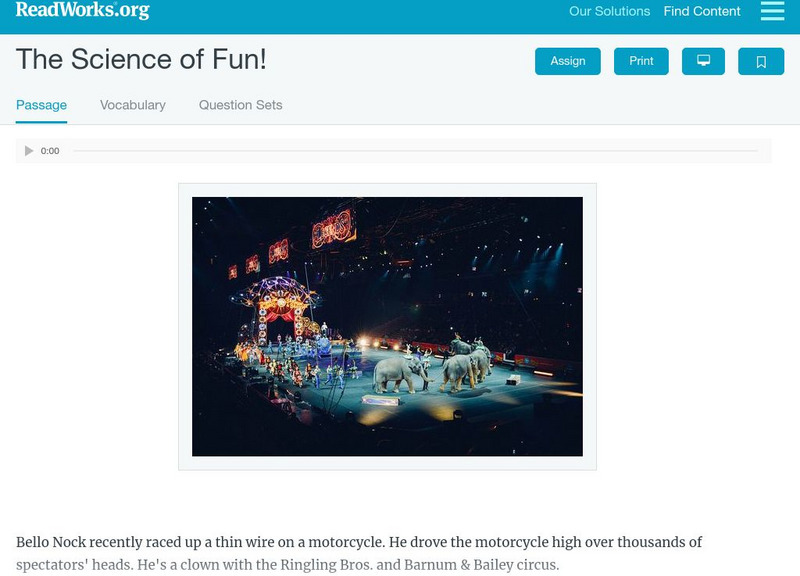
Read Works
Read Works: The Science of Fun!
[Free Registration/Login Required] An informational text about the science behind circus acts. A question sheet is available to help students build skills in reading comprehension.

University of Colorado
University of Colorado: Ph Et Interactive Simulations: Gravity and Orbits
An interactive simulation that teaches about gravitational force, circular motion, and astronomy by manipulating the sun, earth, moon, and a space station to observe the effects of gravity and orbital paths. This simulation can either be...
Vision Learning
Visionlearning: Mechanics: Gravity: Newtonian Relationships
Explanation of how astronomers and scientist developed the current theories of gravity.
Georgia Department of Education
Ga Virtual Learning: Ap Physics 1: Gravity
Combined with aspects of circular motion, students discover that Kepler's third law follows directly from the law of universal gravitation. This unit will expand upon the conservation of energy principle for problems beyond the confines...
University of Colorado
University of Colorado: Ph Et Interactive Simulations: Pendulum Lab
An interactive simulation that teaches about periodic motion, simple harmonic motion, and conservation of energy. Observe one or two pendulums to determine how the swing is influenced by the length of the string, the mass of the pendulum...

Khan Academy
Khan Academy: What Is Newton's First Law?
Newton's First Law also called the law of inertia is the most important thing to realize about motion. This article offers more information on motion and explains solved problems involving Newton's First Law. Also included is a video...
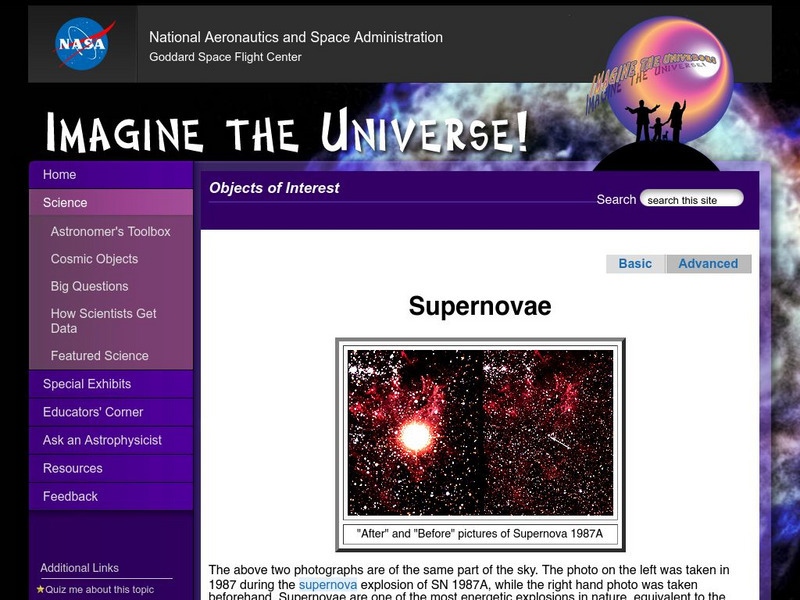
NASA
Nasa: Imagine the Universe: Supernovae (Advanced)
Supernovae are divided into two basic physical types, including a description of supernova types and how they are classified based on the existence of hydrogen spectral lines. Definitions of key terms are provided.
Other
Personal: The Laws of Motion
This personal site explains the physics of angular momentum and their application to flight. Part of a much larger site on the procedures, principles, and perceptions of flight.
Other
Live strong.com: The Physics of Throwing a Football
Discussions on the subject of throwing a football are as common as chalk lines on a football field. Coaches and players talk about the proper grip, footwork and throwing motion, but few discussions mention the physics involved. Prolific...
Science Struck
Science Struck: What Is Gravity and How Does It Work
A very detailed look at gravitational force and the many theories that have been put forward to try to explain it. Includes lots of illustrations.
South Carolina Educational Television
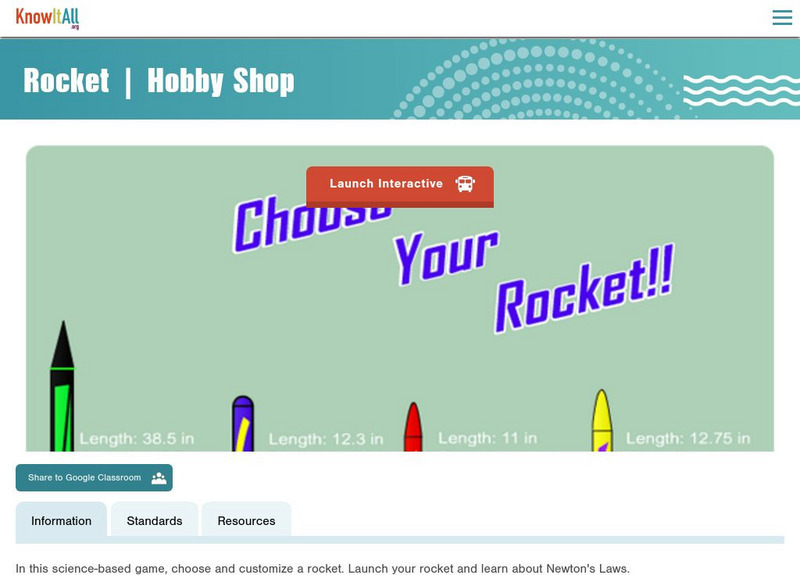
Etv: The Hobby Shop: The Rocket
Design your own virtual rocket, and then test launch it. Watch tutorials about Newton's laws of motion and rocket basics to help you improve your rocket's performance.
Physics Classroom
The Physics Classroom: The Apple, the Moon, and the Inverse Square Law
Describes the logic behind the development of Newton's law of universal gravitation. Beginning with Johannes Kepler and his three laws of planetary motion, content walks the reader through Newton's thought process and development of this...

Khan Academy
Khan Academy: Start: How Do Computers Simulate the Motion of Virtual Particles?
In this lesson we'll explore how we use fairly simple physics to draw particles which move according to the forces we feel in the real world (such as wind & gravity).