Hi, what do you want to do?





Other
Wellcome Trust: Tree of Life Interactive
Explore evolution with this interactive Tree of Life. Click on any species along the timeline to learn more about it. The timeline is accompanied by a video and the user can switch back and forth between them at any point.
Other
In Pieces: 30 Species. 30 Pieces. 1 Fragmented Survival.
Explore this interactive exhibition featuring 30 of the world's most interesting but unfortunately endangered species. The exhibition provides useful research information and a video on each endangered animal.
American Museum of Natural History
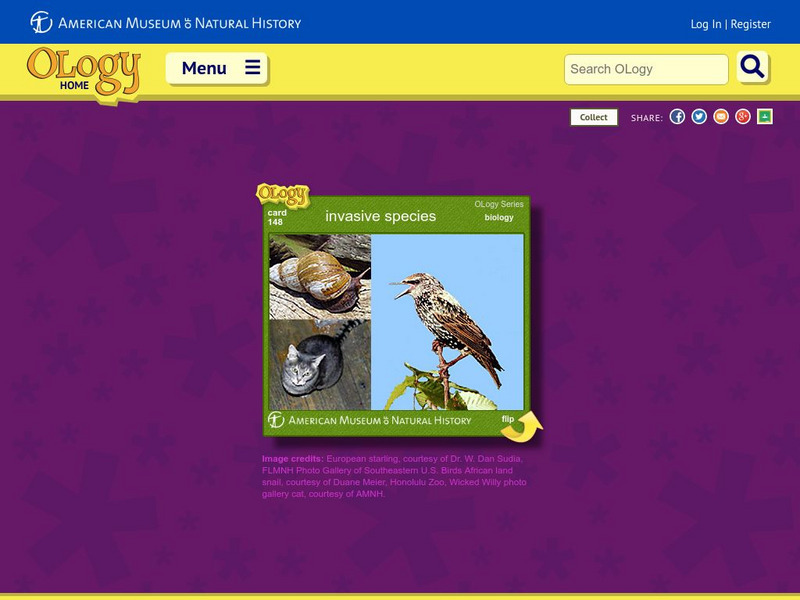
American Museum of Natural History: Invasive Species O Logy Card
Uncover facts about invasive species by turning over this interactive OLogy card.
Georgia Department of Education
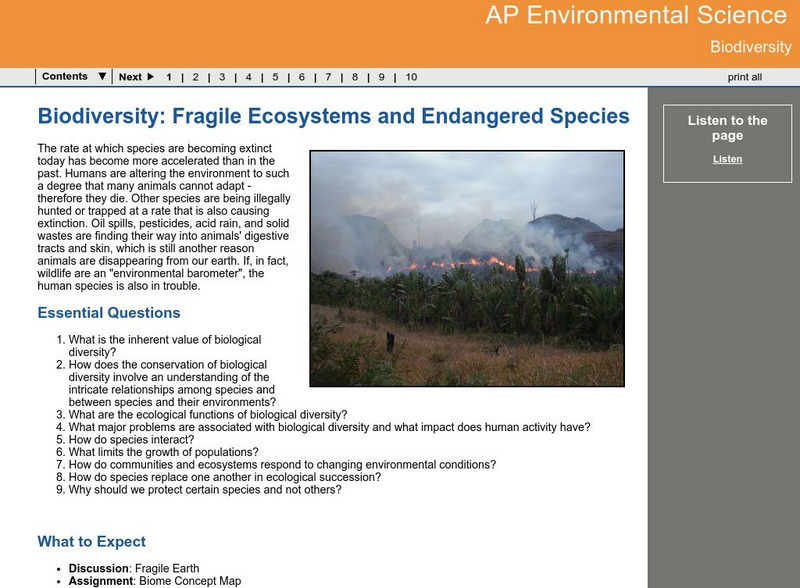
Ga Virtual Learning: Ap Environmental Science: Biodiversity
Through an interactive learning module, students investigate the importance of species richness and biological diversity.
Science Education Resource Center at Carleton College
Serc: Environmental Interactions: Connectedness of a Natural System
A field experience where students undergo an exploration in a natural environment. They are introduced to the concepts of species, population, community, ecosystem, niche, and biosphere.
Smithsonian Institution
National Museum of Natural History: Human Evolution Timeline Interactive
Explore the evidence for human evolution in this interactive timeline - climate change, species, and milestones in becoming human. During the period of human evolution, the Earth's climate has fluctuated between warm and cold. Some of...
Vision Learning
Visionlearning: Biology: Charles Darwin I: The Origin of Species
Instructional module focusing on the early work of Charles Darwin. Discusses Darwin's key role in supporting and describing the theory of evolution as driven by natural selection. Site also includes an interactive practice quiz and links...

PBS
Pbs Learning Media: Saving Crystal River
Explore the effects that an invasive species can have on the environment. In this interactive lesson, students learn how Lyngbya, a destructive form of algae, is creating environmental problems for the plants and wildlife in the Crystal...
PBS
Pbs Learning Media: How Disruptions Affect Animal Populations
Young scholars explore the effects that ecosystem disruptions can have on animal populations. They learn about the disruptions that have driven three species-the Madagascar fish eagle, the Iberian lynx, and the rowi kiwi, to the brink of...
Howard Hughes Medical Institute
Hhmi: Bio Interactive: Explore Your Inner Animals
Did you know parts of our body was inherited from distant animal ancestors? In this interactive students will investigate different anatomical features of the human body to reveal our evolutionary history. Learn how humans share...

Cold Spring Harbor Laboratory
Dna From the Beginning: Genes Can Be Moved Between Species
Recombinant DNA technology has made it possible to gain insight into how genes work. This concept is further developed in this article with an animated explanation, art gallery, audio/video interviews, biographies, and an interactive...

Cold Spring Harbor Laboratory
Dna Interactive: Applications
Examples of using DNA for forensic purposes is discussed here, as well as uses to unravel historical puzzles, trace the history of a species and answer health problems.

American Museum of Natural History
American Museum of Natural History: Ology: Endangered!
After making the gameboard, play this interactive learning game that teaches about "The Endangered Species Act", a law that protects animals and plants that are in danger of going extinct.
Vision Learning
Visionlearning: Biology: Charles Darwin Ii: Natural Selection
Instructional module focusing on Charles Darwin's explanation of natural selection as the mechanism for evolution. Discusses how this force of natural selection promotes changes in species over time. Site also includes an interactive...
Vision Learning
Visionlearning: Biology: Taxonomy Ii: Ruling Names of Giants
Instructional module focusing on binomial nomenclature. Discussion includes Carolus Linnaeus' taxonomic classification system for naming all species. Site also includes an interactive practice quiz and links relating to the topic.
Vision Learning
Visionlearning: Biology: Charles Darwin Iii: Descent With Modification
Instructional module focusing on Charles Darwin's theory of Descent with Modification. Discusses how slight changes from parent to offspring create variation and potentially create new species over time. Site also includes an interactive...
Vision Learning
Visionlearning: Biology: Taxonomy I: What's in a Name
Instructional module focusing on biological classification. Discussion includes Carolus Linnaeus' taxonomic classification system for organizing and classifying living things. Site also includes an interactive practice quiz and links...
PBS
Pbs: Jean Michael Cousteau Ocean Adventures: Predator Protector
This is a great interactive game that allows players to guide three different threatened shark species to food and away from danger.
PBS
Pbs Learning Media: Why We Should Protect Freshwater Mussels
In this interactive lesson plan, students will increase their understanding of the important role that freshwater mussels play in our watershed. Students will learn about freshwater mussel species, how mussels improve water quality in...
Georgia Department of Education
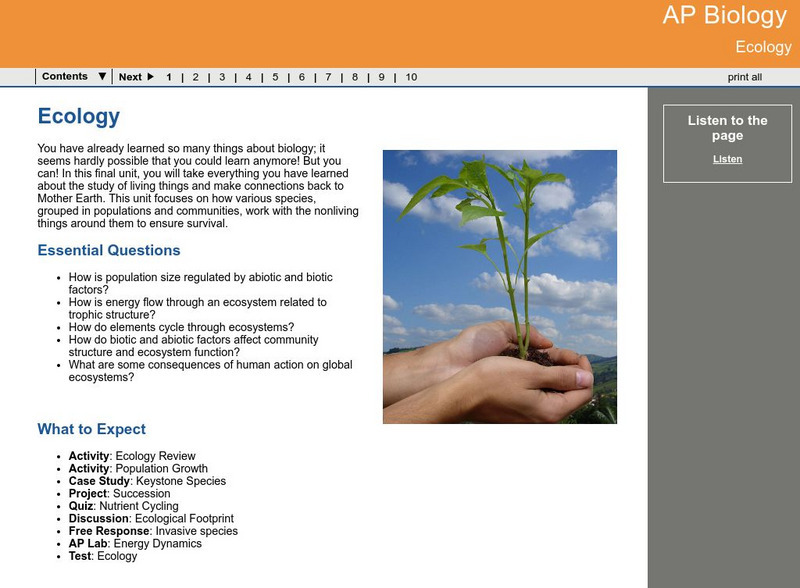
Ga Virtual Learning: Ap Biology: Ecology
Students review the study of living things and make connections back to Earth's systems. This unit focuses on how various species, grouped in populations and communities, work with the nonliving things around them to ensure survival.
University of California
Ucmp: Life Has a History
This is a very good introduction to the role evolution plays in the development of biodiversity. These topics and extinction are explained with the use of colorful interactive pictures.
Tramline
Virtual Field Trip: Temperate Forest Biome
Travel with your students on a Virtual Field Trip to learn about Temperate Forest Biomes. You will also discover many informative and interactive websites.

Vision Learning
Visionlearning: Biology: Galapagos Finches
Interactive animation illustrates how Charles Darwin used his study of finch beaks to explain evolution. A phylogenetic tree diagram shows how the birds' color and beak shape changed over generations.

Other
Plant Watch
The Plant Watch website is designed to teach students how to record observations about plants. The site provides good information about the parts of plants and the section, "Plant Descriptions," will lead you to detailed information on...