Hi, what do you want to do?





Science Education Resource Center at Carleton College
Serc: Mn Step: Sinking and Floating Water
An experiment in density where colored water, both hot and cold, are poured into containers of water at room temperature. Students will observe that the warm water rises and the cold water sinks due to their different densities.
Science Education Resource Center at Carleton College
Serc: Investigating Density in Solutions: How Can You Make an Egg Float?
In this activity, students will learn about density by determining how to make an egg float in water. By the end of the instructional activity, students will understand that density and weight are different and that density matters in...

PBS
Pbs Learning Media: Sesame Street: Sink or Float Educator Guide
This is an educator's guide for a unit on things that sink or float. It includes lesson plans, experiments, and activities. Young scholars apply the scientific method as they investigate whether objects sink or float.
Science Education Resource Center at Carleton College
Serc: Water Activity
Students investigate water by estimating how long it takes to freeze, then see if the ice cube will float in water, and eventually work with other items to see if they sink or float in water.
Science Education Resource Center at Carleton College
Serc: Bowling Balls: Will They Sink or Will They Float?
Students will investigate what determines whether a material will sink or float. They will be given a bowling ball and have to make measurements and conclusions on whether their bowling ball will float, hover, or sink when placed in an...
Science Education Resource Center at Carleton College
Serc: Mn Step: Sink or Float: All Liquids Do Not Have the Same Density
An experiment in density. After a review of floating and sinking of different materials, learners test four bottles, all holding four ounces of water, to see if they will float or sink. They each contain a different density of sugar...
Science Education Resource Center at Carleton College
Serc: Mn Step: Sink or Float? Inquiry Investigation
For this activity, students make predictions about whether different objects float or sink, then test them. They are asked to record their observations and results for each, and compare their results to others'.
American Chemical Society
Inquiry in Action: Changing the Density of a Liquid: Heating and Cooling
In this activity, students will investigate whether the temperature of water affects its density. Students will place colored hot and cold water in a cup of room-temperature water to see that cold water sinks while hot water floats. Then...

Alabama Learning Exchange
Alex: Teaching Measurement: Literature and Manipulatives
The tradebook, Who Sank the Boat? by Pamela Allen, is an excellent tool in teaching measurement. Students will engage in activities involving different types of measurement. In the story, five animal friends decide to take a boat ride....
Science and Mathematics Initiative for Learning Enhancement (SMILE)
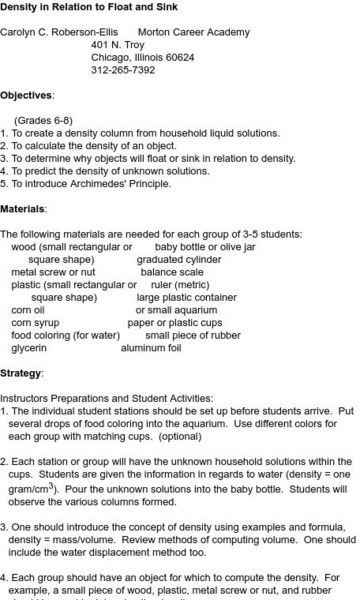
Smile: Density in Relation to Float and Sink
Students find the densities of objects based on sinking or floating in this activity that demonstrates Archimedes Principle.
PBS
Pbs Learning Media: Floating and Sinking: Hot Air Balloons
Why do hot air balloons float? This resource from the NOVA Web site offers a series of interactive activities that illustrates the physics of hot air balloons.

Science Education Resource Center at Carleton College
Serc: Investigating Floating and Sinking: Density
This investigation introduces the concepts of volume, mass, and density and how they interact. Students will make predictions of whether an object will float or sink after finding mass and volume of an object.
Science Education Resource Center at Carleton College
Serc: Mn Step: Sinking Water: Glaciers, Ocean Currents and Weather Patterns
A lesson where students learn how warm water is less dense than cold water, and what this means for global climate change as ice from the polar regions melts. Students will do experiments in buoyancy and water density when hot or cold,...

Science Education Resource Center at Carleton College
Serc: Mn Step: Solid and Liquid Density Investigation
For this activity, young scholars investigate whether objects and liquids float or sink when placed in water. As they proceed, they will develop an understanding of what density is. Student handouts are provided.
TeachEngineering
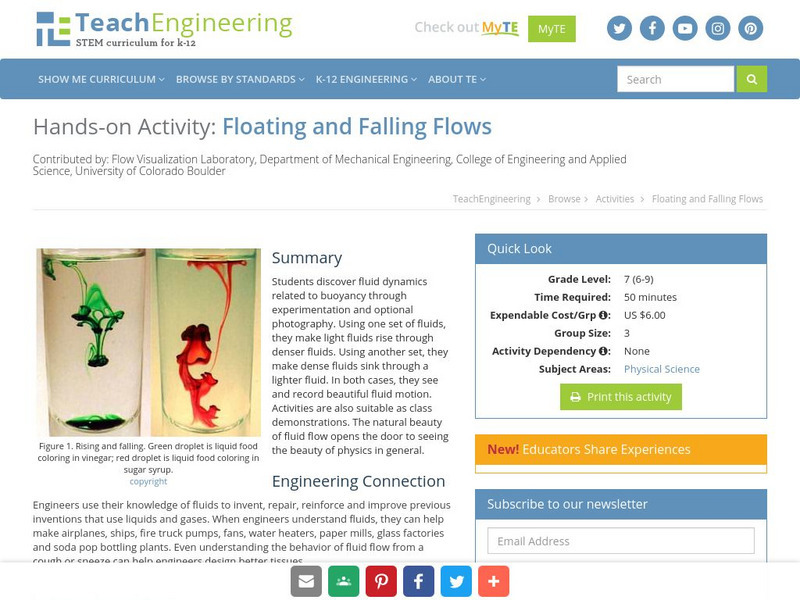
Teach Engineering: Floating and Falling Flows
Students discover fluid dynamics related to buoyancy through experimentation and optional photography. Using one set of fluids, they make light fluids rise through denser fluids. Using another set, they make dense fluids sink through a...
Science Education Resource Center at Carleton College
Serc: Investigating Buoyancy, Density, and Fluid Principles: Make Mini Submarine
In this lab, students will use the scientific method to design an experiment that explains how/why a submarine floats and sinks.
Science Education Resource Center at Carleton College
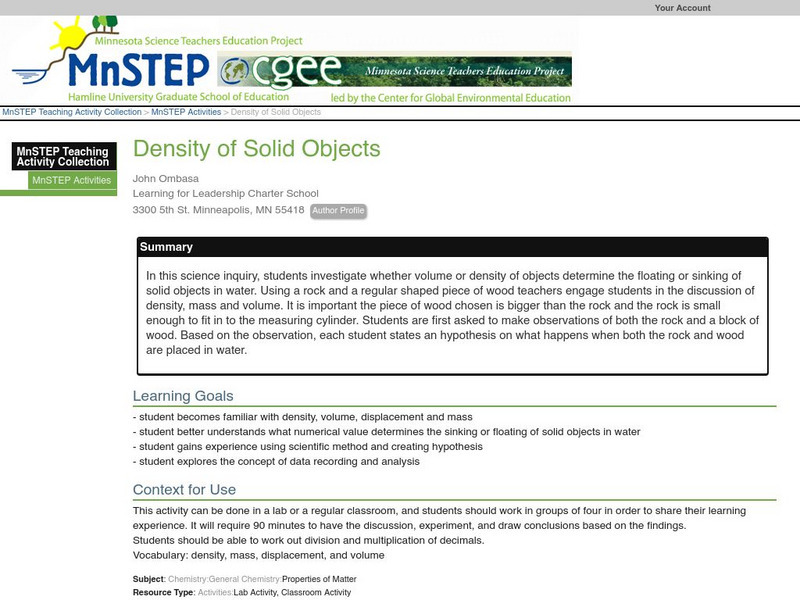
Serc: Density of Solid Objects
In this science inquiry, learners investigate whether volume or density of objects determine the floating or sinking in water. Using a rock and a block of wood teachers engage students in the discussion of density, mass and volume.
American Chemical Society
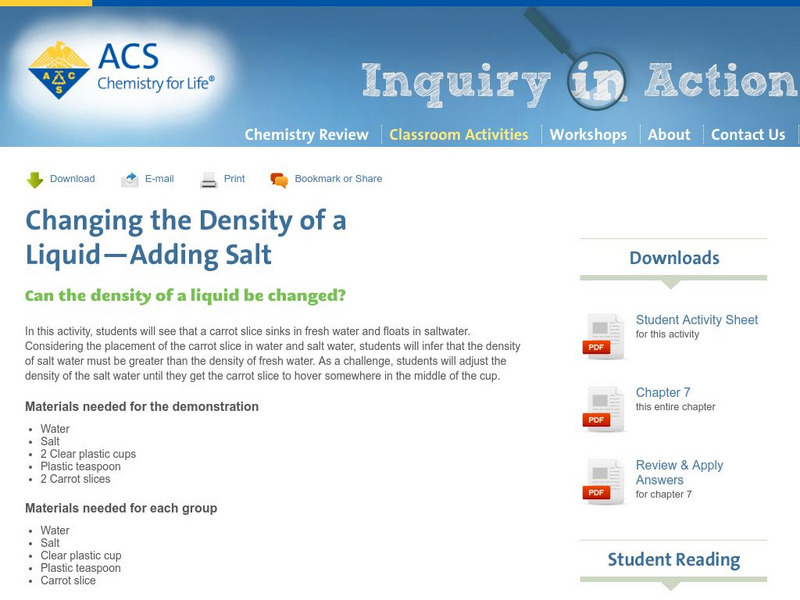
Inquiry in Action: Changing the Density of a Liquid: Adding Salt
In this activity, students will see that a carrot slice sinks in fresh water and floats in saltwater. Considering the placement of the carrot slice in water and salt water, students will infer that the density of salt water must be...

American Chemical Society
Inquiry in Action: Defining Density
Do heavy things always sink and light things always float? In this introductory demonstration and activity, students are introduced to the concept of density as they explore a rock and a wooden block in water.
TeachEngineering
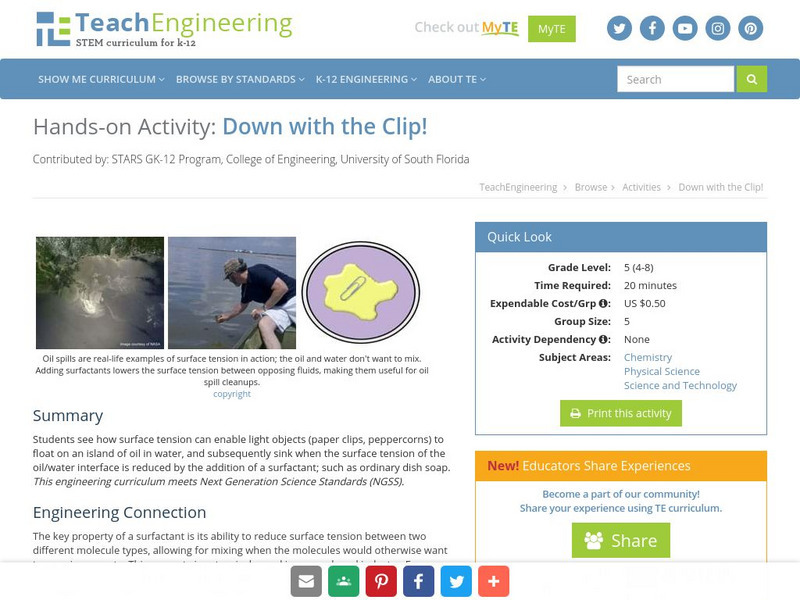
Teach Engineering: Down With the Clip!
Students see how surface tension can enable light objects (paper clips, peppercorns) to float on an island of oil in water, and subsequently sink when the surface tension of the oil/water interface is reduced by the addition of a...

PBS
Pbs Teachers: Submarine Race Experiment
Balance the force of gravity with the force of the expanding gasses created by mixing baking soda and vinegar. Create a soda bottle submarine that sinks to the bottom of the bathtub and then rises back to the surface.
![The Engineering Place: Balloon Flinking [Pdf] Lesson Plan](https://content.lessonplanet.com/knovation/original/172615-2de503a48a3b9f1faaa61527a0b2e7e4.jpg?1661554798 "The Engineering Place: Balloon Flinking [Pdf] Lesson Plan")
Google
The Engineering Place: Balloon Flinking [Pdf]
A lesson and activity sheet on buoyancy. Students add weight to a helium-filled balloon to keep it suspended so that it won't float or sink, but instead will 'flink.'
TeachEngineering
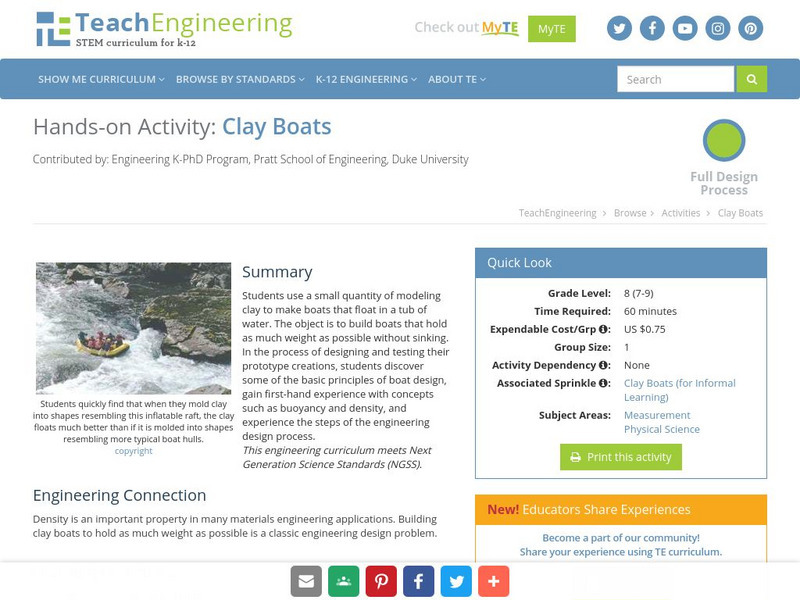
Teach Engineering: Clay Boats
Each student uses a small quantity of modeling clay to make a boat that will float in a tub of water. The object is to build a boat that will hold as much weight as possible without sinking. In the process of designing and testing their...

Alabama Learning Exchange
Alex: What's the Matter: A Sinker or Floater?
Students will explore matter that sinks or floats when submerged in water and that matter is categorized as either a sinker or a floater. Students will work actively in small, cooperative learning groups as well as gather in a whole...