Hi, what do you want to do?






New York State Education Department
TASC Transition Curriculum: Workshop 13
The six instructional shifts in this workshop definitely move math and science teachers' understanding of instruction. The workshop, 13th out of a series of 15, asks participants to examine sample tests and to look at how the six...

New York State Education Department
TASC Transition Curriculum: Workshop 7
Designed specifically for math instructors, the seventh workshop of a 15-part series allows time to explore Webb's DOK, ponder open-ended questions, and create lessons to apply what is learned. Teachers craft high-quality math problems...

New York State Education Department
TASC Transition Curriculum: Workshop 1
Work out your core, Common Core State Standards, through the first workshop in a series of 15 designed for educators. Inquiry-based activities designed for all content areas and grade levels explore the shifts to new standards,...

EngageNY
TASC Transition Curriculum: Workshop 8
Lights, camera, action! Math educators consider how to improve their instruction by examining a model of the five-practice problem-solving model involving a movie theater. Participants examine cognitive demand in relation to problem...

Science Buddies
Science Buddies: Project Ideas: Learn to Design an Ion Engine
The goal of this electricity and electronics science fair project is to understand how ions are used to propel spacecraft in space, and to use a NASA online simulator to design your own ion engine. The Science Buddies project ideas are...
Science Buddies
Science Buddies: Project Ideas: Crystal Ball Math: Predicting Population Growth
In this environmental science fair project, students will learn some of the ways in which the population growth of animals is modeled, and then use the logistic model to determine how a population grows when it starts far below, at, or...
Science Buddies
Science Buddies: Project Ideas: The Biomechanics of Pitching
The goal of this sports science fair project is to learn more about the biomechanics of baseball pitching. The student will investigate if stepping forward and the length of the step affects the speed of the pitch. The Science Buddies...
Science Buddies
Science Buddies: Project Ideas: How Horses Keep Warm in the Wind
In this mammalian biology science fair project, students will learn about methods of heat transfer and determine the best direction in which horses should stand in a cold wind to maintain their core temperature. The Science Buddies...
Science Buddies
Science Buddies: Project Ideas: Delayed Gratification
In this human behavior science fair project, learn about delayed gratification. The Science Buddies project ideas are set up consistently beginning with an abstract, objective, and introduction, followed by a section on terms, concepts,...
Science Buddies
Science Buddies: Project Ideas: Are Childproof Containers Really Childproof?
In this science fair project, determine if childproof containers are effective and investigate if a child can learn how to open the containers with practice. The Science Buddies project ideas are set up consistently beginning with an...
Science Buddies
Science Buddies: Smart Watering: Adjusting Your Sprinklers for Optimal Soil
Use this science fair project to learn how to test your soil to see if it is getting the right amount of water from the sprinklers. Project is set up beginning with an abstract, objective, and introduction, followed by a section on...
Science Buddies
Science Buddies: Project Ideas: Whirl Y Bird vs. Whale Y Bird
Improve the design of a very simple aircraft, the whirlybird, and learn about hydrodynamics and biomimicry in this science experiment. The Science Buddies project ideas are set up consistently beginning with an abstract, objective, and...
Science Buddies
Science Buddies: Piaget's Theory: One Cup of Water Is Less Than One Cup of Water
In this human behavior science fair project, the student will learn about Piaget's developmental stages and the Theory of Conservation. The student will investigate the age at which children understand the equality of numbers and mass....
Science Buddies
Science Buddies: Learn How to Disinfect Contaminated Water
Clean water is not a given everywhere in the world. In this science fair project, students will investigate whether sunlight could be used to disinfect contaminated water. The Science Buddies project ideas are set up consistently...
Rice University
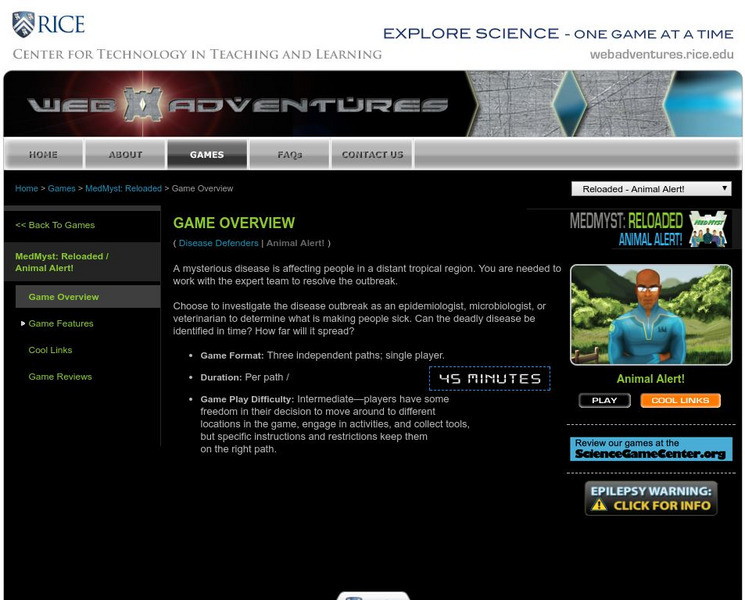
Rice University: Web Adventures: Medmyst: Reloaded: Animal Alert
In this online adventure game, players learn about a mysterious disease that is affecting people in a distant tropical region. Players can choose to role-play as an epidemiologist, microbiologist, or veterinarian to solve infectious...
Smithsonian Institution
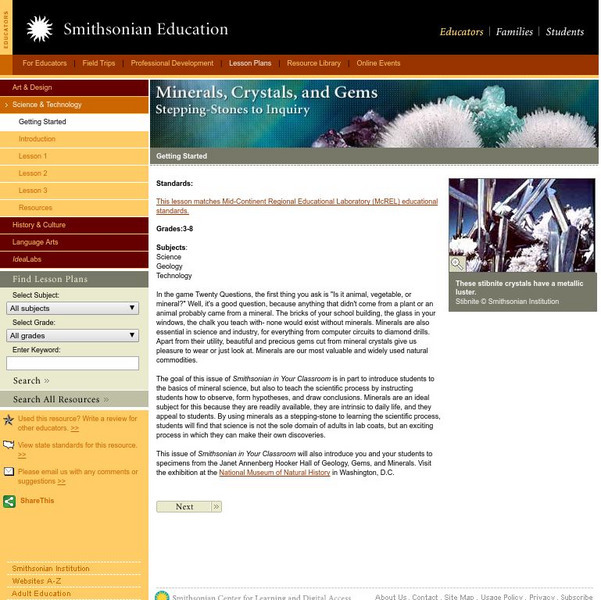
Smithsonian Education: Minerals, Crystals, and Gems
Through this series of three lessons, young scholars will gain an understanding of the basics of mineral science. In their investigation they will also work through the scientific process as they practice their observation skills, form...
Other
My Science Box: Raising Plants
The objective of this lesson is to study the life cycle and structure of plants. Students learn about the concept of classifying objects as either living or non-living by growing plants from seeds, fertilizing them, collecting seed, then...
Middle School Science
Middle School Science: Balloon Powered Race Cars
An idea developed by a physical science teacher who applied Newton's Laws of Motion in creating a balloon powered race car. Find simple objective, materials, rules, and procedures.
What2Learn
What2 Learn: Gene Trivia
This Science game about genes was created using the What2Learn game machine. The objective of the game is to correctly answer the questions about genetics. Students should learn genetics and heredity before playing the game.
Texas Education Agency
Texas Gateway: Atomic and Molecular Explanation of Pressure and Temperature
Learn how to calculate the kinetic energy of a gas molecule, describe the relationship between the temperature of a gas and the kinetic energy of atoms and molecule, and describe the distribution of speeds of molecules in a gas. The...
TeachEngineering
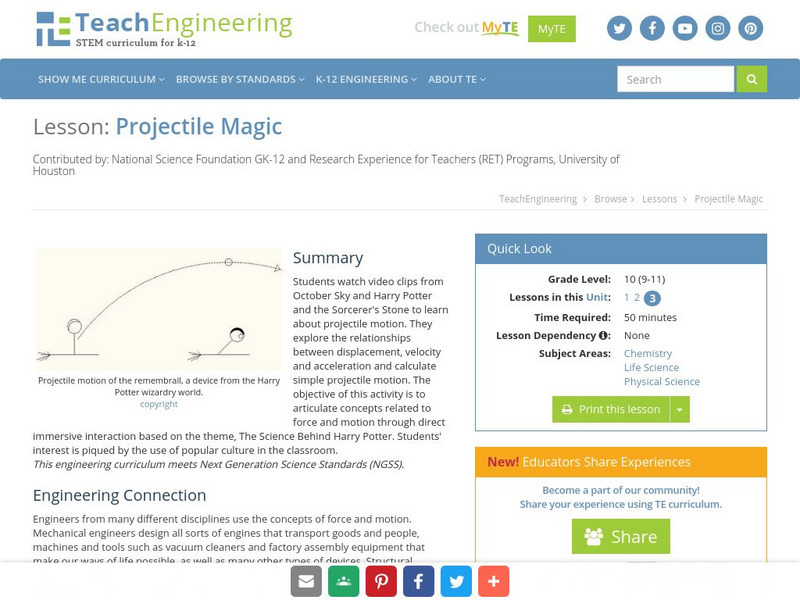
Teach Engineering: Projectile Magic
Students watch video clips from October Sky and Harry Potter and the Sorcerer's Stone to learn about projectile motion. They explore the relationships between displacement, velocity and acceleration and calculate simple projectile...
TeachEngineering
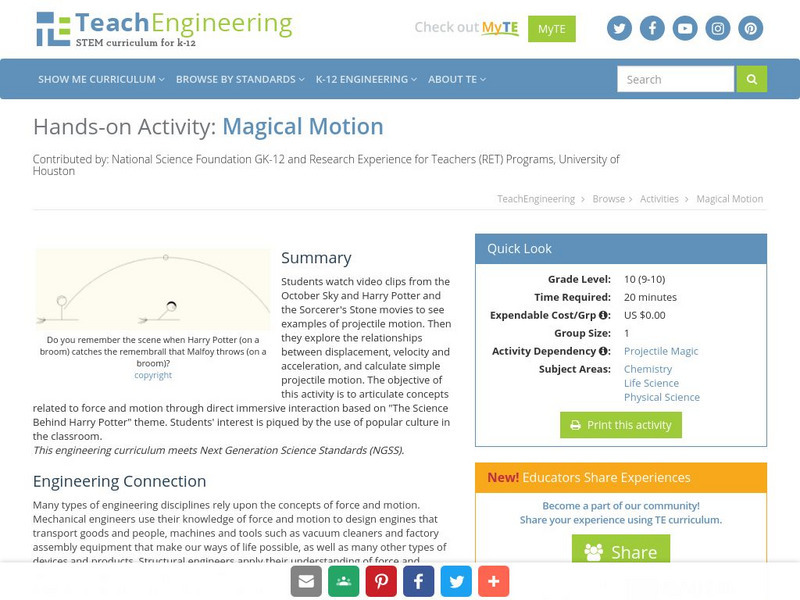
Teach Engineering: Magical Motion
Students watch video clips from the October Sky and Harry Potter and the Sorcerer's Stone movies to see examples of projectile motion. Then they explore the relationships between displacement, velocity and acceleration, and calculate...
TeachEngineering
Teach Engineering: To Heat or Not to Heat?
Students are introduced to various types of energy with a focus on thermal energy and types of heat transfer as they are challenged to design a better travel thermos that is cost efficient, aesthetically pleasing and meets the design...
TeachEngineering
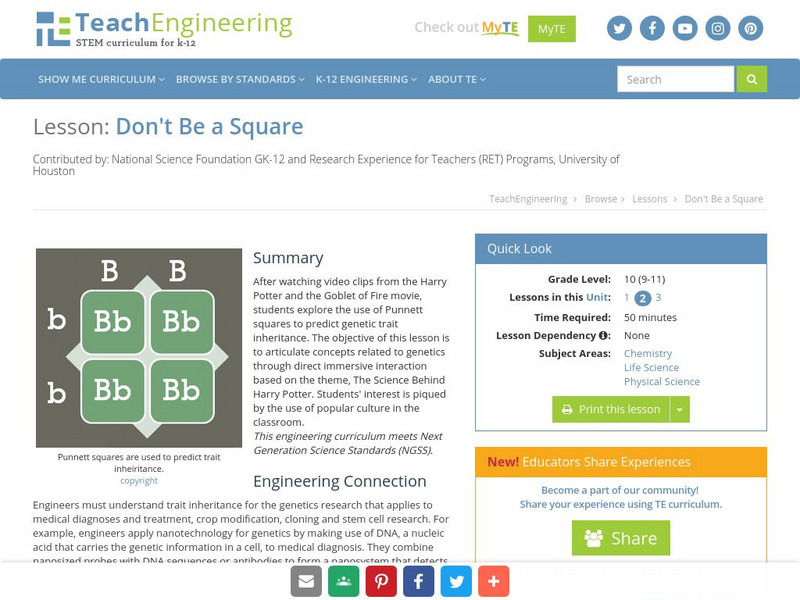
Teach Engineering: Don't Be a Square
After watching video clips from the Harry Potter and the Goblet of Fire movie, students explore the use of Punnett squares to predict genetic trait inheritance. The objective of this lesson is to articulate concepts related to genetics...