Hi, what do you want to do?






PBS
Pbs Learning Media: Life Science for Grade 4 With Wild Kratts
This unit uses Wild Kratt videos, hands-on activities, and document resources to teach about animal senses. Extensions for further learning are also provided.
CK-12 Foundation
Ck 12: Fourth Grade Science
[Free Registration/Login may be required to access all resource tools.] This is a science text for Grade 4. It has sections on physical science, earth science, and life science. Each of those is broken down into eleven or twelve topics.
Google
Louisiana Curriculum Hub: Ela Guidebooks: Grade 4: Surviving Hurricanes: Unit Files
A Google Drive folder with instructional presentations, discussion questions, student activities, and assessments for the text, Surviving Hurricanes.
Other
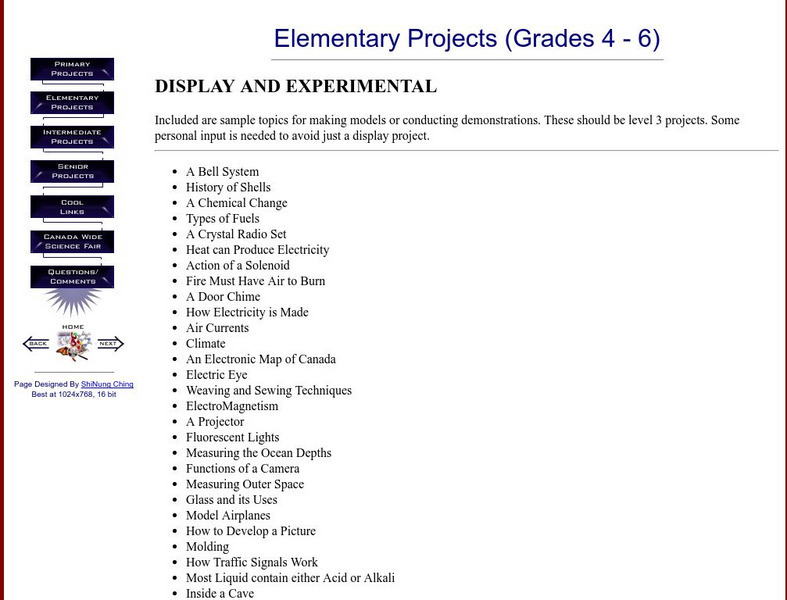
Science Fairs: Ideas for Elementary Projects: Grades 4 6
This Science Fairs website is a resource for a wide variety of science fair starter ideas. Use an idea from here and build your own project.
Utah Education Network
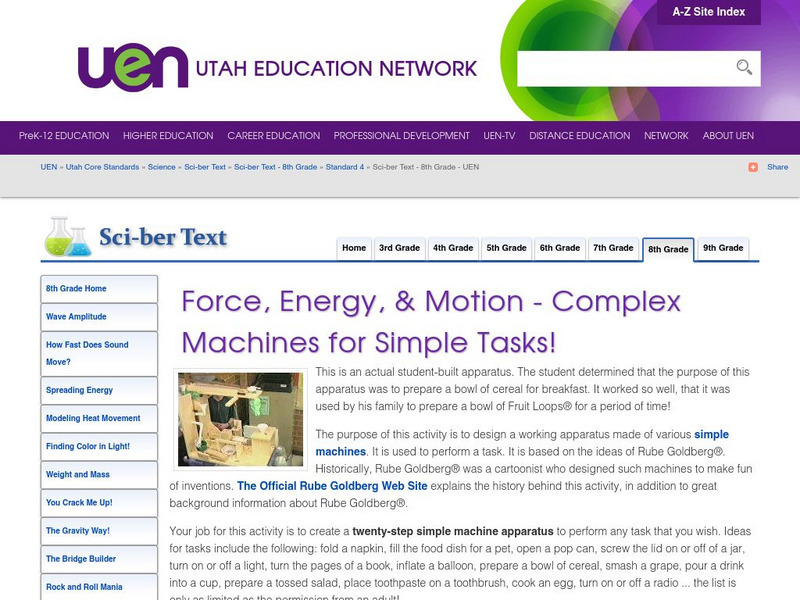
Uen: Force, Energy, and Motion: Complex Machines for Simple Tasks!
Designed for Grade Eight, this collection of lessons provides information, examples and quizzes related to simple machines. Elementary students studying this topic will find this site informative as well.
SRI International
Performance Assessment Links in Science: Observing Objects
This is a performance task for Grade Four students where they observe two different pendulums and compare the two types of motion. The activity is designed for a lab setting where students work at individual stations. A rubric and...
Other
Nelson Science: Healthy Ecosystems: The Needs of Living Things [Pdf]
A 4-page section of the Grade 7 Nelson Science and Technology Perspectives textbook. It looks at what organisms need to survive, specifically sunlight, air, water, and food. This is a visually-rich text with tips to help students'...
Other
Alaska Sea Grant: Investigation 4 Human Impact Survey
Students examine and record data about the impact human activity has on a local aquatic environment in this teaching unit. They then analyze the information and develop a plan for improvement. The unit depends on being able to take the...
Other
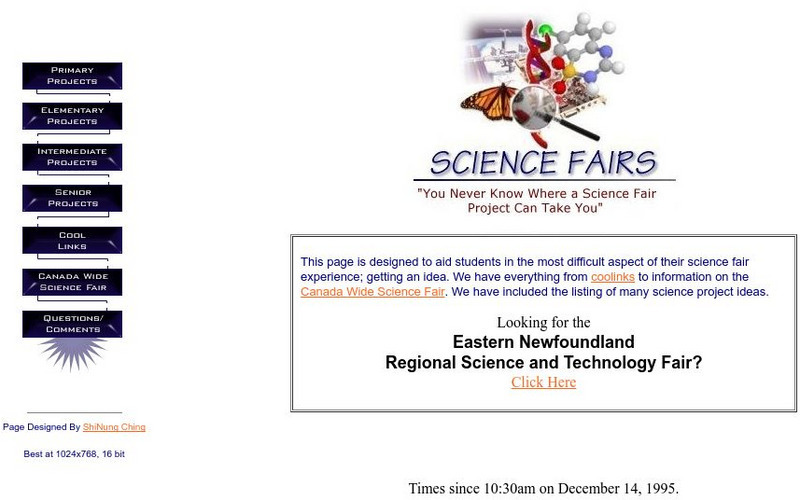
Cdli: Science Fairs Homepage
At this site from the Center for Distance Learning and Innovation there's a monstrous listing of possible science fair projects. You can choose from primary (grades 1-4), elementary (grades 4-6), intermediate (grades 7-9), or senior...

SRI International
Performance Assessment Links in Science: Up, Up and Away (Lesson)
Students will observe water evaporation in this performance task, and investigate the water cycle. The task is designed for Grade Two.
SRI International
Performance Assessment Links in Science: Some of Its Parts
As they examine two variations of a can opener, learners will discuss what the purpose is of each of its sub-parts, and which of the can openers is the better machine. They will also suggest improvements to the can opener. This is a...
PBS
Wnet: Thirteen: Ed Online: What Do Inquiry Based Lesson Plans Look Like?
Inquiry-based lesson plans are usually referred to as "facilitation plans," to help teachers remember their role as facilitator of learning, rather than fount of all wisdom. The notion also helps teachers structure lessons more loosely...
CK-12 Foundation
Ck 12: First Grade Science: Signals Light and Sound
[Free Registration/Login may be required to access all resource tools.] Explores how light and sound are used by people for communication.
E-learning for Kids
E Learning for Kids: Science: Antarctica Research Center: What Do Cells Do?
For this lesson, students learn about the specialization of cells to perform different functions, and how they are organized into tissues and organs in the human body.

SRI International
Performance Assessment Links in Science: Do You See What I See? (Lesson)
For this Grade Two performance task, students observe the contents of a terrarium and explain the purpose of the water, rocks and soil inside it.

Alabama Learning Exchange
Alex: Digging in for Dirt Day!
This lesson is managed through stations that students will rotate around every 20- 30 minutes. Each second grade teacher conducts one station. Parent volunteers can also be used to manage stations. Students will use an auger to gather...
E-learning for Kids
E Learning for Kids: Science: Titanic Shipwreck: How Does Heat Travel?
David is exploring the Titanic shipwreck. He needs to stay warm down below in the water. Help him learn about heat and temperature.
E-learning for Kids
E Learning for Kids: Science: California Crab Boat: How Do Animals Reproduce?
Join Lisa and her uncle to find out about animals and how they reproduce.
E-learning for Kids
E Learning for Kids: Science: Antilles: What Are the Environmental Factors of a Habitat?
Join Sam on his journey to the bottom of the sea. Explore beautiful animals living in the sea, and learn about the importance of a well-balanced habitat.
E-learning for Kids
E Learning for Kids: Science: Netherlands: What Are Permanent and Temporary Changes?
In this lesson, students match a substance with its state of matter, identify what state something is, and learn about temporary and permanent changes in matter.
E-learning for Kids
E Learning for Kids: Science: Loch Ness: What Happens When Solids and Liquids Are Heated or Cooled?
Students will look at what happens to different types of matter when they have a change of state.
E-learning for Kids
E Learning for Kids: Science: Antarctica: What Is Position and Reference Point?
With all the snow and ice in Antarctica, it's easy to get lost. Help Tim find his way using a map and a compass.
E-learning for Kids
E Learning for Kids: Science: Antarctica: What Is Distance?
Help curious Matt find out everything there is to know about determining distances.
E-learning for Kids
E Learning for Kids: Science: Bermuda Triangle: What Happens When an Object Gains or Loses Heat?
Learn about states of matter on a flight tour over the Atlantic Ocean.