Hi, what do you want to do?





Michael Blaber, PhD
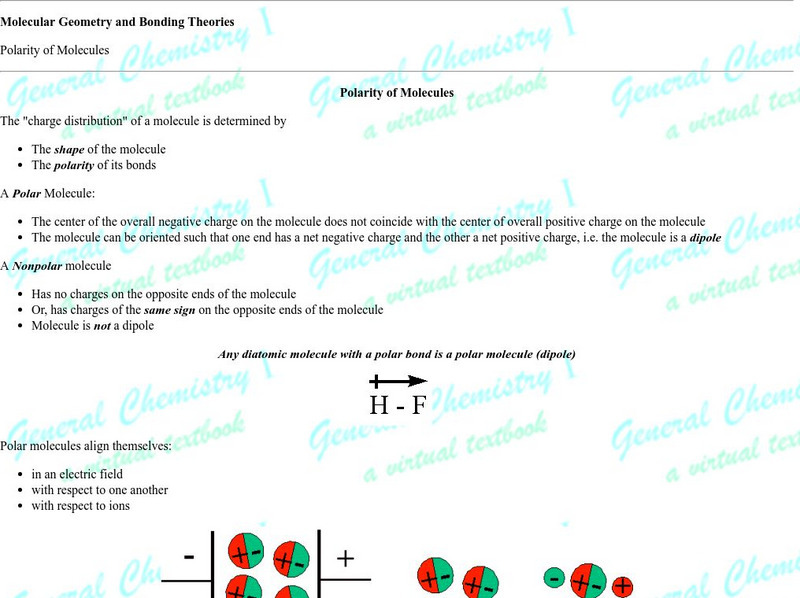
Fsu: Molecular Geometry and Bonding Theories: Polarity of Molecules
Florida State University provides a discussion of polarity of binary and polyatomic molecules, with tables and graphics.
Texas Instruments
Texas Instruments: Geometries and Polarities of Compounds
In this StudyCard activity, students are asked to describe the geometry and polarity of several molecules and ions. Geometries covered include linear, bent, trigonal planar, trigonal pyramidal, and tetrahedral. Students will need to have...

University of Colorado
University of Colorado: Ph Et Interactive Simulations: Molecule Polarity
When is a molecule polar? Change the electronegativity of atoms in a molecule to see how it affects polarity. See how the molecule behaves in an electric field. Change the bond angle to see how shape affects polarity. See how it works...

University of Colorado
University of Colorado: Physics 2000: Polarization
A series of pages that explain polarization, polarized light and its effects, polarized filters, and sunglasses. Interactive Java applets.
American Chemical Society
Middle School Chemistry: Lesson Plans: Water Is a Polar Molecule
Young scholars develop their own water molecule model to help them understand the idea that water has a slight positive charge at one end of the molecule and a slight negative charge at the other.
CK-12 Foundation
Ck 12: Water Properties
[Free Registration/Login may be required to access all resource tools.] In the following online tutorial students will describe the structure and polarity of a water molecule. They will also describe the hydrogen bonding that occurs in...
University of Colorado
University of Colorado: Ph Et Interactive Simulations: Molecule Polarity
An interactive simulation that teaches about polarity, electronegativity, and bonds by changing the electronegativity of atoms and bond angles in a molecule to see how it affects polarity. This simulation can either be downloaded or...
TeachEngineering
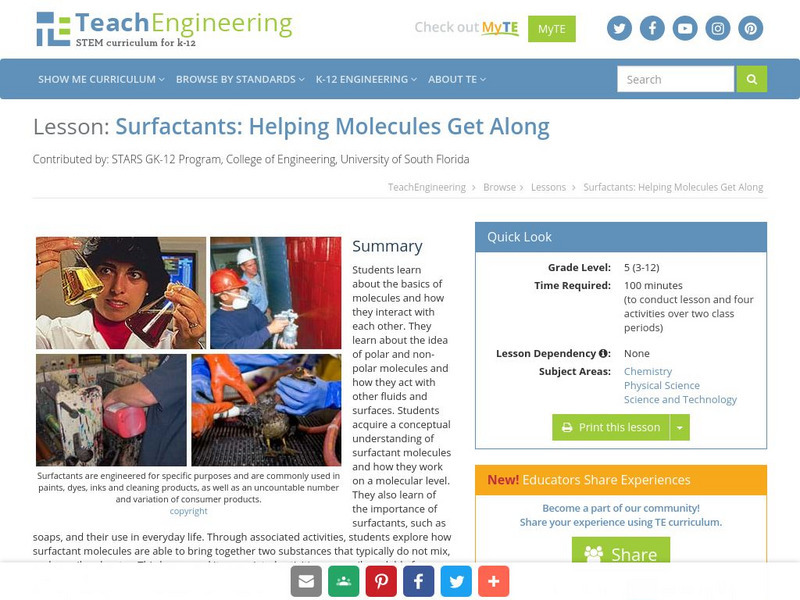
Teach Engineering: Surfactants: Helping Molecules Get Along
Learners learn about the basics of molecules and how they interact with each other. They learn about the idea of polar and non-polar molecules and how they act with other fluids and surfaces. Students acquire a conceptual understanding...
University of Colorado
University of Colorado: Physics 2000: Polarization
An incredible series of illustrated pages that explain polarization, polarized light and its effects, and polarized filters and sunglasses. Features interactive Java applets.
Concord Consortium
Concord Consortium: Science of Atoms and Molecules: Nucleic Acids and Proteins
Through this activity, students work with macromolecules, proteins and nucleic acids. The focus is on the atomic structure of proteins, how linear polymers are made, and the surface charges of the resulting polymers. . Multiple-choice...
Chiral Publishing
Chiral Publishing: An Introduction to Chemistry: Predicting Molecular Polarity
This section in the online textbook describes how to tell if a molecule is polar or non polar. Detailed steps and examples are good references. Also find links to presentations and chapter maps for other chemistry topics.
Sophia Learning
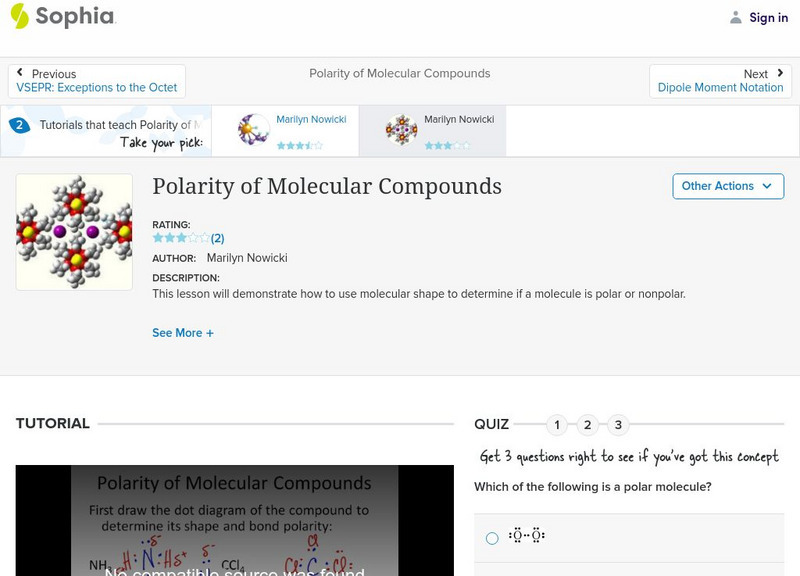
Sophia: Polarity of Molecular Compounds: Lesson 2
This lesson will demonstrate how to use molecular shape to determine if a molecule is polar or nonpolar. It is 2 of 2 in the series titled "Polarity of Molecular Compounds."
CK-12 Foundation
Ck 12: Polarity and Intermolecular Forces
[Free Registration/Login may be required to access all resource tools.] The following online tutorial describes how the electronegativity difference between two atoms in a covalent bond results in the formation of a nonpolar covalent,...
CK-12 Foundation
Ck 12: Chemistry: Structure of Water
[Free Registration/Login may be required to access all resource tools.] Covers structure of water molecule, hydrogen bonding on water, polarity of water molecule, and bond angles of water molecule.
Georgia Department of Education
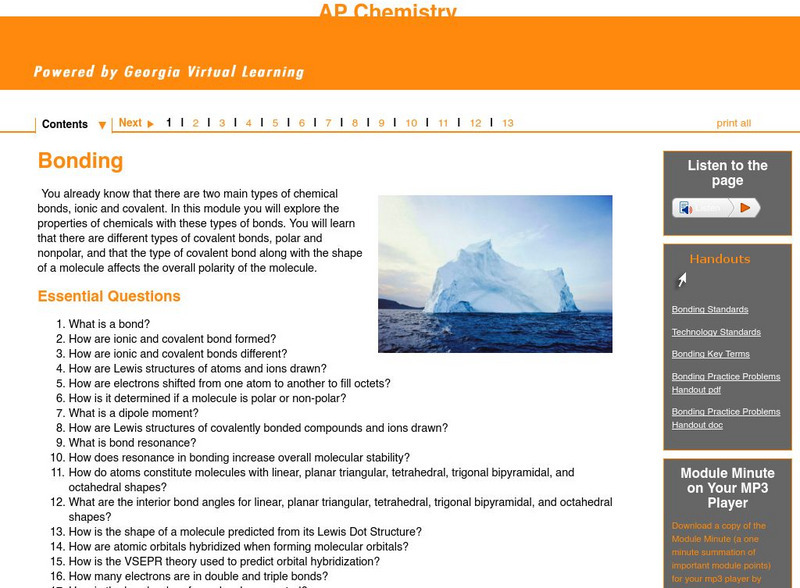
Ga Virtual Learning: Ap Chemistry: Bonding
In this module students explore the properties of chemicals with covalent and ionic bonds. Students learn that there are different types of covalent bonds, polar and nonpolar, and that the type of covalent bond along with the shape of a...
Concord Consortium
Concord Consortium: Boiling Point of Polar and Nonpolar Substances
Control the temperature and observe the impact on the motion and interactions between particles. Compare the interactions between nonpolar molecules and between polar molecules to see how polarity affects the boiling point of substances...

Concord Consortium
Concord Consortium: Stem Resources: Electrons in Atoms and Molecules
A module with animations, explanations, and questions about the importance of electrons in the structure of an atom. Understand the definition and locations of electrons in the atom. Explore the role of electrons in bonding, polarity,...

CK-12 Foundation
Ck 12: Earth Science: States of Water
[Free Registration/Login may be required to access all resource tools.] Describes the three states of water.
CK-12 Foundation
Ck 12: Earth Science: States of Water
[Free Registration/Login may be required to access all resource tools.] Describes the three states of matter of water.
Frostburg State University
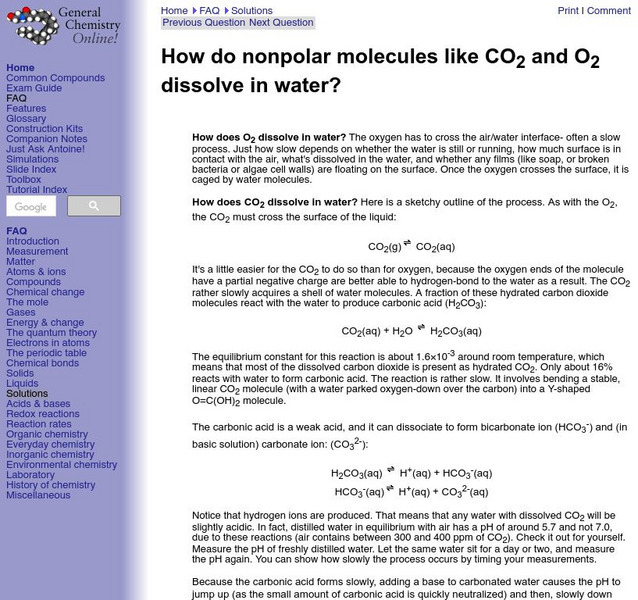
University of Frostburg: How Nonpolar Molecules Dissolve
This site from the University of Frostburg provides an explanation of the process by which nonpolar molecules dissolve in water.
University of Arizona
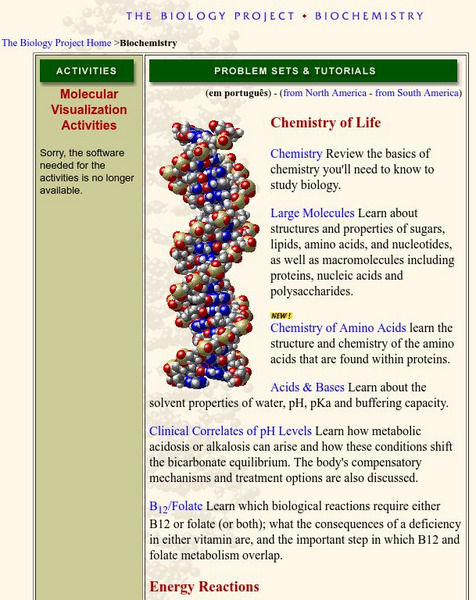
University of Arizona: Biochemistry
Problem sets, tutorials, and activities related to biochemistry.
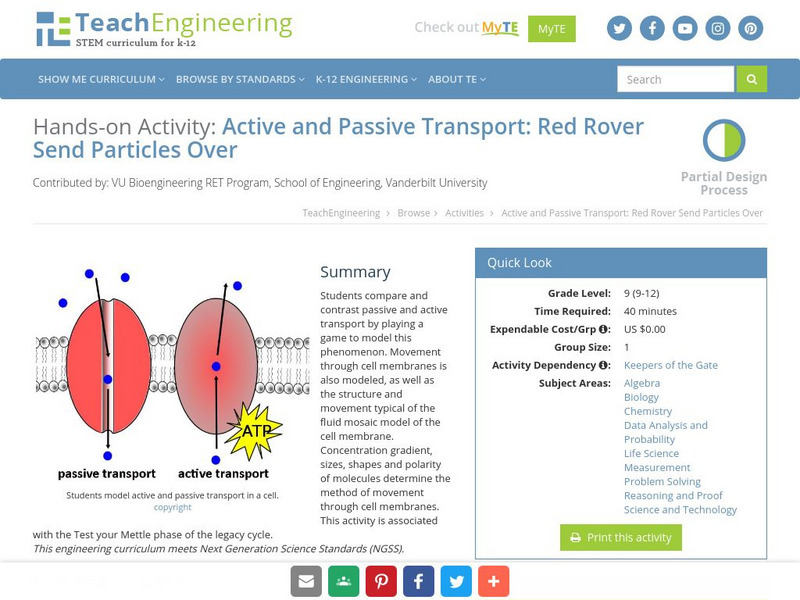
TeachEngineering
Teach Engineering: Active and Passive Transport: Red Rover Send Particles Over
Students compare and contrast passive and active transport by playing a game to model this phenomenon. Movement through cell membranes is also modeled, as well as the structure and movement typical of the fluid mosaic model of the cell...
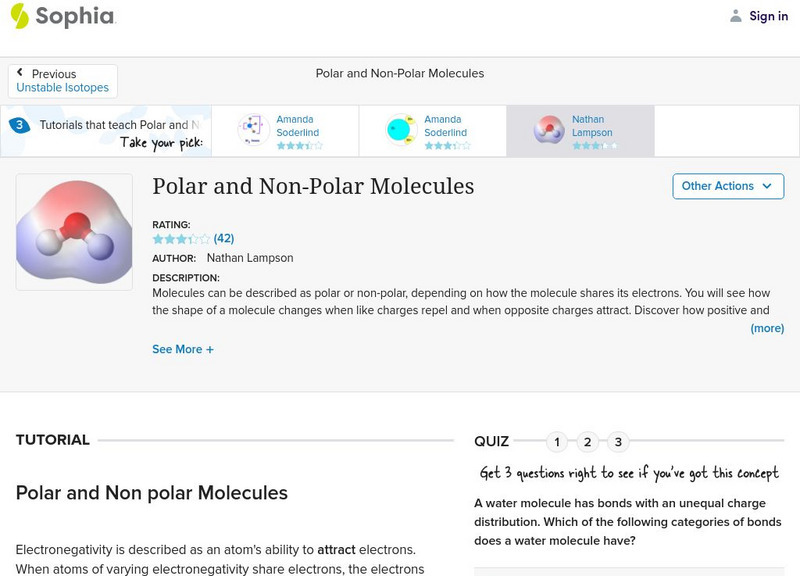
Sophia Learning
Sophia: Polar and Non Polar Molecules: Lesson 1
This lesson will introduce polar and non-polar molecules, explaining their location, charge, and mass. It is 1 of 3 in the series titled "Polar and Non polar Molecules."