Hi, what do you want to do?






American Association of Physics Teachers
Com Padre Digital Library: Open Source Physics: Free Fall Air Resistance Model
A Java-based simulation where students can observe what happens to a free-falling object, with and without air resistance. Controls allow the user to adjust settings and the results are graphed as the simulation progresses.

CK-12 Foundation
Ck 12: Episd: Free Fall
[Free Registration/Login may be required to access all resource tools.] Use this opportunity to understand accelerated motion in two dimensions, free fall.

Physics Classroom
The Physics Classroom: 1 D Kinematics: Representing Free Fall by Graphs
In this physics tutorial, the motion of a free-falling motion will be represented using position versus time and velocity versus time graphs.
Physics Classroom
The Physics Classroom: 1 D Kinematics: Kinematic Equations and Free Fall
Students practice applying free fall concepts to problem-solving in this interactive physics tutorial.
Science Education Resource Center at Carleton College
Serc: Investigating the Constancy of Gravity: Free Fall Using a Water Bottle
For this physics interactive lecture demonstration, learners will predict what will happen if a plastic bottle, filled with water and having a hole near the bottom, is dropped. Will the bottle fall at the same rate as the water inside...
Physics Classroom
The Physics Classroom: Free Fall and Air Resistance
This lesson in high school physics on Newton's Second Law of Motion provides a discussion of free fall and air resistance, and answers, "Why do objects which encounter air resistance ultimately reach a terminal velocity?" and "In...
Physics Classroom
The Physics Classroom: Elephant & Feather (Free Fall)
A demonstration involving an elephant and a feather and explanation of why all objects maintain the same acceleration in the state of free fall without any air resistance.
Physics Classroom
The Physics Classroom: 1 D Kinematics: Free Fall [Pdf]
Use this printable physics worksheet which allows students to practice problems describing motion in a free fall.

Texas Instruments
Texas Instruments: Free Fall
This activity assesses students' knowledge and understanding of free fall principles.
CK-12 Foundation
Ck 12 Exploration Series: Simulations: Physics: Model Rocket
[Free Registration/Login Required] Learn about the relationship between position and velocity for a model rocket during launch and in free-fall. Experiment with rocket mass, rocket thrust, and rocket burn time to understand the...
Texas Education Agency
Texas Gateway: Kinematics: Falling Objects
By the end of this section, you will be able to describe the effects of gravity on objects in motion, describe the motion of objects that are in free fall, and calculate the position and velocity of objects in free fall.
CK-12 Foundation
Ck 12: Episd: Physics: Kinematics
[Free Registration/Login may be required to access all resource tools.] An online chapter focused on motion and the shapes it takes. Topics range from speed and velocity to acceleration and free fall. Find detailed visuals, learning...
Physics Classroom
The Physics Classroom: Acceleration
Topics covered include what acceleration is, the difference between constant and non-constant acceleration, acceleration in a free-falling object, the equation used to compute acceleration, and the difference between positive and...
Texas Instruments
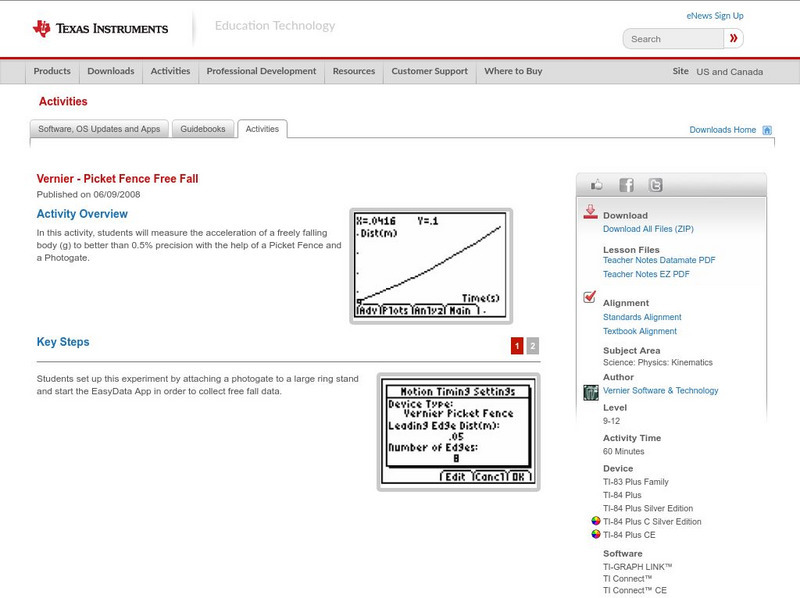
Texas Instruments: Picket Fence Free Fall
In this activity, students will measure the acceleration of a freely falling body (g) to better than 0.5% precision with the help of a Picket Fence and a Photogate.
Science Education Resource Center at Carleton College
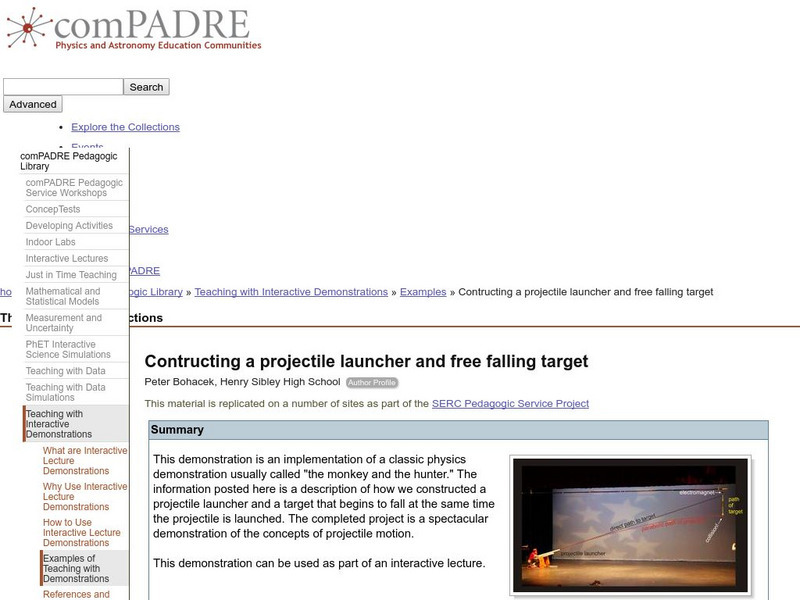
Serc: Constructing a Projectile Launcher and Free Falling Target
Implement the classic physics demonstration "the monkey and the hunter" using this description of a projectile launcher and a target that begins to fall at the same time the projectile is launched. The completed project is a spectacular...
CK-12 Foundation
Ck 12 Exploration Series: Simulations: Physics: Cliff Diver
[Free Registration/Login Required] Learn about the relationship between position and velocity for a diver accelerating under the influence of gravity and air resistance. Measure velocity and position based on variables of the height of...

Annenberg Foundation
Annenberg Learner: Amusement Park Physics: The Principles of Free Fall
An article describing free fall principles in roller coaster rides. In addition to the explanation of free fall, an experiment is described that allows you to test free fall with a cup of water. Part of a larger presentation on roller...
Physics Classroom
The Physics Classroom: Introduction to Free Fall
A lesson on free fall covers the fact that free-falling objects do not encounter air resistance and all free-falling objects (on Earth) accelerate downwards at a rate of approximately 10 m/s/s (to be exact, 9.8 m/s/s).

Georgia State University
Georgia State University: Hyper Physics: Energy of Falling Object
This site is from the Physics Department at Georgia State University. The reliance upon the law of conservation of energy as an approach to problem-solving is presented and encouraged. It is modeled through a problem involving a...
Physics Classroom
The Physics Classroom: 1 D Kinematics: How Fast? And How Far?
Students understand the physics of a free falling object through these illustrated example problems.

Open Curriculum
Open Curriculum: Acceleration and Free Fall
These notes and illustrations will help you understand the concept and properties of acceleration.
Physics Classroom
The Physics Classroom: 1 D Kinematics: Table of Contents
Learners examine motion with words, equations, diagrams, and graphs. Some topics investigated are position, velocity, acceleration, and free fall. The tutorial consists of lessons and problems to check for understanding.
Texas Education Agency
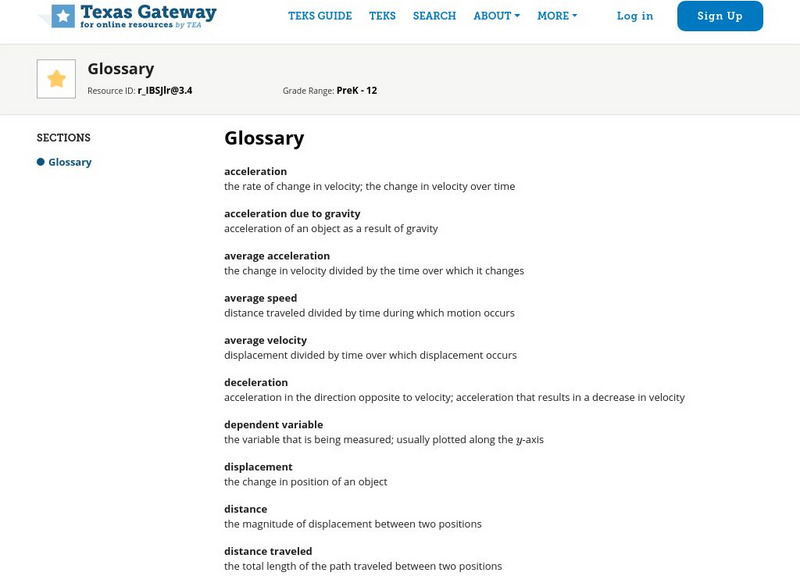
Texas Gateway: Ap Physics: Glossary for Kinematics
This is a glossary of terms and definitions used in AP Physics: Chapter 2: Kinematics.
Physics Classroom
The Physics Classroom: Elephant and Feather: Air Resistance
The concept of air resistance is discussed in terms of why a heavier object falls faster than a lighter object when both dropped from the same height. In this discussion and animation, an elephant and feather are used as examples.