Hi, what do you want to do?






Physics Classroom
The Physics Classroom: Vectors Motion and Forces in Two Dimensions
Three complete tutorials on vectors and two dimension forces and motion. Lessons include informational text, interactive activities, animations, and quick, interactive comprehension checks along the way.
Physics Classroom
The Physics Classroom: Motion and Forces in Two Dimensions: Vectors/direction
The emphasis of this unit is to understand some fundamentals about vectors, and to apply the fundamentals in order to understand motion and forces that occur in two dimensions.
Physics Classroom
The Physics Classroom: Motion and Forces in Two Dimensions: Vector Addition
An extensive discussion of vector addition with links to interactives and exercises.
Texas Education Agency
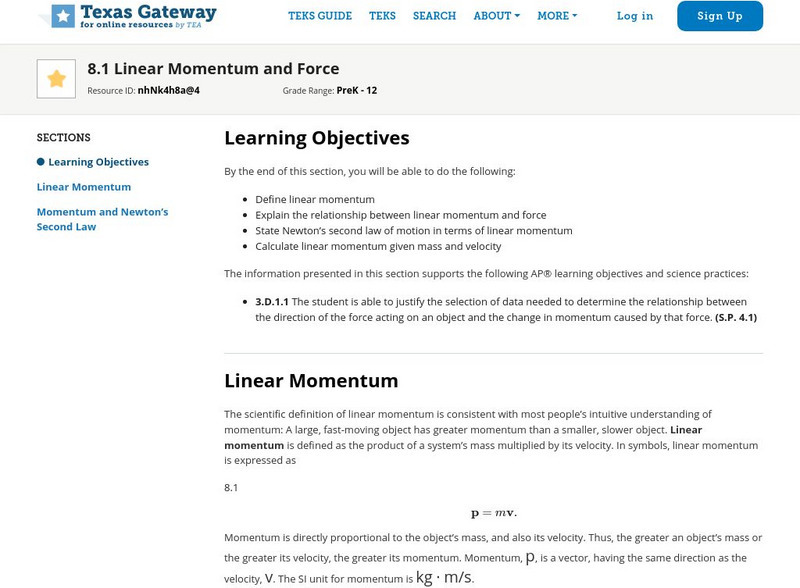
Texas Gateway: Linear Momentum and Force
By the end of this section, you will be able to define linear momentum, explain the relationship between linear momentum and force, state Newton's second law of motion in terms of linear momentum, and calculate linear momentum given mass...
Texas Education Agency
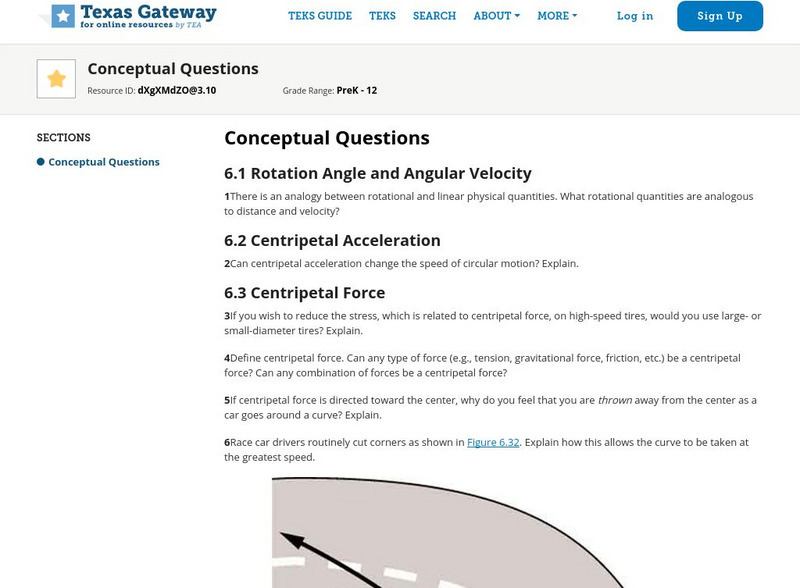
Texas Gateway: Ap Physics: Uniform Circular Motion and Gravitation: Questions
This is a list of 23 questions covering the major concepts of Chapter 6: Uniform Circular Motion and Gravitation from the AP Physics online text.
Texas Education Agency
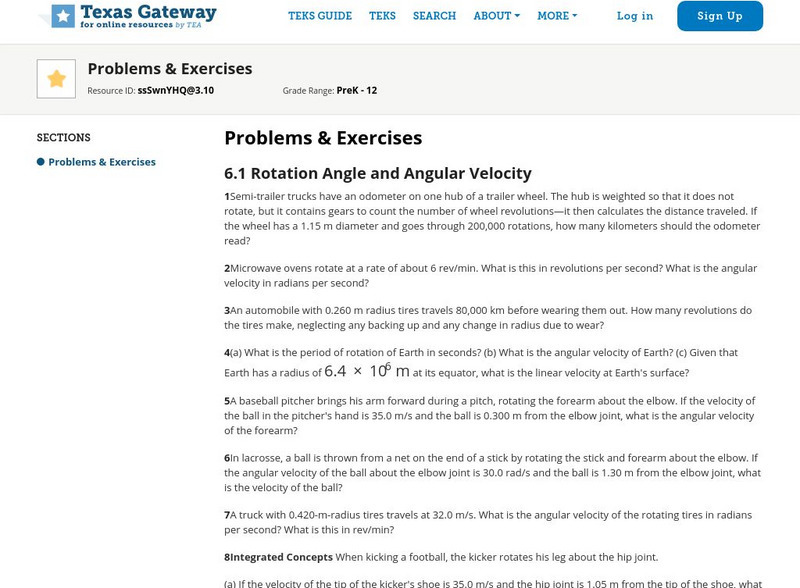
Texas Gateway: Uniform Circular Motion and Gravitation: Problems and Exercises
This page offers a list of 50 problems/exercises to solve based on the content of Chapter 6: Uniform Circular Motion and Gravitation from the AP Physics online text.
OpenStax
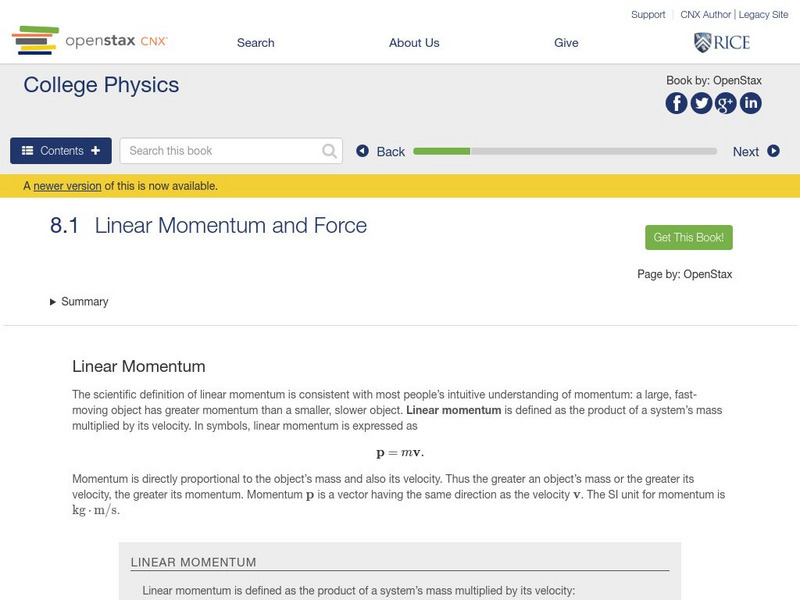
Open Stax: Linear Momentum and Force: Linear Momentum
From a chapter on Linear Momentum and Collisions in a Physics textbook. This section of the chapter covers linear momentum, how momentum and force are related, how momentum fits into Newton's second law of motion, and how to calculate...
Physics Classroom
The Physics Classroom: Motion and Forces in Two Dimensions: What Is a Projectile
Students apply both kinematic principles and Newton's laws of motion to understand and explain the motion of objects moving in two dimensions, more specifically, the motion of projectiles.
Physics Classroom
The Physics Classroom: Motion and Forces in Two Dimensions: Vector Components
Students examine examples of vectors that are directed in two dimensions- upward and rightward, northward and westward, eastward and southward, etc.
Texas Education Agency
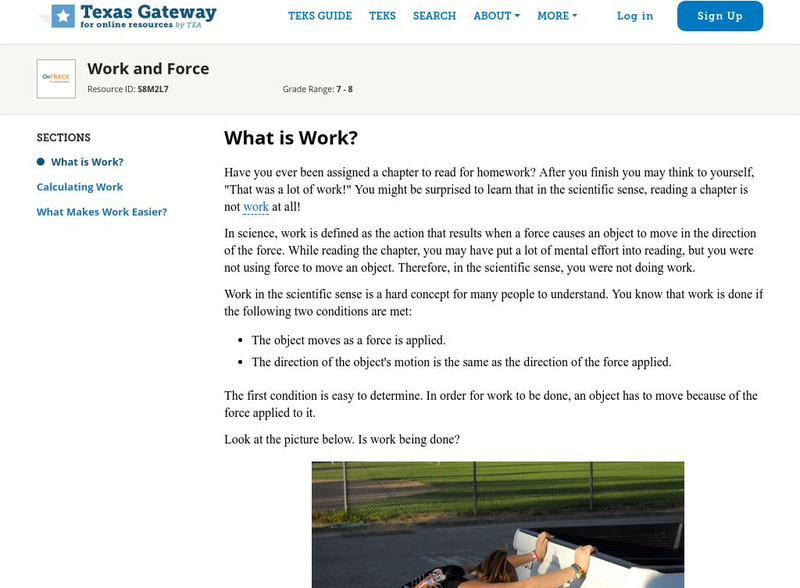
Texas Gateway: Work and Force
Given descriptions, illustrations, graphs, or charts, students will contrast situations where work is done with different amounts of force to situations where no work is done, such as moving a box with a ramp and without a ramp or...
Physics Classroom
The Physics Classroom: Motion and Forces in Two Dimensions: Relative Velocity
Through illustrated examples and interactive practice problems, students explore problems that involve relative velocity- where the actual motion of an object is different than its motion relative to a stationary observer.
Texas Education Agency
Texas Gateway: Uniform Circular Motion and Gravitation: Centripetal Forces
By the end of this section, you will be able to calculate coefficient of friction on a car tire and to calculate ideal speed and angle of a car on a turn.
Texas Education Agency
Texas Gateway: Oscillatory Motion and Waves: Problems and Exercises
This is a list of problems and exercises to solve based on the content of Chapter 16: Oscillatory Motion and Waves from the AP Physics online text.
Physics Classroom
The Physics Classroom: Motion and Forces in Two Dimensions: Vector Addition
In this physics tutorial, the task of summing vectors will be extended to cases in which the vectors are directed in directions other than purely vertical and horizontal.
Physics Classroom
The Physics Classroom: Motion and Forces in Two Dimensions: Component Addition
In this physics tutorial, students learn how to approach more complex vector addition situations by combining the concept of vector components and the principles of vector resolution with the use of the Pythagorean theorem.

Discovery Education
Discovery Education: Motion, Forces, Energy and Electricity
Help your students understand motion and force through the construction of catapults.
Texas Education Agency
Texas Gateway: Linear Momentum and Force: Introduction to Rocket Propulsion
By the end of this section, you will be able to state Newton's third law of motion, explain the principle involved in propulsion of rockets and jet engines, derive an expression for the acceleration of the rocket , discuss the factors...
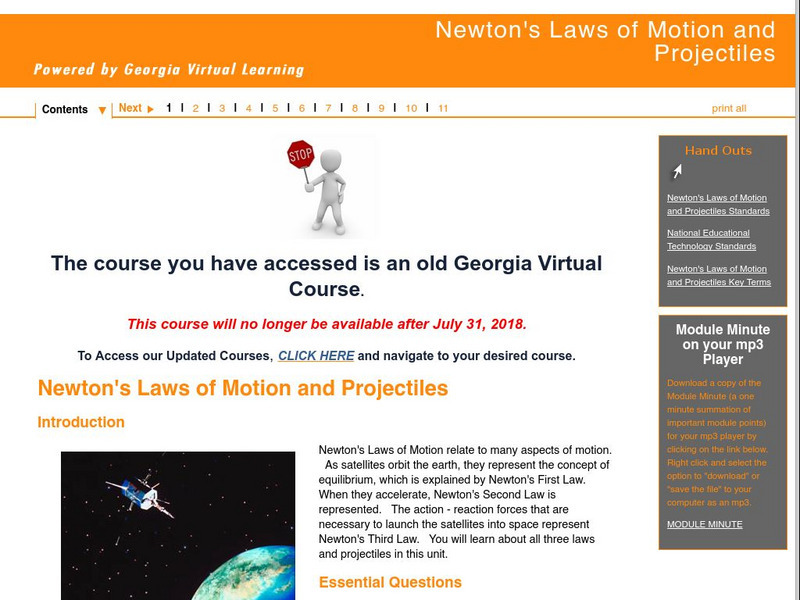
Georgia Department of Education
Ga Virtual Learning: Newton's Laws of Motion and Projectiles
Through informational text, interactive activities, practice problems, online labs, virtual simulations, and video clips, students learn about Newton's Laws of Motion.
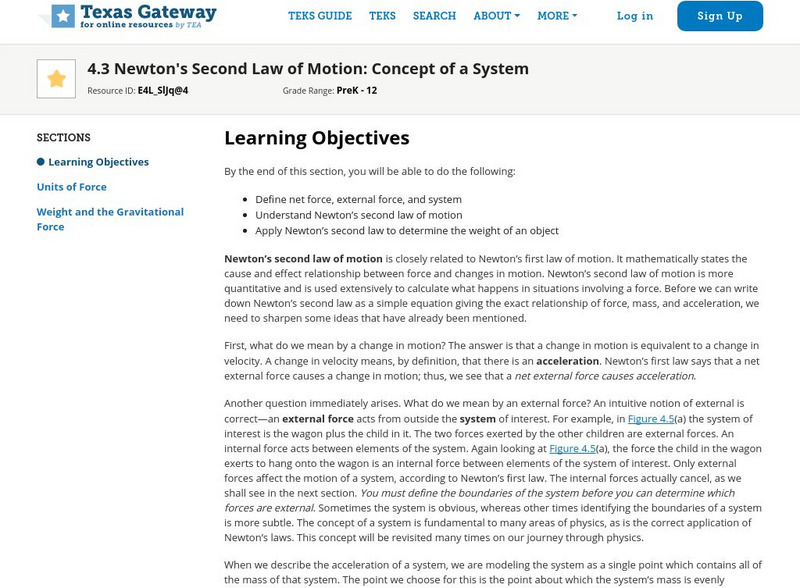
Texas Education Agency
Texas Gateway: 4.3 Newton's Second Law of Motion: Concept of a System
By the end of this section, you will be able to define net force, external force, and system; understand Newton's second law of motion; and apply Newton's second law to determine the weight of an object.
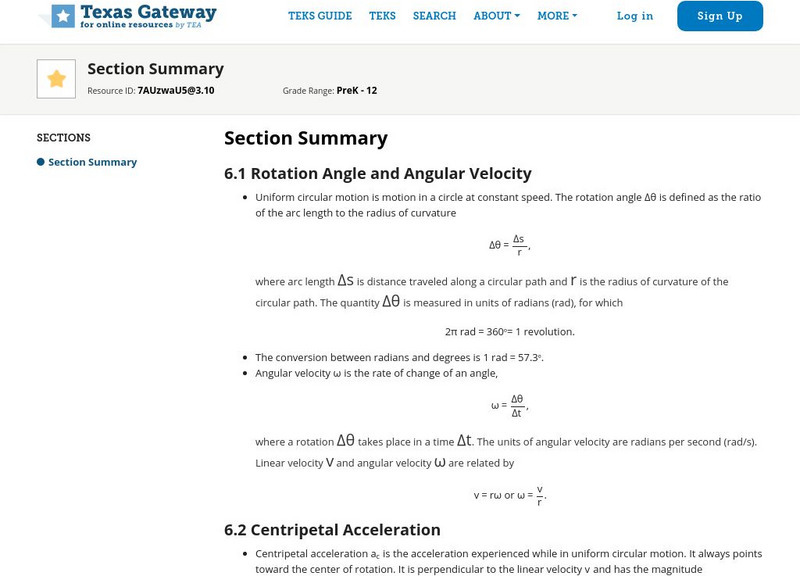
Texas Education Agency
Texas Gateway: Ap Physics: Uniform Circular Motion and Gravitation: Summary
This page features a summary of each section of Chapter 6: Uniform Circular Motion and Gravitation from the AP Physics online text.
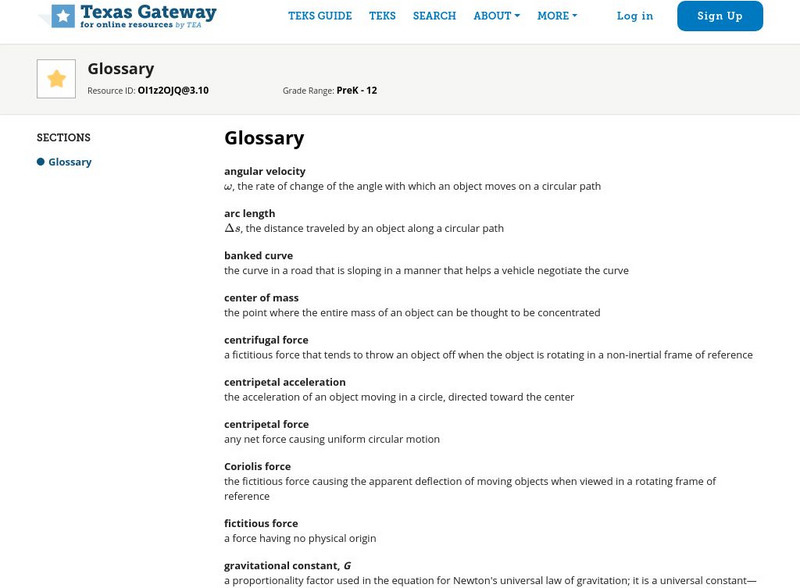
Texas Education Agency
Texas Gateway: Ap Physics: Uniform Circular Motion and Gravitation: Glossary
This is a glossary of terms and definitions used in Chapter 6: Uniform Circular Motion and Gravitation from the AP Physics online text.

Khan Academy
Khan Academy: Trig and Forces: The Pendulum
Using Newton's Laws of motion to calculate the acceleration of a pendulum as well as to compute and draw its position along the swing and move about the screen in a computationally based graphic system.
Physics Classroom
The Physics Classroom: Vectors Motion and Forces in Two Dimensions: Resultants
This physics tutorial illustrates problems that show the vector sum of two or more vectors is the resultant.
Physics Classroom
The Physics Classroom: Motion and Forces in Two Dimensions: Vector Resolution
In this unit, students learn two basic methods for determining the magnitudes of the components of a vector directed in two dimensions. The two methods of vector resolution students will examine are the parallelogram method the...