Hi, what do you want to do?






Physics Classroom
The Physics Classroom: The Apple, the Moon, and the Inverse Square Law
Describes the logic behind the development of Newton's law of universal gravitation. Beginning with Johannes Kepler and his three laws of planetary motion, content walks the reader through Newton's thought process and development of this...

Other
Planetary Society: Relative and Absolute Ages in Histories of Earth and the Moon
A lengthy scholarly article that discusses the geologic time scale, its history of development, age-dating events that occurred in different eras, and how absolute and relative dating are used to assess the ages of the Earth and Moon....
Utah Education Network
Uen: Trb 3:1 Investigation 1 Comparing the Earth & Moon
Third graders compare the earth and the moon in this activity.
White House Historical Association
White House Historical Association: John F. Kennedy and the Space Race
A look at John F. Kennedy's goal for the United States, which was to send the first man to the Moon and to bring him safely back to Earth. Informational text and lesson plan for young scholars in grades 9-12.
Harvard University
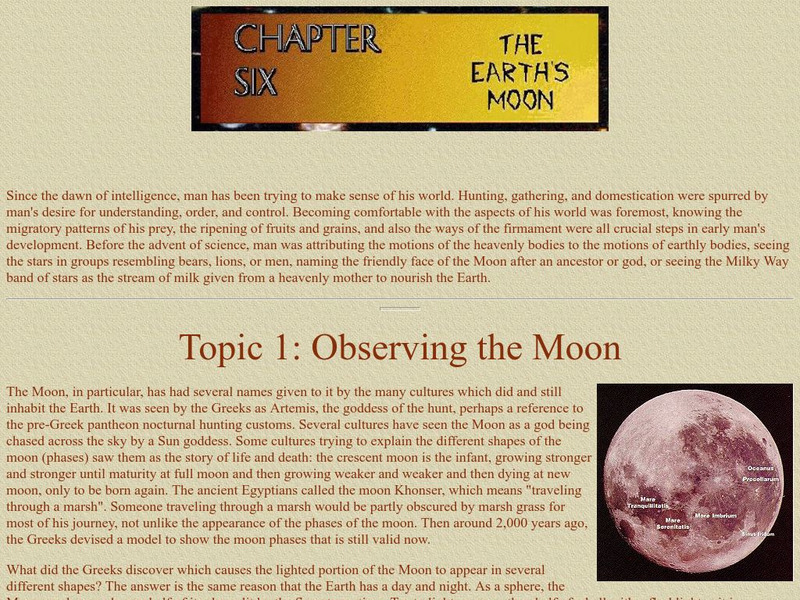
Harvard University: Eyes on the Sky, Feet on the Ground: The Earth's Moon
In this online textbook, students explore the phases of the moon, the moon's orbit, the origin of the moon, and the tides. Includes numerous inquiry-based activities.
Utah Education Network
Uen: The Earth Is Flat
Activity helps students understand that the shape of the earth and the moon are spherical.
PBS
Pbs Learning Media: The Moon in the Sky
Students observe representational images and use as evidence to describe how the Moon is visible in the day and night sky. The digital slideshow is used to provide students with the opportunity to observe and describe how the Moon can be...
Science Struck
Science Struck: How Was the Earth Created
This resource gives a detailed explanation of the stages that the Earth and the solar system went through beginning with their origins in the Big Bang up to the present time.
Space.com
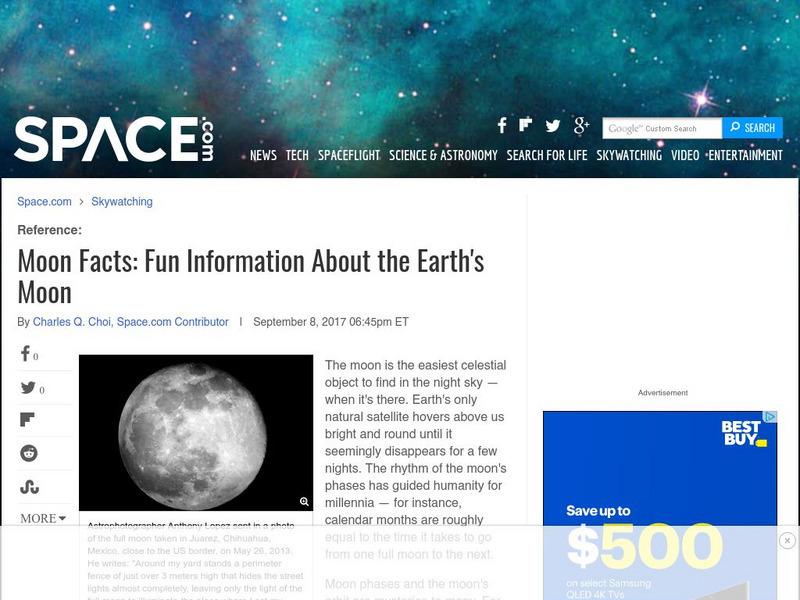
Moon Facts: Fun Information About the Earth's Moon
How did the moon form? Learn the answer to this and numerous other fun facts in this article from Space.com.

E-learning for Kids
E Learning for Kids: Egypt: How Do the Sun, Moon and Earth Revolve Around Each Other?
Omar helps his parents sell things at the market. Join him while he learns about the relationship of the Sun, Moon, and Earth.

E-learning for Kids
E Learning for Kids: Science: Center of the Ocean: The Sun, the Earth, and the Moon
Nita lives on Coco Island in the Indian Ocean, and is learning more about the Sun, the Earth, and the Moon. Join her and learn about day and night.

Nine Planets
The Nine Planets: Earth Facts
Find lots of information about our planet Earth here. Covers basic facts, Earth's history, layers of the Earth, plate tectonics, composition of the atmosphere, Earth's magnetic field, and some facts about our moon.
NASA
Nasa: Earth's Moon: Overview: Our Natural Satellite
Prepared by NASA, this site provides a detailed look at the Earth's moon. The menu tabs are divided into overview, photo gallery, and facts and figures.
NASA
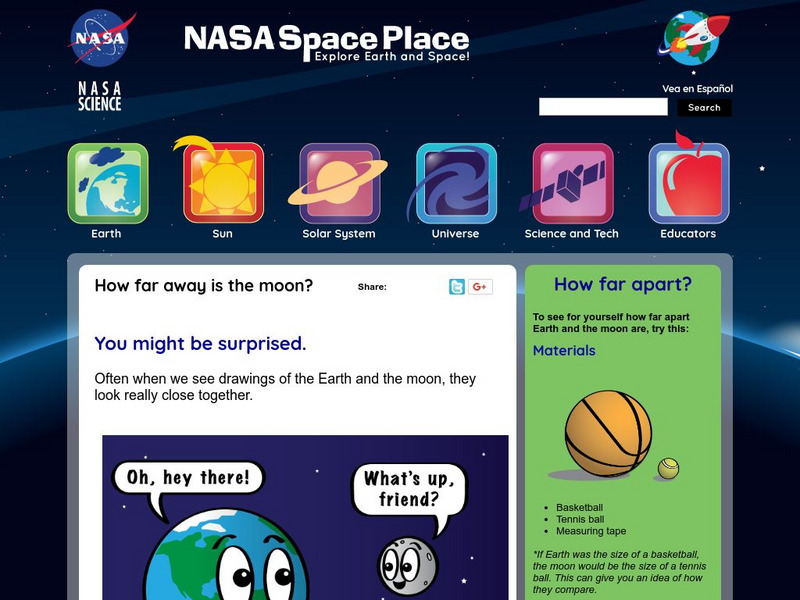
Nasa: Space Place: How Far Away Is the Moon
Often when we see drawings of the Earth and the moon, they look really close together. Check out this cartoon series that helps illustrate the reality of this concept.
BBC
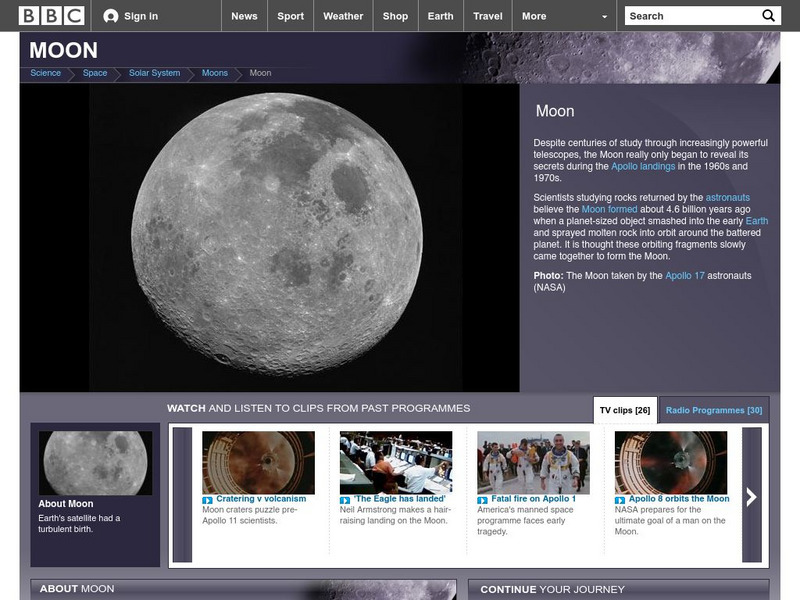
Bbc Science and Nature: The Moon
The BBC brings together a lot of useful information about the moon and related topics, such as the lunar landings, and publishes it in the form of a traveler's guide.
Utah Education Network
Uen: The Night Sky
Learn about the rotation of the earth, the movement of the moon, and the position of the sun.
PBS
Pbs Learning Media: Epic Earth
This mesmerizing video shows seven views of the earth taken by NASA's camera. Watch the moon cross over the earth, storms in the ocean, and smoke from a wildfire. Included are teaching tips for teachers and background information.
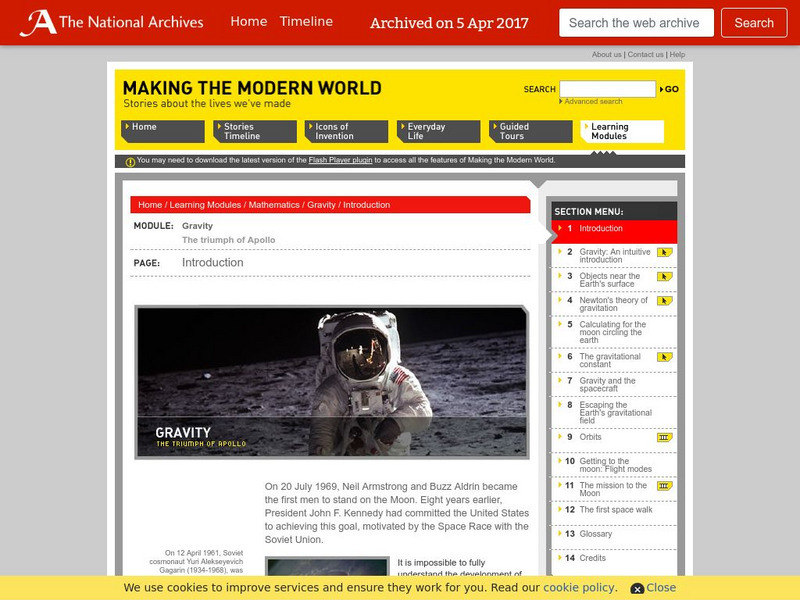
Science Museum, London
Making the Modern World: Gravity
The learning module helps students gain a deeper understanding of gravity. Some topics explored are orbits, the mission to the Moon, and the first space walk. Activities and videos are included.
Utah Education Network
Uen: A Moon With a View
Understand the rotation of the earth and the appearance of movement of other bodies in the sky.
Physics Classroom
The Physics Classroom: Circular and Satellite Motion: The Inverse Square Law
Through illustrated examples and interactive practice, students explore Newton's ability to relate the cause for heavenly motion (the orbit of the moon about the earth) to the cause for Earthly motion (the falling of an apple to the...
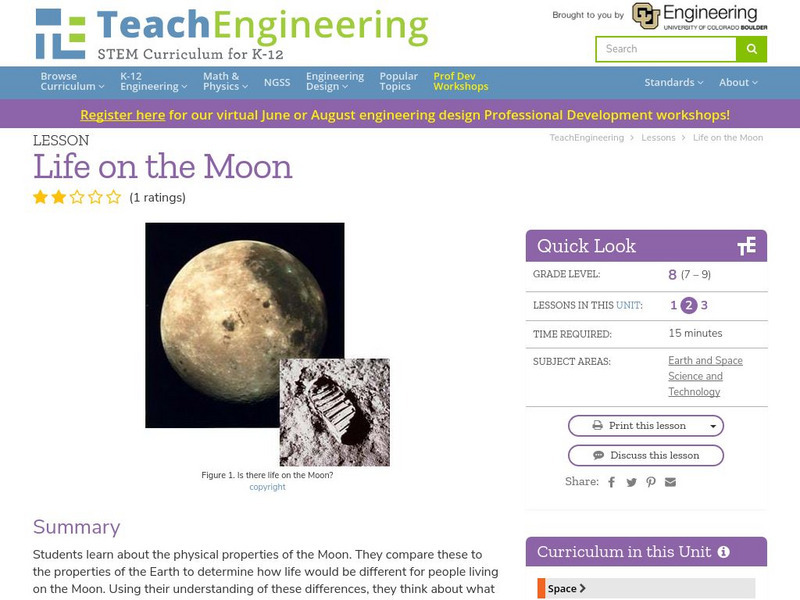
TeachEngineering
Teach Engineering: Life on the Moon
Students learn about the physical properties of the Moon. They compare these to the properties of the Earth to determine how life would be different for people living on the Moon. Using their understanding of these differences, they...
NASA
Nasa: Earth, Moon and Mars Balloons
In this lesson, students will construct a scale model of the Earth-Moon-Mars system.
Curated OER
Web Gallery of Art: Hina Te Fatou (The Moon and the Earth)
An image of "Hina te Fatou (The Moon and the Earth)", created by Paul Gauguin in 1893 (Oil on canvas, 112 x 61 cm).
CK-12 Foundation
Ck 12: Physics Simulation: Phases of the Moon
[Free Registration/Login Required] Learn how the steady motion of the Moon around the Earth, and the phases created by the relative position of the Earth, Sun, and Moon, allow us to tell time by simply looking at the shape and...