Hi, what do you want to do?






The Newberry Library
Newberry: Exploration and Encounter: Map 2: Indian Map of the Southeast, 1721
K-12 lessons using historical maps from Newberry Library presents an Indian map of the Southeast, ca. 1721. Students use maps to understand how spatial relationships are represented. Links to supplemental resources and reference material.

BSCS Science Learning
Bscs: Frog Eat Frog World
Using maps and graphs of large data sets collected in FrogWatch, students will determine the range, preferred land cover, and proximity to water of the American bullfrog to figure out the bullfrog's requirements for food, water, and...
Other
Bscs: Frog Symphony
In this self-directed lesson, learners use maps and graphs of data to investigate the habitats and time of year and day to hear a full chorus of frogs. A handout with everything the student needs to complete this lesson is available as a...
Other
Bscs: Frog Eat Frog World
In this self-directed lesson, students will use maps and Frogwatch data to explore the natural and invasive range of the American bullfrog. A handout with everything the student needs to complete this lesson is available as a PDF or...
US Geological Survey
Geographic Information Systems
This is an extensive resource explaining what Geographic Information Systems (GIS) are, how they work, applications of GIS, and GIS through history.
Rice University
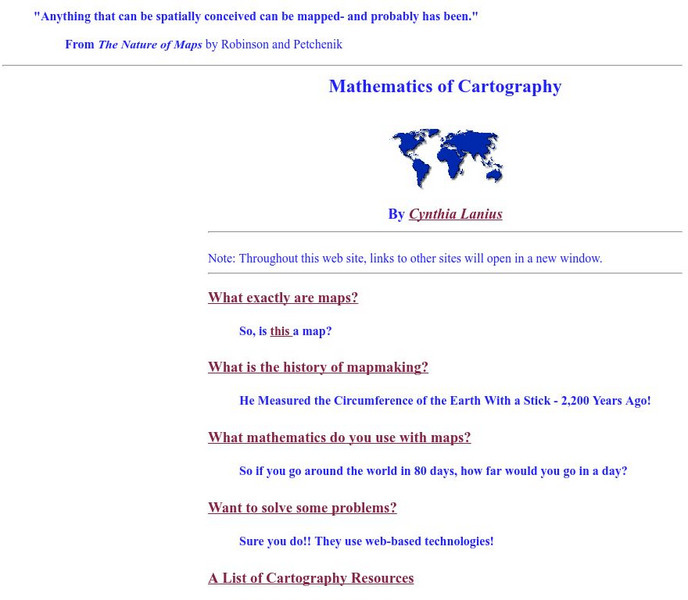
Rice University: Cynthia Lanius: Mathematics of Cartography
Can there be a connection between map making and math? Explore the mathematics of cartography in this resource that integrates web-based instruction, mathematical problem solving, geometry, history, and art. Interesting information and...
University of South Florida
Propel: Social Studies Education Geography
Geography studies the relationships between people, places, and environments by mapping information about them into a spatial context.
American Geosciences Institute
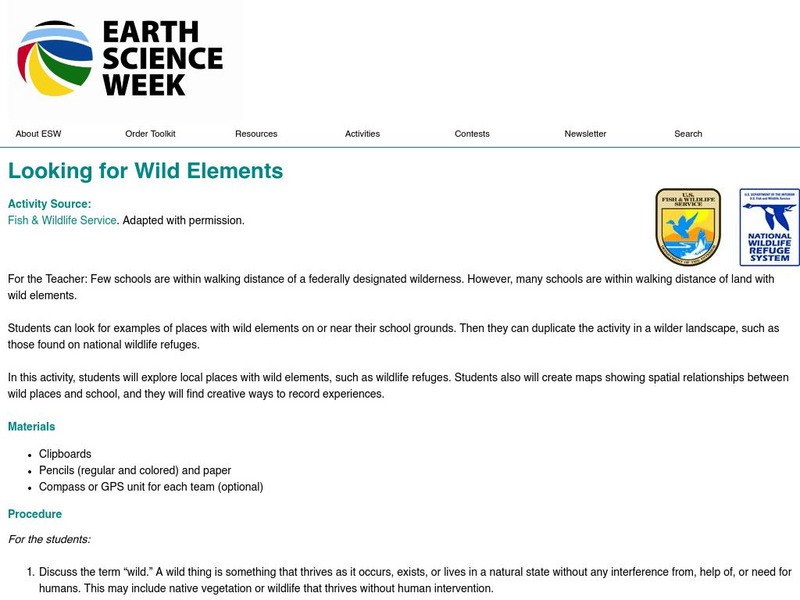
American Geosciences Institute: Earth Science Week: Looking for Wild Elements
Students will explore local places with wild elements, such as wildlife refuges. Students also will create maps showing spatial relationships between wild places and school, and they will find creative ways to record experiences.