Hi, what do you want to do?





Exploratorium
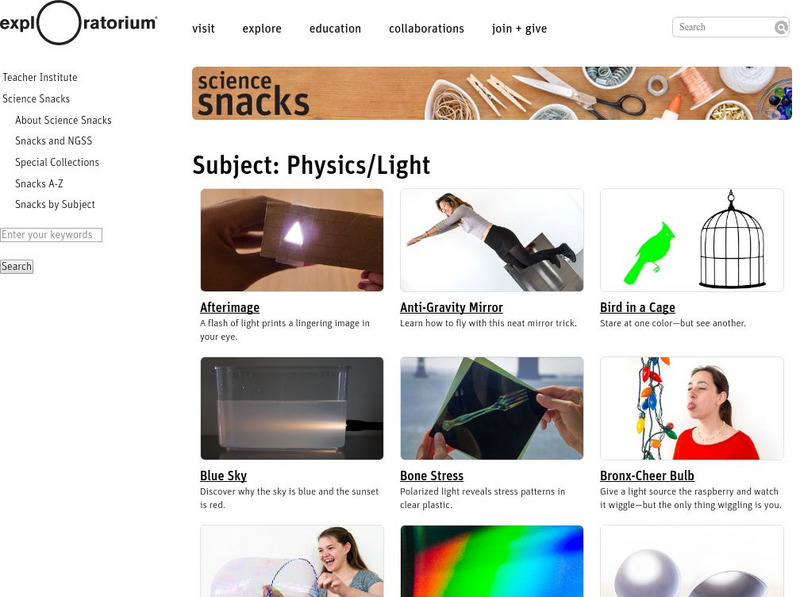
Exploratorium: Science Snacks: Physics/light
Here is a large collection of simple science class activities for understanding the physics of light.
Space Telescope Science Institute
Amazing Space: Star Light Star Bright
A few short, interactive activities on light waves can be found on this site. Numerous others links and teacher resources are posted here as well. A good background on light is offered for teachers.
Utah State Office of Education
Utah Science: Properties and Behaviors of Heat, Light and Sound
How can scientists lump heat, light and sound together when investigating properties and behaviors? This learning module will address that question through a series of activities.

PBS
Pbs Learning Media: What Is a Wave?
This interactive activity adapted from the University of Utah's ASPIRE Lab provides an overview of the characteristics and properties of various types of waves, including light waves, sound waves, and water waves.
University of Colorado
University of Colorado: Ph Et Interactive Simulations: Wave Interference
Conduct virtual experiments with water, sound, and light waves to determine the sine wave and patterns created in each.
Museum of Science
The Atom's Family: Radiometer
Help Dracula find out about light waves by using a virtual radiometer.
Better Lesson
Better Lesson: Waves Performance Assessment Part 1
Students will use a variety of objects to participate in a partner activity and communicate using light and sound waves. Resources include a video, pictures and videos of the lesson in action, and examples of student work.

NASA
Nasa: Optics: Light, Color, and Their Uses
Download this Educators Guide to light, color, and their uses. Choose from different activities using lenses, prisms, hidden messages, periscopes, and kaleidoscopes
NASA
Nasa: Optics: Light, Color, and Their Uses
Download this Educators Guide to light, color, and their uses. Choose from different activities using lenses, prisms, hidden messages, periscopes, and kaleidoscopes
Science Education Resource Center at Carleton College
Serc: Investigating Light: A Form of Energy You Can See
Students will investigate how light is a form of energy that travels as waves away from the source. The basis for this lesson is taken from the Houghton Mifflin science curriculum. In the lesson experiments, students will predict if...
University of California
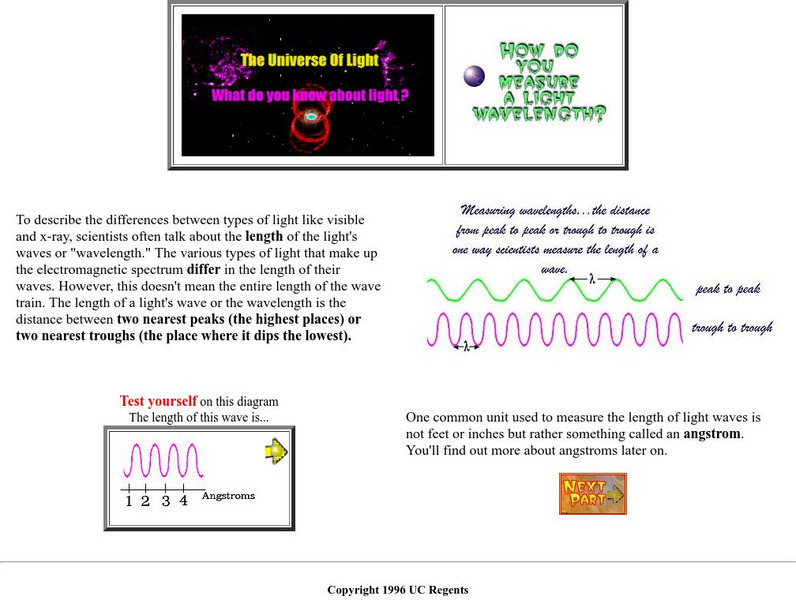
Uc Berkeley: How Do You Measure a Light Wavelength?
Cool science site tests your knowledge of light by exploring the question: "How do you measure a light wavelength?" Allows users to test themselves as well as provides additional activities on wavelength and amplitude.
Science Education Resource Center at Carleton College
Serc: Light & Sound, Light Reflection Relay
In this exploration, learners will investigate how light reflects off smooth surfaces, learn about angles of reflection, and apply that knowledge in a relay experiment.
TeachEngineering
Teach Engineering: Stations of Light
Student groups rotate through four stations to examine light energy behavior: refraction, magnification, prisms and polarization. They see how a beam of light is refracted (bent) through various transparent mediums. While learning how a...
TeachEngineering
Teach Engineering: Waves: The Three Color Mystery
Students are presented with a challenge question concerning color blindness and asked to use engineering principles to design devices to help people who are color blind. Using the legacy cycle as a model, this unit is comprised of five...
Georgia Department of Education
Ga Virtual Learning: Electromagnetic Waves
Through informational text, interactive activities, practice problems, and virtual simulations, students explore the properties of electromagnetic waves.
NASA
Rxte Learning Center: Frequency, Wave Length, and Energy Activity
Resource focuses on the relationship between the frequency, wavelength and speed of light. Has a link to an interactive activity relating frequency, wavelength, and energy.
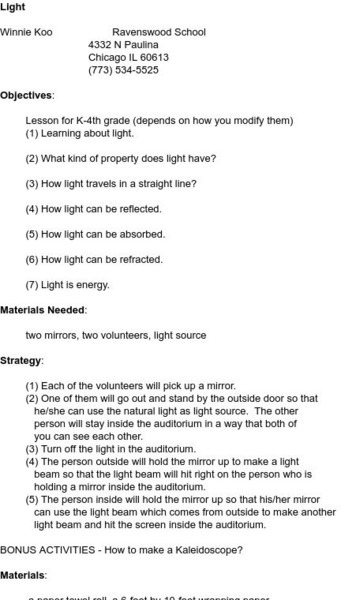
Science and Mathematics Initiative for Learning Enhancement (SMILE)
Smile: Light (K 4)
This site provides two activities that students can do in class. One uses mirrors to reflect light beams whole another is making a kaleidescope.
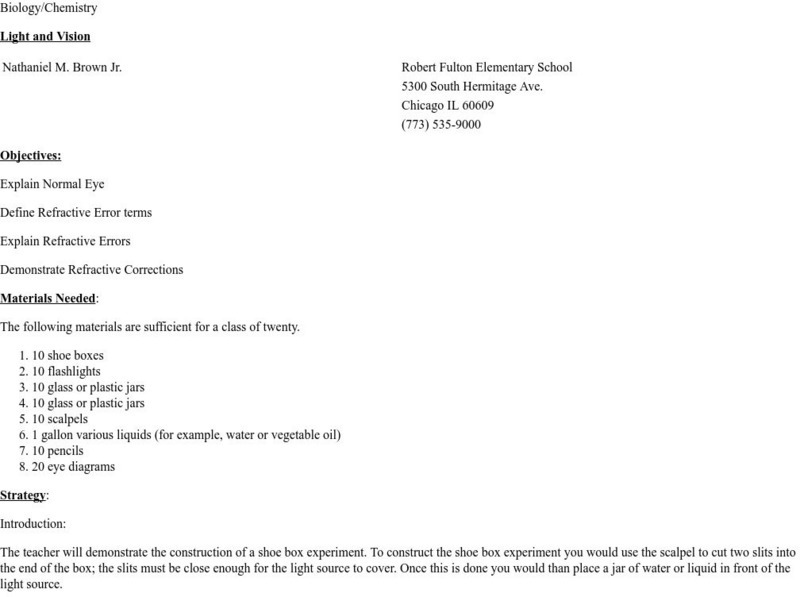
Science and Mathematics Initiative for Learning Enhancement (SMILE)
Smile: Light and Vision
Lesson plan should be used for intermediate students. Students work in pairs or groups to create a shoe box that will bend light.
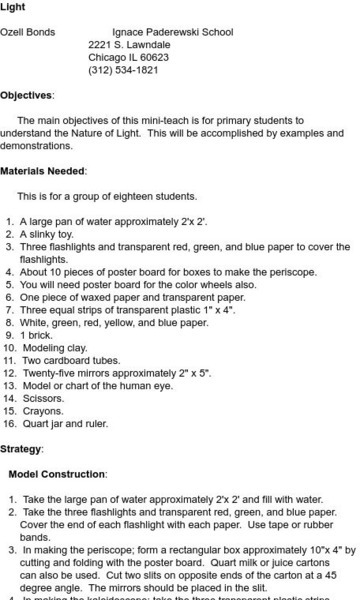
Science and Mathematics Initiative for Learning Enhancement (SMILE)
Smile: Light (Intermediate)
Lesson plan for various group activities about light. Provides demonstration and directions for the plans along with assessment.
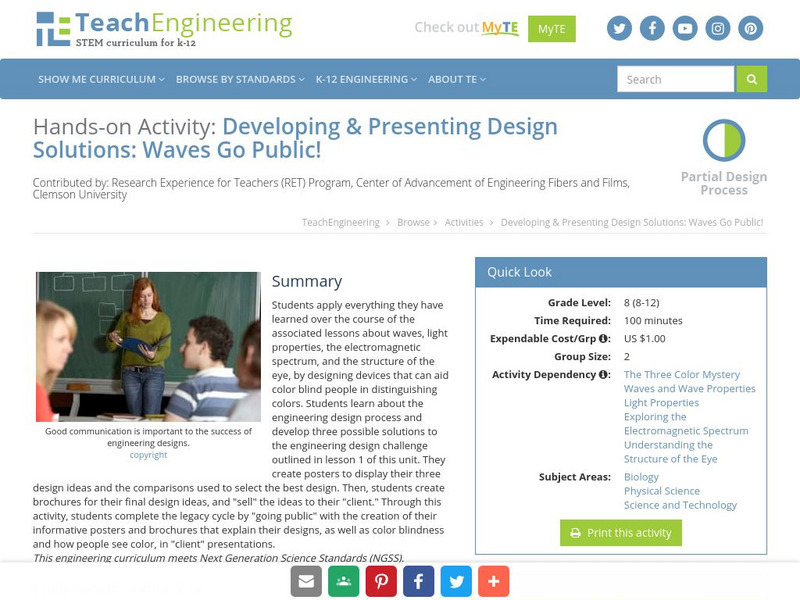
TeachEngineering
Teach Engineering: Waves Go Public!
Students apply everything they have learned over the course of the associated lessons about waves, light properties, the electromagnetic spectrum, and the structure of the eye, by designing devices that can aid color blind people in...
Discovery Education
Discovery Education: The Em Spectrum: Waves of Energy
Students are introduced to the electromagnetic spectrum through this group research activity. Each group investigates a different wavelength range within the em spectrum and reports back to class. Discussion ideas also included.
NASA
Nasa: The Space Place: Match Light Faces With Heat Faces
This site from the National Aeronautics and Space Administration provides information on the subject. "An infrared camera sees heat, rather than light. Can you match up the face in the infrared image with the same face in visible light?"
Creative Science Centre
Creative Science Centre: A Voice on a Sunbeam
Here is described a simple process to 'put a voice on a sunbeam' and transmit it over a distance. It is a fascinating example of amplitude modulation of light using sound vibrations. It then describes how the modulated light is detected...
TeachEngineering
Teach Engineering: The Energy of Light
In this introduction to light energy, students learn about reflection and refraction as they learn that light travels in wave form. Through hands-on activities, they see how prisms, magnifying glasses and polarized lenses work. They also...