Hi, what do you want to do?






Library of Congress
Loc: The Invention of the Telegraph
This site chronicles the invention of the telegraph by Samuel Morse (1791-1872 CE).

Science Struck
Science Struck: Invention of the Telephone: History and Timeline
While the invention of the telephone is usually attributed to Alexander Graham Bell, credit must also be given to others who were working on the concept around the same time. Read about the history of the telephone here. Includes a...
Massachusetts Institute of Technology
Mit: Invention of the Week: Thomas Alva Edison
As the inventor of the lightbulb, phonograph, and the printing telegraph, Thomas Alva Edison (1847-1931), improved the daily lives of everyday people.
Gilder Lehrman Institute of American History
Gilder Lehrman Institute: History Now: Technology of the 1800s
[Free Registration/Login Required] Article considers the inventions and innovations in communication, transportation, and manufacturing that drove America forward in the nineteenth century. Includes a link to an interactive history of...
University of Virginia
University of Virginia: Alexander Graham Bell's Path to the Telephone
A detailed survey of the invention and evolution of the telephone. This scholarly article includes a Master Map that shows Bell's thought processes as he developed the telephone, with each step linked to more in-depth information. The...
Smithsonian Institution
Lemelson Center: Thomas Edison's Places of Invention
An article by Paul Israel from the Prototype newsletter discusses the various laboratories used by Thomas Edison as he was developing his inventions.

University of Houston
University of Houston: Engines of Our Ingenuity: No. 1393: Inventing the Telegraph
Read about the history of the telegraph in this article, which is a transcript of a radio broadcast.
Massachusetts Institute of Technology
Mit: Inventor of the Week: Granville T. Woods
Inventor Granville T. Woods is featured in this brief biography for his multiplex telegraph which was a useful invention for the railroad industry.
Massachusetts Institute of Technology
Mit: Inventor of the Week: Samuel f.b. Morse
Provides a short biography of Samuel F.B. Morse, and his invention of the one-wire telegraph and the Morse Code. Also contains pictures.
National Inventors Hall of Fame
National Inventors Hall of Fame: Thomas Alva Edison
This site honorsThomas Alva Edison as a historic inventor and focuses attention on his invention of the electric lamp.
Smithsonian Institution
Lemelson Center: Invention Stories
Six categories of inventions highlight the inventors in those categories and describe their sometimes world-changing inventions. Other inventions are not so critical, but nonetheless fascinating.
Great Idea Finder
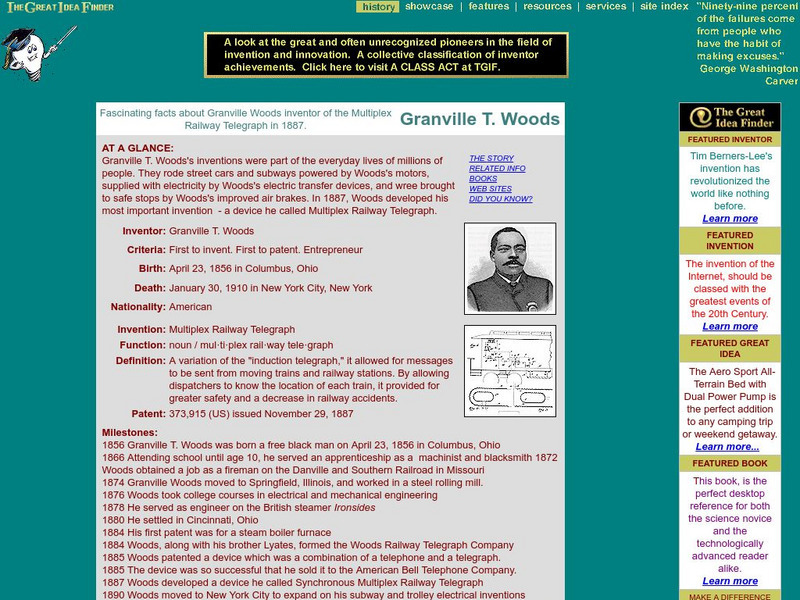
The Great Idea Finder: Inventor Granville Woods Biography
A detailed biography of Granville T. Woods, who was known as "the Black Edison" because of his many inventions. He is best known for greatly improving the safety of railroads by his invention of the Multiplex Railway Telegraph.
Massachusetts Institute of Technology
Mit: Inventor of the Week: Granville T. Woods: The Multiplex Telegraph
A description of Granville Woods' successful invention, the multiplex telegraph, which greatly improved railroad safety. From the Lemelson-MIT Project.
Other
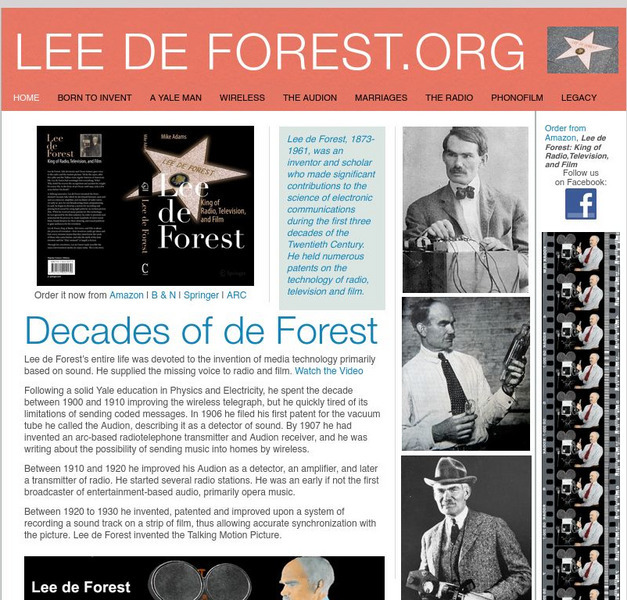
Lee De Forest, American Inventor: The Complete Lee De Forest
An extensive site covering all aspects of Lee de Forest, his inventions, writings, and personal life. Find drawings and pictures of his audion tube and find out about his legacy, especially in the world of electronics.
Smithsonian Institution
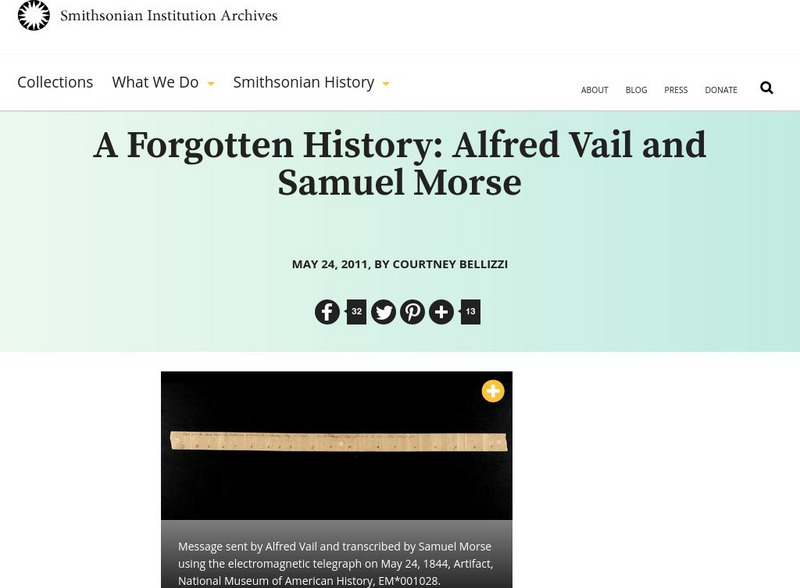
Smithsonian Institution Forgotten History: Alfred Vail and Samuel Morse
This article explains Alfred Vail's partnership with Samuel Morse and his contributions to the development of the telegraph.
Curated OER
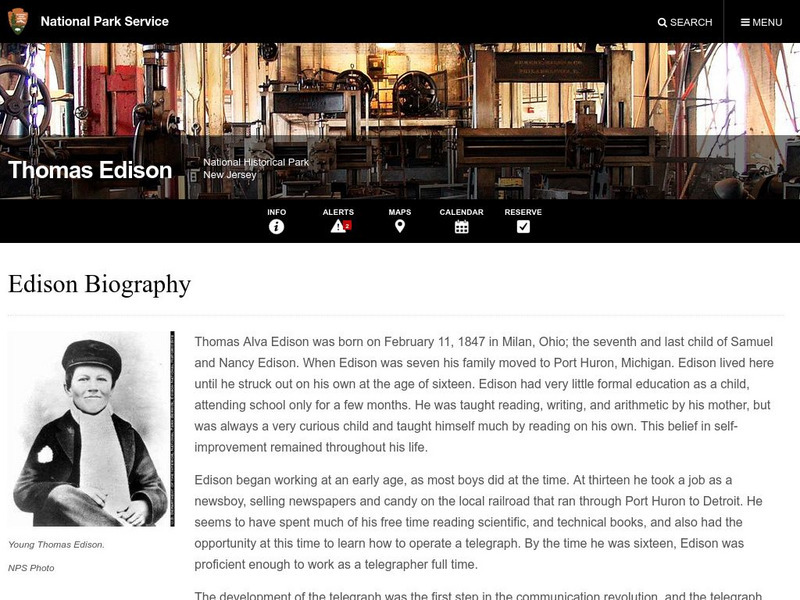
National Park Service: Thomas Edison National Historical Park: Edison Biography
Here is a very detailed biography of Thomas Edison ranging from his boyhood and his work as a telegrapher, moving on to his invention of the phonograph and incandescent light bulb, and finally, a description of his laboratories where he...

National High Magnetic Field Laboratory
Magnet Academy: Morse Telegraph 1844
The man most commonly associated with the telegraph, Samuel Morse, did not invent the communications tool. But he developed it, commercialized it and invented the famous code for it that bears his name.

PBS
Pbs: American Experience: More About Bell
Part of the larger site about Alexander Graham Bell from the series, American Experience, this biography focuses mainly on his education and experimentation which resulted in his development of the telephone. Included is information...
Independence Hall Association
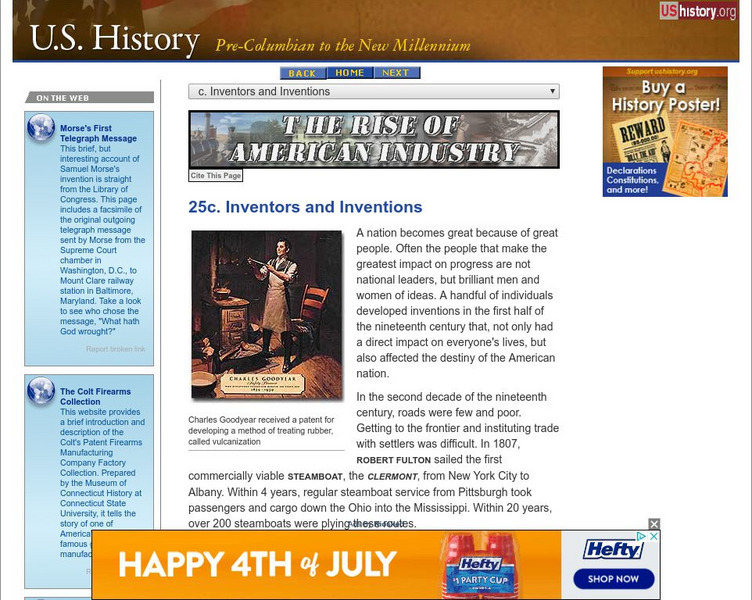
U.s. History: Inventors and Inventions
The industrial revolution in America spawned the inventions of many inventors, who improved technology in many different areas. See how transportation, agriculture, and communications were transformed because of these inventions.
Rutgers University
Thomas Edison Papers: Biography of Thomas Edison
The first person to make the storage battery practical, with 147 patents, Edison's life is a testimony to invention. This biography, in outline form, is in two parts; go to 1879 site after this.

PBS
Pbs: American Experience: Joseph Henry Lays Groundwork for the Telephone
This is the man who most encouraged Bell to invent the telephone. Bell said, "But for Henry, I never would have gone ahead with the telephone." This is a fascinating account both of Bell's invention and of Henry's life. Half a biography,...
Other
Samuel Finley Breeze Morse
Provides biographical information on Samuel Morse as well as information on his invention of the telegraph. (Pictures no longer load.)

National High Magnetic Field Laboratory
Magnet Academy: Mirror Galvanometer
Invented by William Thomson (who later became Lord Kelvin for such clever acts as this), the mirror galvanometer was a useful instrument that played a key role in the history of the telegraph. (Java tutorial)
A&E Television
History.com: 6 Key Inventions by Thomas Edison
Edison's genius was improving on others' technologies and making them more practical for the general public. Thomas Edison applied for his first patent in 1868, when he was just 21 years old. The famous inventor's first brainchild was...