Hi, what do you want to do?





Council for Economic Education
Econ Ed Link: Human Resources and Capital Resources: It's a Match!
Students will define and identify human resources and capital resources workers use in their jobs.
Council for Economic Education
Econ Ed Link: Economic Spotter: Resources During Wwii
This is a lesson that deals with scarcity during WWII. Natural, human, and capital resources are discussed.
![Edutopia: Goods and Services [Pdf] Activity](https://statictemp.lp.lexp.cloud/images/attachment_defaults/resource/large/FPO-knovation.png "Edutopia: Goods and Services [Pdf] Activity")
Edutopia
Edutopia: Goods and Services [Pdf]
A unit that teaches the difference between goods and services, the difference between producers and consumers, the difference between human, natural, and capital resources, and the difference between bartering/trading and buying/selling....
Council for Economic Education
Econ Ed Link: Mystery Workers: Productive Resources
This website focuses on productive resources which are divided into three categories, natural, human, and capital.
Council for Economic Education
Econ Ed Link: Those Golden Jeans
Check out this informative economics lesson plan designed to review the three productive resources--natural resources, human resources, and capital resources--needed to produce goods and services.
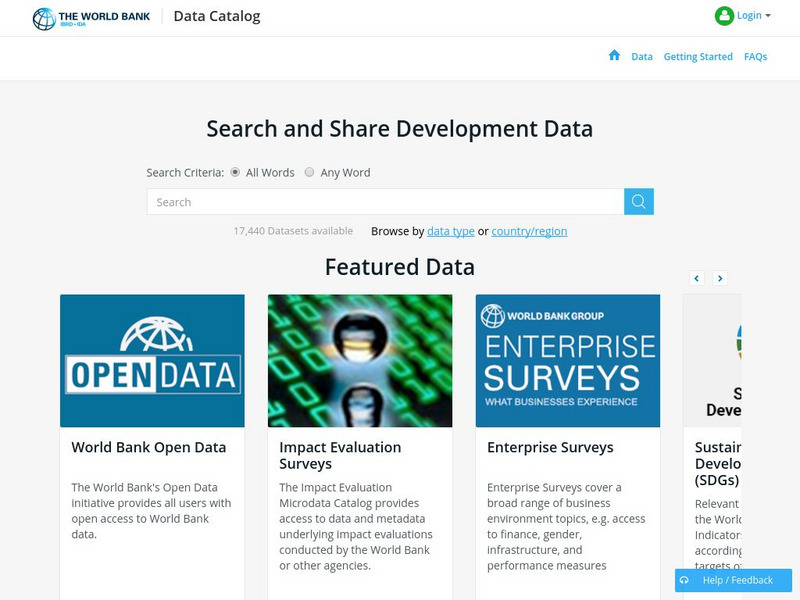
The World Bank
World Bank: Data Catalog
This resource provides statistical data on numerous categories for nearly every country in the world. A great tool for a comparative analysis. Human, natural, and capital resources are all included.
Council for Economic Education
Econ Ed Link: The Civil War: A War of Resources
The North won the Civil War in large part due to its superior resources. In this lesson young scholars will learn the difference between capital resources, human capital, and natural resources. They will investigate and compare the...
Council for Economic Education
Econ Ed Link: Economic Spotter: Resources During World War Ii
In World War II pennies were made of steel and zinc instead of copper and women were working at jobs that men had always been hired to do. Why? Because during war times, scarcity forces many things to change!
Council for Economic Education
Econ Ed Link: Booker T. Washington:"fifty Cents and a Dream"
Young Booker T. Washington had a dream. That dream was to use the resources at his disposal to earn the money necessary to get an education that would allow him and others to become financially secure. This lesson based on the picture...
Council for Economic Education
Econ Ed Link: Music, Maestro, Please: Show Business and the Factors of Production
The city of Philadelphia, Pennsylvania recently opened a $300 million dollar center for the performing arts, the Kimmel Center. This lesson was developed for a special teacher workshop to incorporate economics and the arts to teach kids...
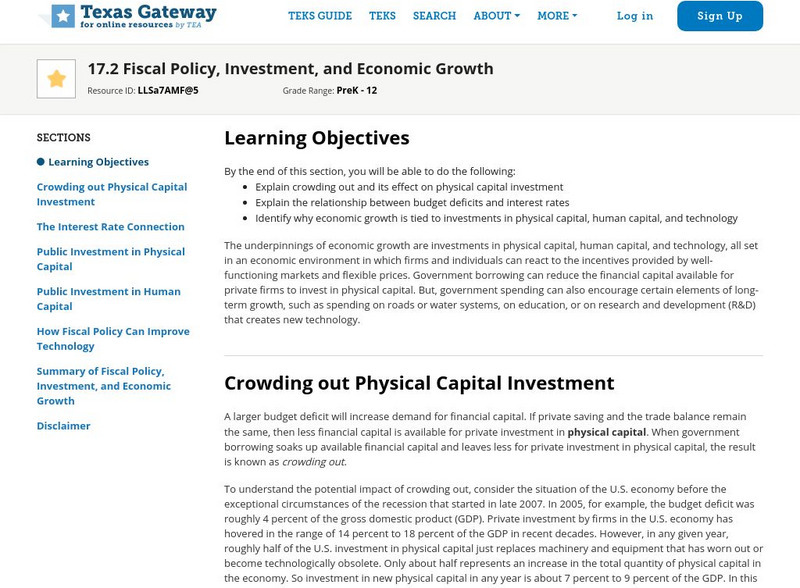
Texas Education Agency
Texas Gateway: Ch. 17: Fiscal Policy, Investment, and Economic Growth
By the end of this section, you will be able to do the following: Explain crowding out and its effect on physical capital investment; Explain the relationship between budget deficits and interest rates; and Identify why economic growth...
Council for Economic Education
Econ Ed Link: Human Capital Concept Video and Quiz
Video [3:04] describing the concept of human capital as a combination of a person's education, knowledge, experience, health, habits, training and talent.
Practical Money Skills
Practical Money Skills: Human Capital
"Human capital" is the talent, skills, education, and experience of human beings that allow them to be productive in the creation of products and services. As our economy has evolved over time into one that is more service-oriented,...
Council for Economic Education
Econ Ed Link: Henry Ford and the Model T: A Case Study in Productivity (Part 2)
Henry Ford's use of mass production strategies to manufacture the Model T revolutionized industrial manufacturing. This 3-part learning unit provides students with the story of Henry Ford and the Model T from an economics perspective....
Council for Economic Education
Econ Ed Link: Wages and Me
Students explore the reasons for differences in the wages for several occupations. Then students are guided through the Bureau of Labor Statistics website to find information about their potential careers and wage rates nationally and in...
University of Nebraska Omaha
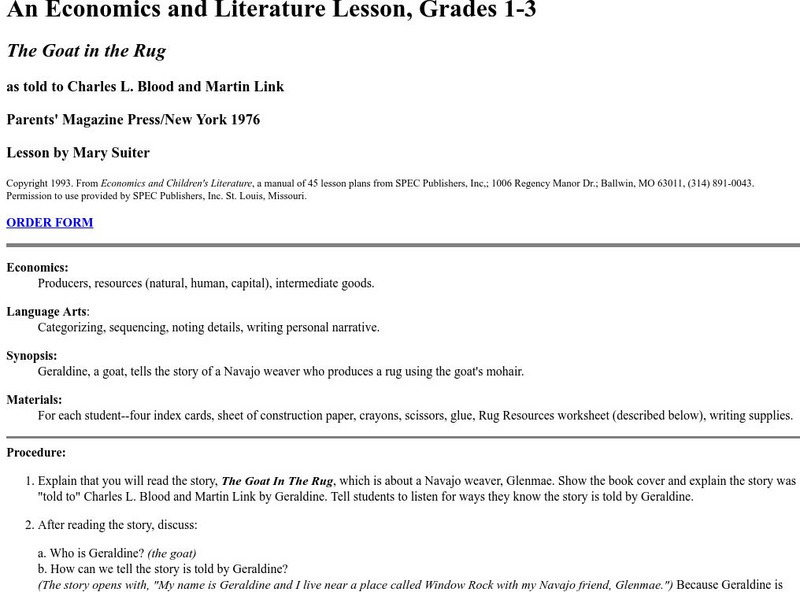
An Economics and Literature Lesson: The Goat in the Rug
This is a lesson plan geared toward first through third grades, cross-curricular, dealing with economics and literature. "Learn about economics: producers, resources (natural, human, capital), intermediate goods; and Language Arts:...
Council for Economic Education
Econ Ed Link: The Shoemaker's Tools
This lesson incorporates the folk tale of The Shoemaker and the Elves to teach your learners about the concept of capital resources. Lesson contains a link to an animated retelling of this beloved classic. Use it to have students...
University of Minnesota
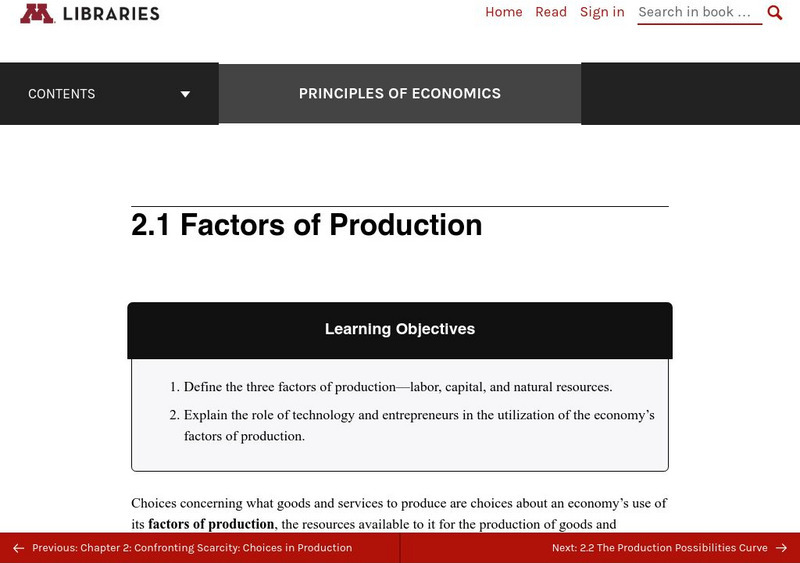
University of Minnesota: 2.1 Factors of Production: Principles of Economics
The three factors of production-labor, capital, and natural resources. Explain the role of technology and entrepreneurs in the utilization of the economy's factors. Labor is the human effort that can be applied to the production of goods...
Council for Economic Education
Econedlink: Scarcity Video and Quiz
This video teaches the concept of Scarcity and includes a quiz. The total resources of society, including natural resources, human resources, capital goods and entrepreneurship, are limited, causing scarcity to exist. [1:13]

Khan Academy
Khan Academy: Ap Us History Period 6: 1865 1898: Social Darwinism & Gilded Age
The study resource from Khan Academy provides an overview of Period 6: 1865-1898 in American History. Social Darwinism, Charles Darwin, and the Gilded Ages are discussed in this lesson. This resource is designed as a review for the AP US...
Council for Economic Education
Econ Ed Link: Capital Investments: Human v. Physical
In this instructional activity you will define human capital and understand why it is necessary for economic growth. Also, you will explore how people can increase their personal level of human capital.
Other
Technology Resources: Resources Are Things We Need to Get a Job Done [Pdf]
Resources are things we need to get a job done. Every technological system makes use of seven types of resources: people, information, materials, tools and machines, energy, capital, and time.
Federal Reserve Bank
Federal Reserve Bank of St. Louis: Tortilla Factory [Pdf]
This lesson accompanies a story by Gary Paulsen called Tortilla Factory, and teaches students to identify the different types of resources (human, capital, natural, etc.) that go into creating corn tortillas and other products.
Council for Economic Education
Econ Ed Link: A Fair Wage
Income for most people is determined by the market value of the productive resources they sell. What workers earn depends, primarily, on the market value of what they produce and how productive they are.