Hi, what do you want to do?






Massachusetts Institute of Technology
Mit: Open Course Ware: Ancient Philosophy and Mathematics
Course materials, syllabus, readings and study materials for a complete online course on ancient philosophy from MIT.
Penn Museum
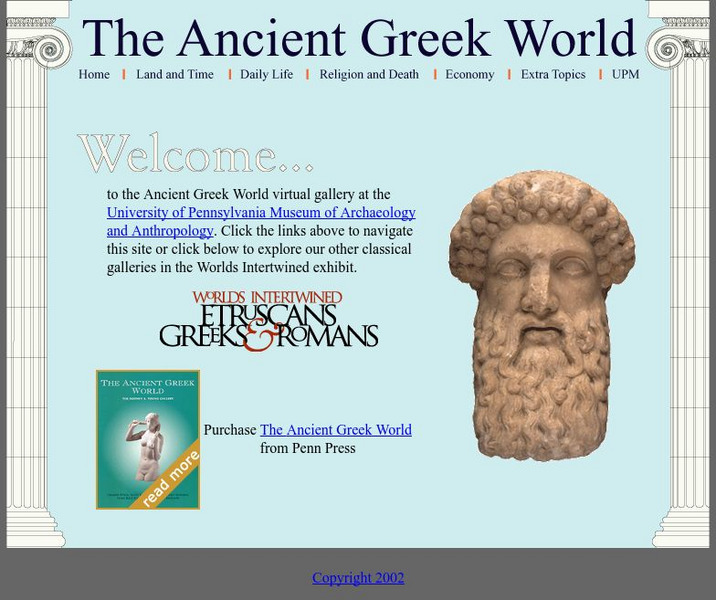
Penn Museum: Ancient Greek World
Massive site for information on the ancient Greek world. Follow the navigation at the top of the page for detailed sections on time periods, daily life, religion and death, economy, and more. Each section includes pictures of artifacts...
Exploring Ancient World Cultures
Exploring Ancient World Cultures: Ancient World Cultures
The University of Evansville provides this site that gives an overview and then additional pages with readings in ancient Greek philosophy and literature. A good general resource.
Massachusetts Institute of Technology
Mit: Open Course Ware: Ancient Philosophy
Ancient Greece has bestowed much to Western philosophy. This course will acquaint the student with some of the ancient Greek contributions to the Western philosophical and scientific tradition.
Internet Encyclopedia of Philosophy
Internet Encyclopedia of Philosophy: Greek Philosophy
Introduction from the Internet Encyclopedia of Philosophy to the main topics and thinkers in the Greek philosophical tradition. Includes links to related articles. Helpful for relating particular philosophers to each other chronologically.
Other
Ancient History: 10 Ancient Greek Inventions and Discoveries Still Used Today
Ten of the important inventions and innovations of the ancient Greeks are described. These include the water mill, the odometer, alarm clocks, cartography, the Olympics, geometry, Hippocratic medicine, philosophy, democracy, and...
Other
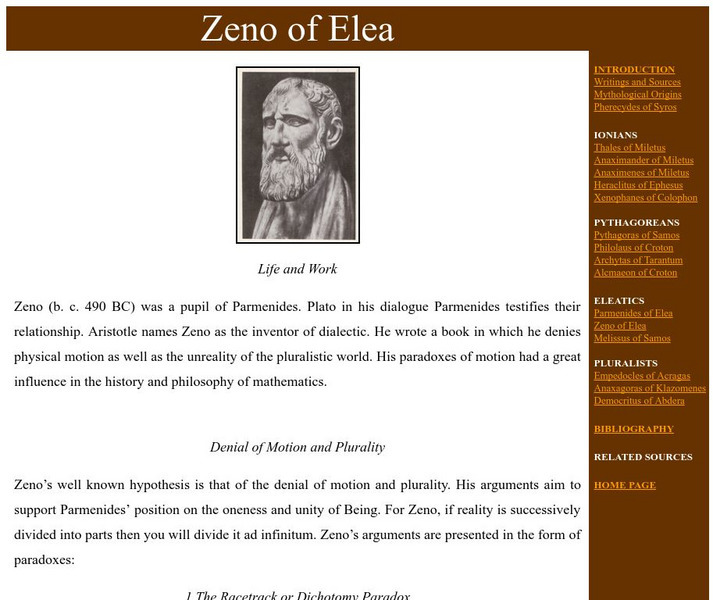
Ancient Greek Philosophy: Zeno of Elea
Describes the little that is known of Zeno of Elea's life. Also discusses his denial of motion and plurality hypothesis. He explained his ideas using paradoxes that continue to challenge intellectual minds today, and that have had a big...
Penn Museum
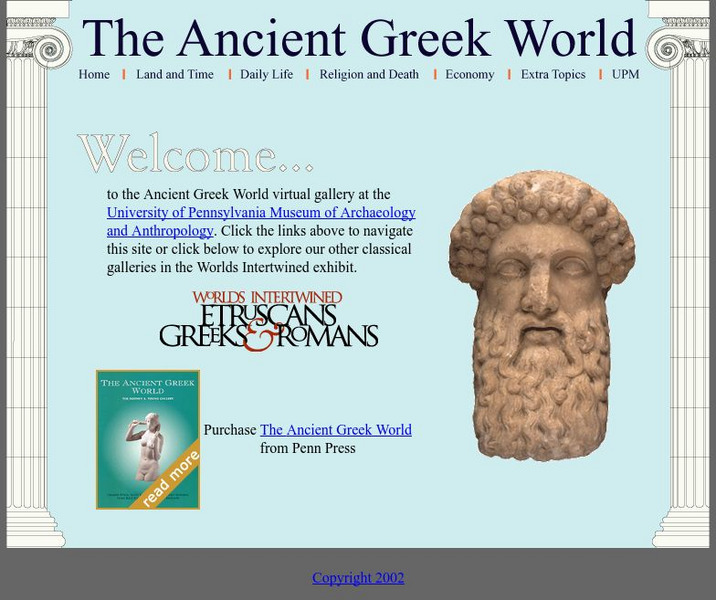
Penn Museum: Ancient Greek World
Explore all aspects of life in ancient Greece. From the Mycenaean to the Hellenistic time periods, learn about Greek daily life, roles for men and women, religion and religious ceremonies, and the Greek economy.
Boston University
Boston University: Sport, Education, and the Meaning of Victory
Author links ancient Greek philosophy to the place of sports in contemporary education. An interesting example of philosophy of sport.
Stanford University
Stanford Encyclopedia of Philosophy: Aristotle
Looks at the life of Aristotle (384-322 B.C.E.) and the far-reaching scope of his intellectual ideas. The article examines in depth his theories in the disciplines of philosophy, politics, mathematics and science, and his legacy.
Stanford University
Stanford Encyclopedia of Philosophy: Democritus
A look at the life of Democritus of Abdera. He helped to develop a theory of atomism, explained in detail here. Other significant ideas he had included his theory of perception, a theory of the soul and its relationship to living things,...
World History Encyclopedia
World History Encyclopedia: Plato
Read about the life of the Greek philosopher Plato, the philosophy he developed, and his legacy.
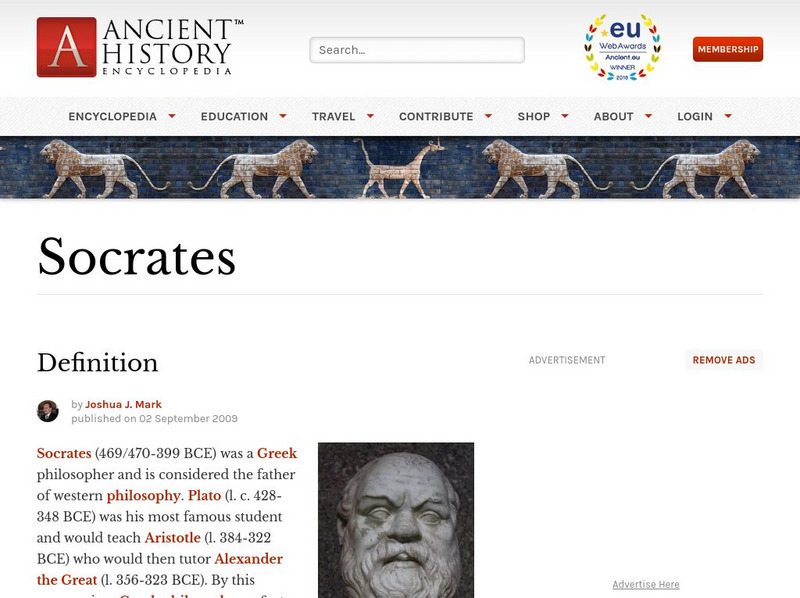
World History Encyclopedia
World History Encyclopedia: Socrates
Read about the life of the Greek philosopher Socrates, the philosophy he developed, his influence, and his execution for impiety and for corrupting young people.
Other
Routledge Encyclopedia of Philosophy: Islamic Philosophy
The history of Islamic philosophy is discussed here. Learn how it has developed over time, how it has been influenced by Greek-Hellenistic philosophy, and how it differs according to demographic and region.
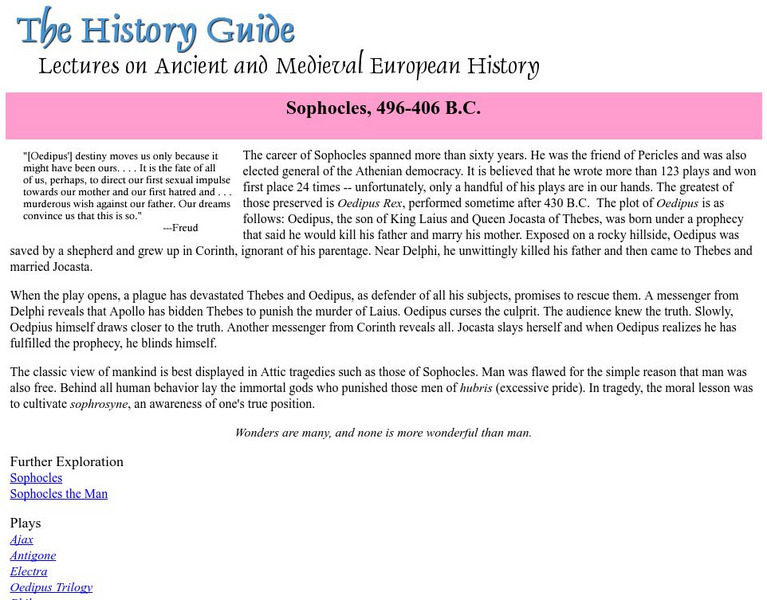
Steven Kreis, PhD
The History Guide: Sophocles
A discussion of the writings of Sophocles, in particular Antigone, and the theme of the conflict between personal and political matters.
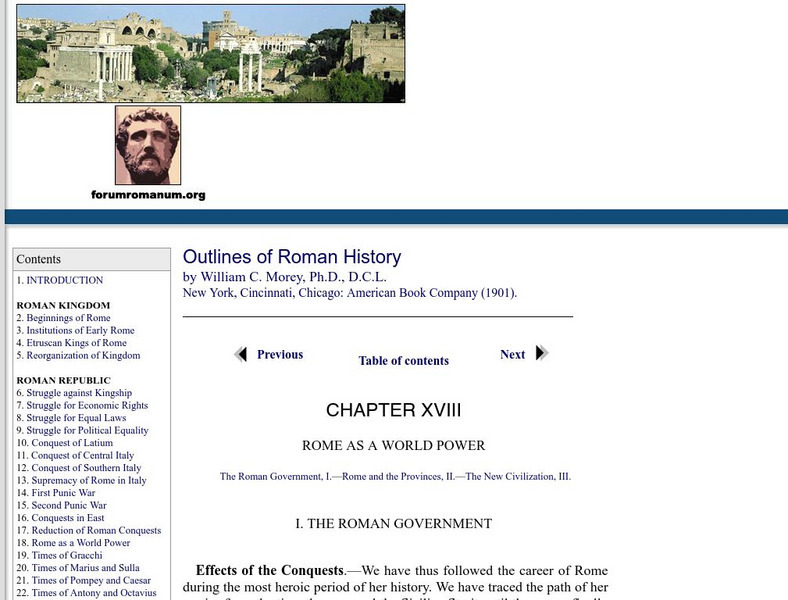
Forum Romanum
Outlines of Roman History: The New Civilization
With Rome's conquest of foreign lands, she assimilates many ideas for literature, architecture, art, religion, and philosophy.
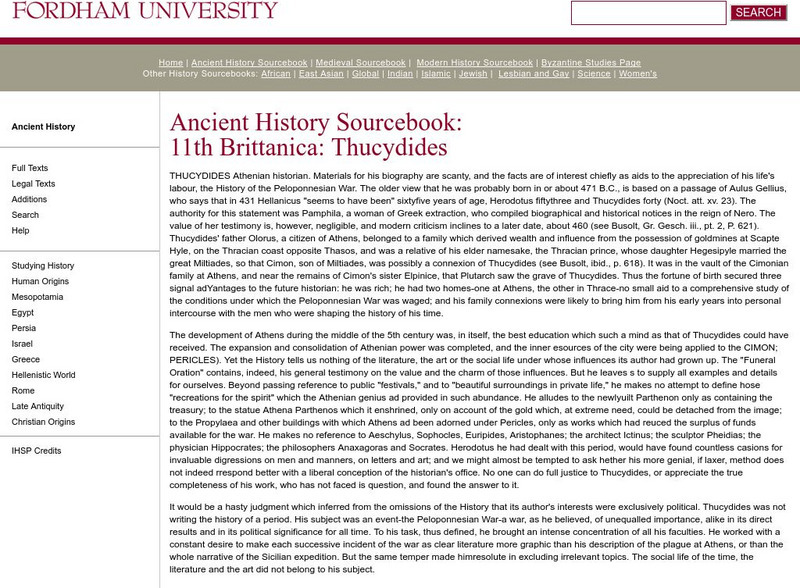
Internet History Sourcebooks Project
Fordham University: Ancient History Sourcebook: Thucydides
This site from the Fordham University provides an extensive biography of Thucydides and his writing of history. It details his life as a statesman, traveller and writer. He was schooled in rhetoric and philosophy. His intention in...
Other
The Basics of Philosophy: Aristotle
A discussion of Aristotle's life and work, including his writings, his system of logical reasoning, and his contributions to different fields, such as politics, philosophy, and science.
Internet Encyclopedia of Philosophy
Internet Encyclopedia of Philosophy: Ancient Greek Skepticism
This site from the Internet Encyclopedia of Philosophy is an excellent, brief introduction to the major thinkers in the ancient Skeptic tradition. Divides the movement into early Pyrrhonism, Academic skepticism, and post-Academic...
Other
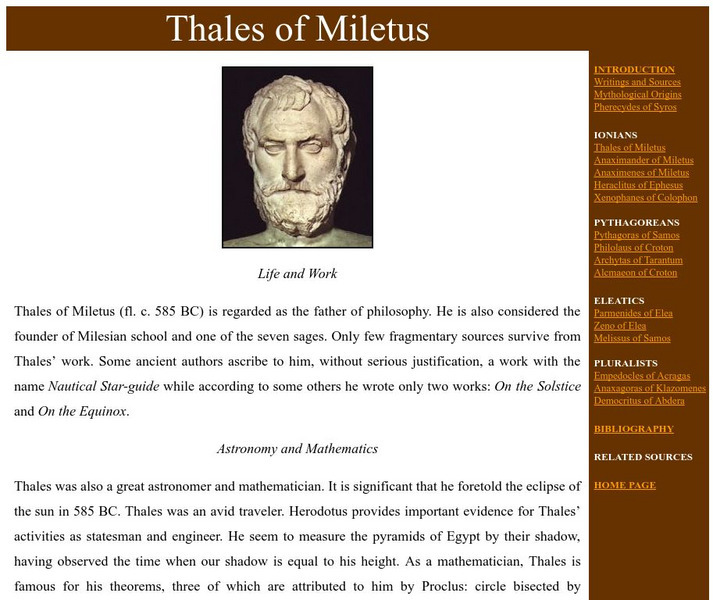
Ancient Greek Philosophy: Thales of Miletus
Includes a short summary of the life and work of the Greek philosopher Thales of Miletus. Discusses his life, work in Astronomy and Mathematics, and view of water and pantheism. Also includes a couple of quotations that make reference to...

World History Encyclopedia
World History Encyclopedia: Epicurus
Read about the life of the Greek philosopher Epicurus and the philosophy he developed called Epicureanism.
Internet Encyclopedia of Philosophy
Internet Encyclopedia of Philosophy: Aristotle: Biology
Looks at the life of Aristotle and his work in the field of biology. His different theories are explained, and the ideas he got right as well as some he got wrong.
Stanford University
Stanford Encyclopedia of Philosophy: Anaxagoras
Discusses the life of Anaxagoras of Clazomenae, his ideas about the metaphysical, the physical, the cosmos, and human intelligence, and the impact he had on later intellectuals. He is especially remembered for having been the first to...
Stanford University
Stanford Encyclopedia of Philosophy: Zeno of Elea
Looks at what is known about the life and work of Zeno of Elea, and explains several of his Paradoxes and how others, including Aristotle, viewed them.