Hi, what do you want to do?





E-learning for Kids
E Learning for Kids: Math: Castle in the Clouds: Space: 2 D Shapes and Symmetry
Students will explore symmetry through a variety of learning games.

Mathigon
Mathigon: Geometry: Transformations and Symmetry: Dilations
This lesson focuses on dilations, a dilation is a transformation that resizes a geometric shape, by making it bigger or smaller.
PBS
Pbs Learning Media: Math + Arts: Geometry in Dance
In this lesson, students observe symmetry, geometric shapes, and angles in two Early American dances, and then choreograph their own dance with symmetrical figures. Media and teaching materials are included.

Alabama Learning Exchange
Alex: Origami Geometry
Origami (ori-folding, kami-paper) is the traditional Japanese art of folding paper. Students will discover relationships between shapes as they are actively engaged in this hands on geometry lesson to learn basic geometric shapes, their...
PBS
Pbs Learning Media: Patterns in Nature
In this video segment [3:25] from Cyberchase, a plant expert shows Bianca the patterns and symmetry found in nature.
Science U
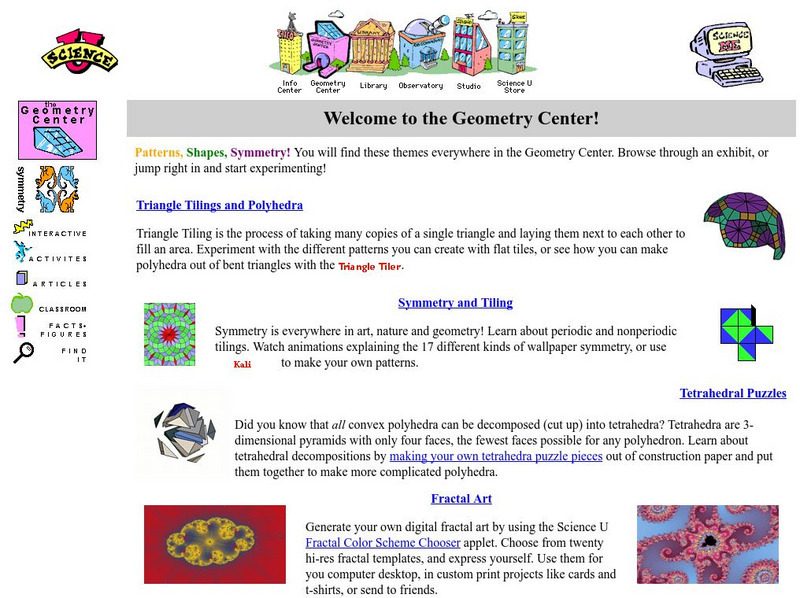
Science U: Welcome to the Geometry Center!
Site provides information and activities on various aspects of geometry, from shapes to patters and symmetry. Make your own tetra puzzle or build an icosahedron in the classroom. Interactive and fun.
ABCya
Ab Cya: Shapes: Geometry Game
Shapes is a fun educational activity to help children learn basic properties of simple geometric figures. Children will practice looking for differences and similarities between shapes to complete puzzles. Shapes! gets progressively more...

University of Cambridge
University of Cambridge: Maths and Sports: National Flags
During the Olympic and Paralympic Games many national flags will be on display. This activity explores 2D shapes, angles and symmetries in the context of flag designs, and is designed to be accessible to primary pupils at Key Stage 2.

National Council of Teachers of Mathematics
The Math Forum: Line Symmetry
This site from The Math Forum is a great site if you are looking for activities to engage your students in learning about line symmetry. Peruse this collection of activities for one or two or four that would be right for your students....
PBS
Pbs Mathline Lesson: Geometry, It's a Perfect Fit [Pdf]
This two-part geometry lesson plan has students identify, describe, and classify two-dimensional shapes. Students engage in hands-on activities including identifying shapes in the classroom, creating patterns with shapes, identifying...

Khan Academy
Khan Academy: Symmetry of 2 D Shapes
Analyze various shapes according to their reflective and rotational symmetries. Students receive immediate feedback and have the opportunity to try questions repeatedly, watch a video or receive hints.
CK-12 Foundation
Ck 12: Elem Math: Identify and Count the Lines of Symmetry in Various Shapes
[Free Registration/Login may be required to access all resource tools.] Students watch a video and take an assessment on identifying and counting lines of symmetry in various shapes.
Mathigon
Mathigon: Geometry: Symmetry Groups
This lesson focuses on symmetry groups; some shapes have more than one symmetry. You can add two symmetries to form a new one. It provides examples and practice exercises including a "symmetry calculator."
CK-12 Foundation
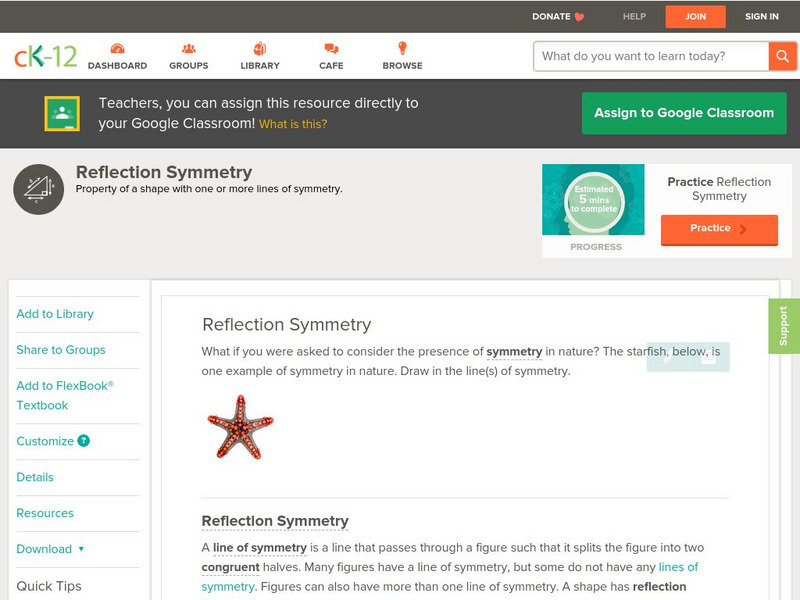
Ck 12: Geometry: Reflection Symmetry
[Free Registration/Login may be required to access all resource tools.] This concept teaches students how to determine whether or not a shape has reflection symmetry and how to draw lines of symmetry.
CK-12 Foundation
Ck 12: Geometry: Symmetry and Tessellations Study Guide
[Free Registration/Login may be required to access all resource tools.] Provides a brief overview of the different types of symmetry and of how to tessellate a shape.

CK-12 Foundation
Ck 12: Elem Math: Determining Whether Given Shapes Are Rotationally Symmetrical
[Free Registration/Login may be required to access all resource tools.] Students watch a video to determine if given shapes have rotational symmetry and then take an assessment to test their skills.
Other
The Math Learning Center: Pattern Shapes
Students use pattern shapes to explore geometry and fractions, creating their own designs, or filling in outlines. As they work with the shapes students explore geometric relationships, think about angles, investigate symmetry, and...
Oswego City School District
Regents Exam Prep Center: Intuitive Symmetry: Point, Line, Plane, Rotational
Investigate the concept of symmetry at this test prep site. See detailed definitions and picture examples, answer the questions in the interactive practice pages, and do the classroom activity where students use a digital camera to...
National Council of Teachers of Mathematics
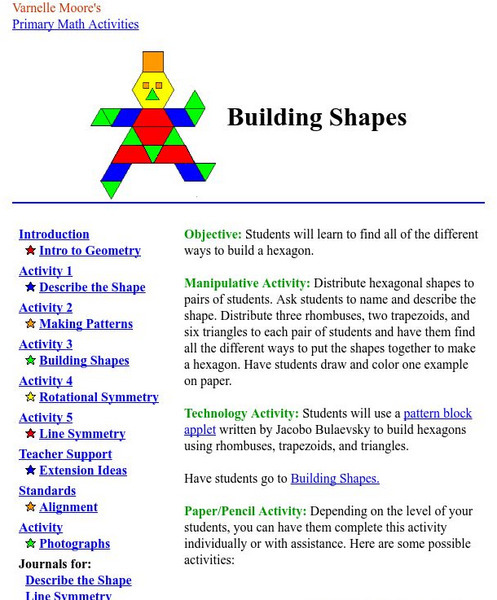
The Math Forum: Building Shapes
Based on building a hexagon, this activity from the Math Forum collection focuses on using different combinations of pattern blocks to create a hexagon. An online activity, pencil and paper method, literature connections, and a...

ClassFlow
Class Flow: Classifying Shapes
[Free Registration/Login Required] With this flipchart students will learn how to classify two-dimensional shapes and discuss the attributes of polygons.

US Department of Education
Helping Your Child Learn Math: Math in the Home
An excellent compilation of activities that engage parents and children in math explorations at home. Detailed lessons covering a wide range of math topics such as fractions, measurements, money, data collection, and math in newspapers....
National Council of Teachers of Mathematics
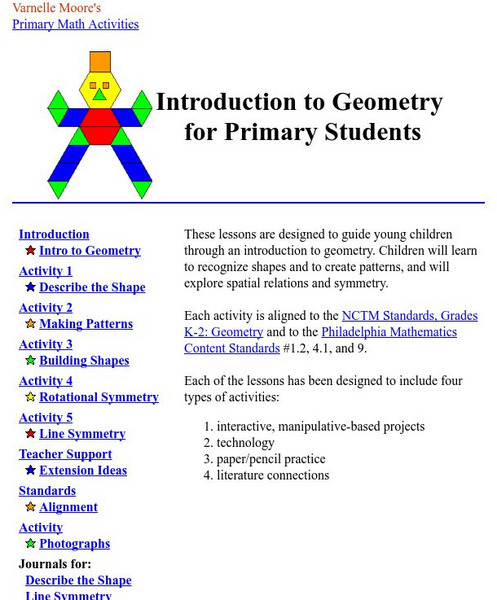
The Math Forum: Geometry: Introduction for Primary Students
These lessons are designed to guide young children through an introduction to geometry. Children learn to recognize shapes and to create patterns, and explore spatial relations and symmetry. Each activity is aligned to mandated standards.
National Council of Teachers of Mathematics
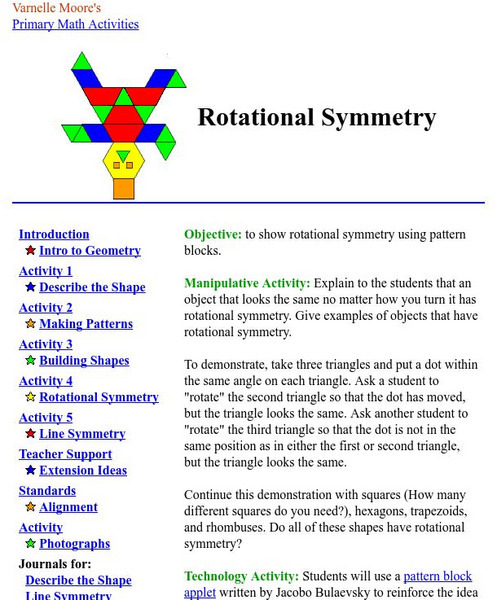
The Math Forum: Rotational Symmetry
This is a good site for elementary teachers to help educate students about symmetry by using pattern blocks. This link has multiple activities that the instructor could use including technological and standard activities.