Hi, what do you want to do?





![Center for Civic Education: Ronald Reagan and Executive Power [Pdf] Lesson Plan](https://static.lp.lexp.cloud/images/attachment_defaults/resource/large/FPO-knovation.png "Center for Civic Education: Ronald Reagan and Executive Power [Pdf] Lesson Plan")
Center For Civic Education
Center for Civic Education: Ronald Reagan and Executive Power [Pdf]
"Ronald Reagan and Executive Power" examines the use of presidential powers by Ronald Reagan, the fortieth president of the United States. It explores Article II of the Constitution, which grants the president executive powers.
Center For Civic Education
Center for Civic Education: Ronald Reagan and Executive Power
This site is a comprehensive examination of Ronald Reagan's administration and how he used his executive powers. It looks at his policies and his ongoing legacy. Includes videos, historical context, and lesson plans from elementary up.
Center For Civic Education
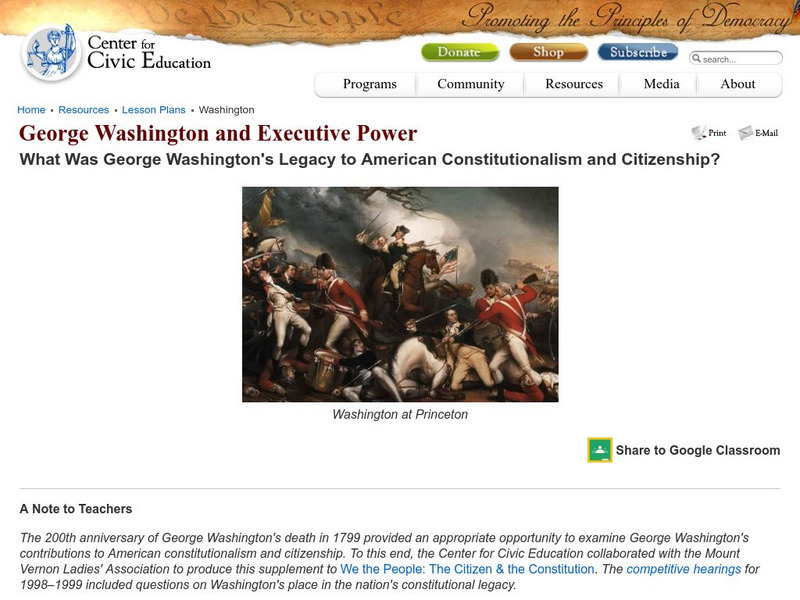
Center for Civic Education: George Washington and Executive Power
This lesson looks at the legacy of George Washington, perhaps the most influential leader in the creation of the American nation. Through his achievements as commander-in-chief during the Revolution, in support of the drafting and...
Center For Civic Education
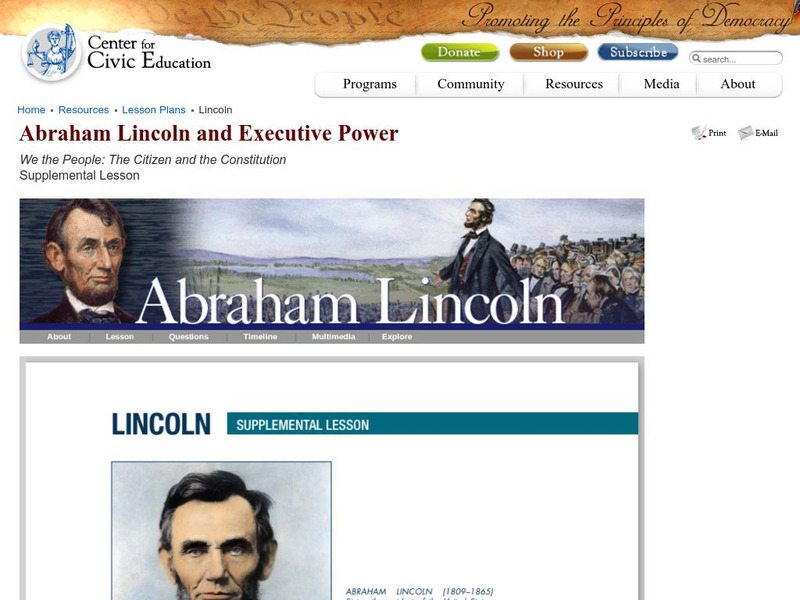
Center for Civic Education: Abraham Lincoln and Executive Power
This lesson traces the rise of Abraham Lincoln from his humble beginnings to the presidency of the United States. You will examine Lincoln's ideas and decisions regarding slavery and the use of the presidential power to preserve the...

Cato Institute
Executive Orders and National Emergencies
The subtitle of this essay is "How Presidents Have Come to 'Run the Country' by Usurping Legislative Power." It discusses how the Constitution defines executive powers in a general way, with few limitations on the power of the President...
Center For Civic Education
Center for Civic Education: James Madison and Executive Power
This lesson examines the legacy of the "philosopher statesman," James Madison. Madison combined the intellectual knowledge and creativity of the scholar with the practical savvy of the politician, a man of strong principles who also...
iCivics
I Civics: Games: Executive Command
Have you ever thought about being president? Executive Command gives you four years in office to accomplish your legislative and policy goals. You'll make a state-of-the-union address, work with your aides and cabinet, try your hand at...
C-SPAN
C Span Classroom: Teaching About Gridlock
Learning module and lesson plan with C-SPAN video resources and related articles for students to examine and deliberate on whether or not the President should exercise executive powers during times of Congressional gridlock.

TED Talks
Ted: Ted Ed: How Do Executive Orders Work?
The framers of the American Constitution made the executive power available to the executive branch. But what exactly is this tool, how does it work, and what's the extent of its power? Christina Greer explains.
Center For Civic Education
Center for Civic Education: George Washington and Executive Power
George Washington had a role in establishing our nation from the Revolutionary War through his presidency. He was a commander, a delegate to the Constitutional Convention, and a reluctant first President. Analyze his political...
Center For Civic Education
Center for Civic Education: James Madison and Executive Power
James Madison has been called the "Father of the Constitution". His ideas have shaped the role of our government, the role of political parties, the Bill of Rights and more. This activity offers extensive background, critical thinking...
Center For Civic Education
Center for Civic Education: Abraham Lincoln and Executive Power
Explore the life of Abraham Lincoln from his childhood through his presidency. This module includes extensive background, review questions, critical thinking questions, a timeline, and links to resources and primary sources.
Thomson Reuters
Find Law: Article Ii: The Creation of the Presidency
A scholarly discussion of Article II of the U.S. Constitution, which establishes the executive branch of the U.S. government. Discusses the origin of the article and the debates on executive power that took place among the Founding...
Other
Mount Vernon Ladies' Association: 5 Issues at the Constitutional Convention
There were 5 main issues that the delegates to the Constitutional Convention argued and debated: Slavery, Representation, State v. Federal Powers, Commerce, and Executive Powers. Analyze these issues by reading the following summaries,...
The White House
The White House: The Executive Branch
Learn about the executive branch of the federal government, how it is organized, and the powers and responsibilities of the President, Vice President, the Executive Office of the President, and the departments within the Cabinet.
iCivics
I Civics: Executive Branch
Students will learn about the executive branch, including the unique role and powers of the president and the function of executive departments and agencies. They will explore key facets of foreign policy and the president's role in it....
iCivics
I Civics: Mini Lesson: Executive Orders
Students discover how presidents use executive orders to wield power and how the legislative and judicial branches support and challenge these measures.

Khan Academy
Khan Academy: Roles and Powers of the President: Advanced
This resource from Khan Academy provides advanced-level practice questions over roles and powers of the president. These questions are intended for students taking high school or college level American Government and Civics courses,...

Khan Academy
Khan Academy: Roles and Powers of the President: Foundational
This resource from Khan Academy provides foundational practice questions the roles and powers of the president. These questions are intended for students taking high school or college level American Government and Civics courses,...

Khan Academy
Khan Academy: Expansion of Presidential Power: Foundational
This resource from Khan Academy provides foundational-level practice questions over the expansion of presidential power. These questions are intended for students taking high school or college level American Government and Civics...
US National Archives
National Archives: Lesson Plans Congress, the President, and the War Powers
Examine the power of Congress to make war by studying primary source documents from various wars throughout U.S. history. Students will analyze how the balance of authority between the legislative branch and executive branch has changed...
University of Missouri
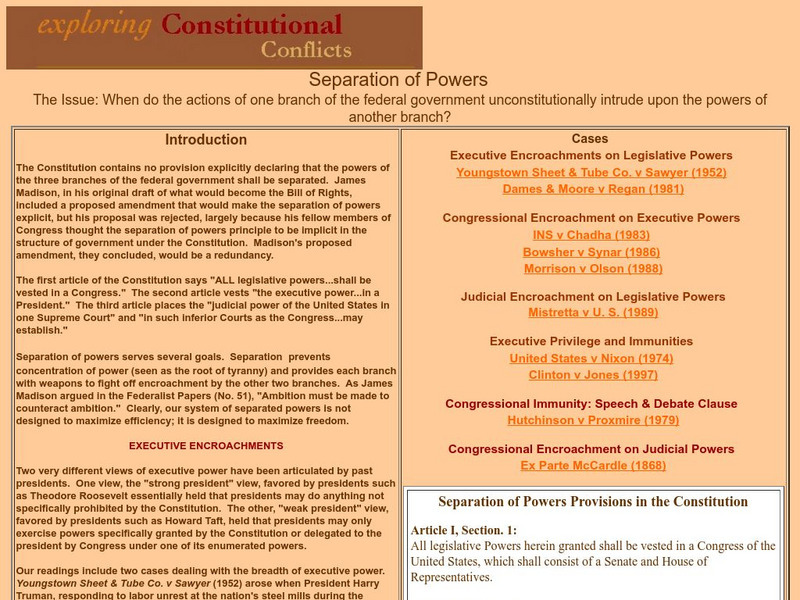
Exploring Constitutional Conflicts: Separation of Powers
When do the actions of one branch of the federal government unconstitutionally intrude upon the powers of another branch? This article surveys the history of this question in historic Supreme Court cases.
This Nation
This nation.com: Executive Order 13132 of August 4, 1999
This Executive Order signed by President Bill Clinton on 8/4/99 is an order that describes the balance between state and federal governments, as warranted by the Framers of the Constitution and federalism.
Constitutional Rights Foundation
Constitutional Rights Foundation: Executive Branch: A Hero Betrayed: The Presidency of Ulysses S. Grant
Lesson with activity on the Executive Branch, distribution of power, scandal and the presidency of Ulysses S. Grant. Includes questions for discussion and class activity. Links to supplemental material.