Hi, what do you want to do?






Robert Schenk, PhD
Cyber Economics: Monopolistic Competition
E-learning site uses an example of "pushcarts on the beach" to demonstrate a monopolistically competitive market structure and how, as more firms enter the market, price, quantity, and deadweight loss are all affected.

Annenberg Foundation
Annenberg Learner: Economics U$a: 21st Century Edition
A micro and macroeconomics course for 21st century learners. 28 half-hour videos sessions with text and guides regarding markets, firms, supply and demand, perfect competition and inelastic demand, economic efficiency, monopolies,...

Other
Foundation for Teaching Economics: Homepage
The Foundation for Teaching Economics is committed to excellence in economic education. The Foundation offers free workshops for high school educators and students. This site includes workshop dates, locations, and registration...
Other
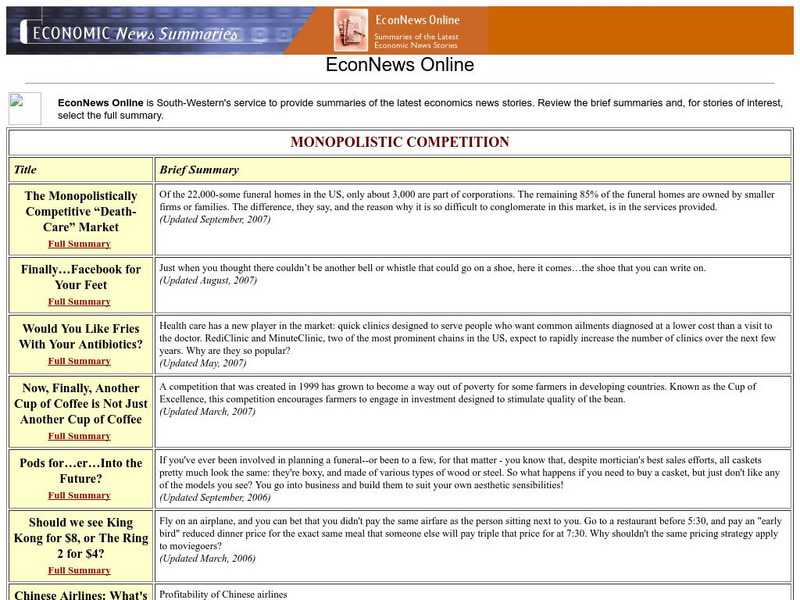
South Western Learning: Econ News: Monopolistic Competition
A wide variety of newspaper headlines are provided on the subject of economics and monopolistic competition. Each story comes with its own discussion questions.
Council for Economic Education
Econ Ed Link: The Economics of Professional Sports: Underpaid Millionaires?
Over the last century, professional baseball has grown to become one of the most popular forms of American entertainment. Indeed, the sport's nickname - "America's Pastime" - has become embedded in the nation's lexicon. More than 60...
Other
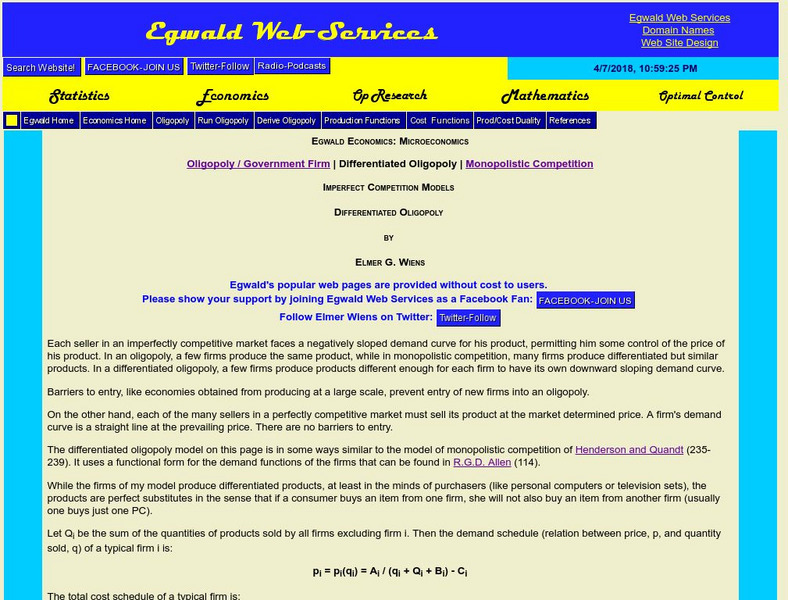
Egwald Web Services: Imperfect Competition Models: Differentiated Oligopoly
This site provides an in-depth study of a "differentiated oligopoly," and uses supporting graphs. For the advanced economics student.

Khan Academy
Khan Academy: Efficiency in Perfectly Competitive Markets
Why are perfectly competitive markets efficient?

Khan Academy
Khan Academy: Perfect Competition Foundational Concepts
Practice what you have learned about the foundational ideas behind perfectly competitive markets, including the characteristics of a perfectly competitive market, profit-maximization, and graphs of perfectly competitive firms.

Khan Academy
Khan Academy: Perfect Competition and Why It Matters
Read about the economic ideal of perfect competition.
Other
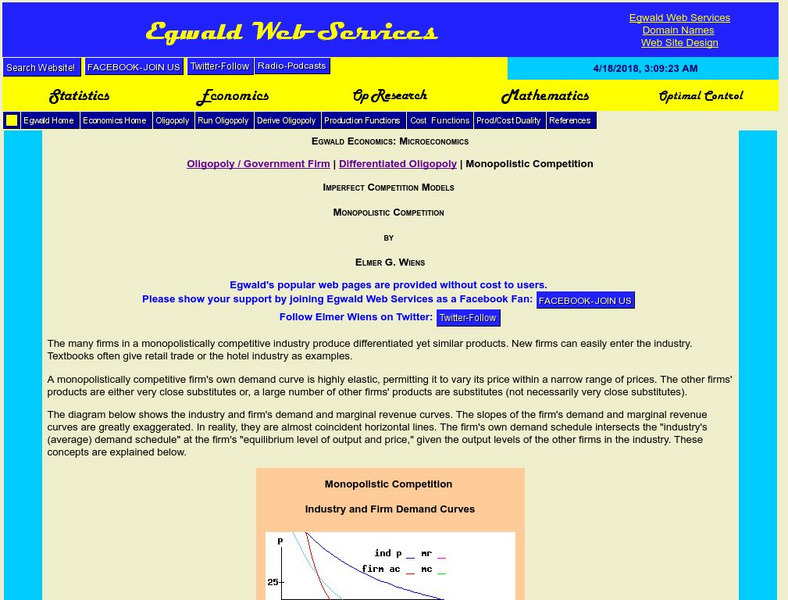
Egwald Web Services: Imperfect Competition Models: Monopolistic Competition
This site provides an in-depth examination of monopolistic competition, along with appropriate levels of output, price, and corresponding profits. This site is for the advanced student of economics.
Other
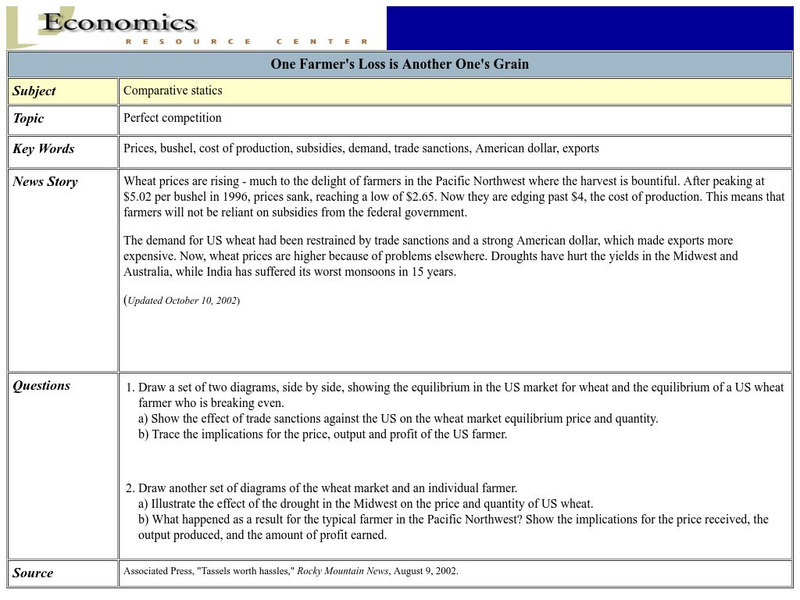
South Western Learning: Econ News: Comparative Statics: Perfect Competition
This site offers economics-based newspaper headlines and asks follow-up questions based on supply and demand in a perfectly competitive market.
Other
South Western Learning: Econ News: Perfect Competition
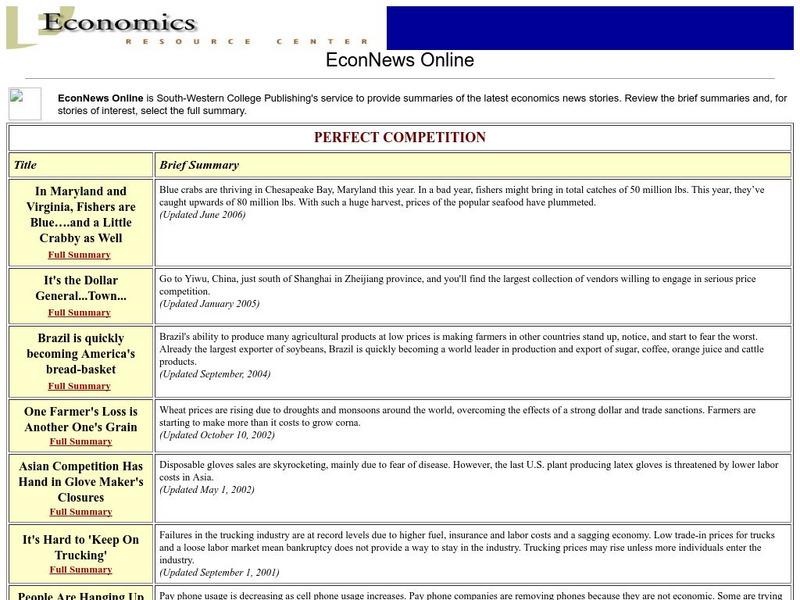
This site offers a variety of economics-related newspaper headlines in perfectly competitive markets, and each headline offers discussion questions related to that topic.

Other
Elemental Economics: Review of Basic Definitions: Competition
This site provides a good description of the four types of market structures: perfect competition, monopolistic competition, oligopoly, and monopoly, along with the major characteristics of each.
University of North Carolina
University of North Carolina: Perfect Competition
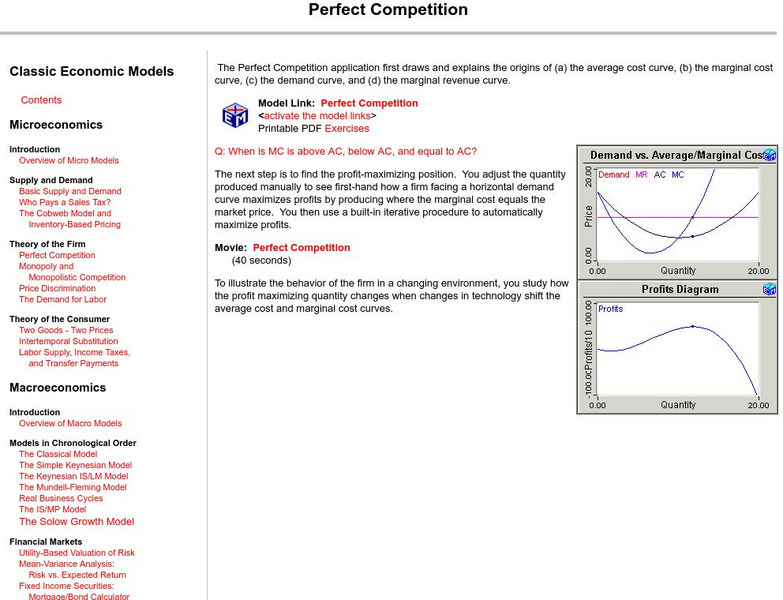
This site shows cost curves for a firm in a perfectly competitive market, and has an interactive graph to show what their profit margin is at various levels of production.
Other
Online Texts: Monopolistic Competition: Demand Change
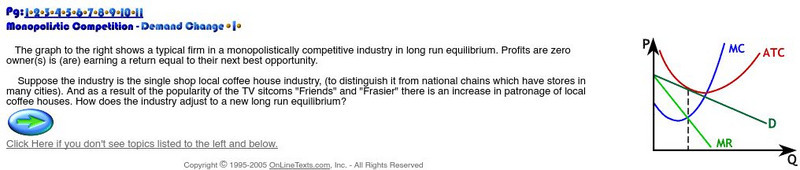
This site uses graphs to show how changes in demand would change a firm's output, price, and profits or losses in a monopolistically competitive market structure.
Council for Economic Education
Econ Ed Link: Bringing the Market to the Farm
This printable lesson discusses producers and consumers from an agricultural perspective. It focuses on choices that the consumer has with regard to purchasing agricultural goods (e.g. fruits and vegetables). As an example, it uses...
Digital History
Digital History: Foreign Competition
This site describes how by the 1970s, foreign manufacturers were embedded in the U.S. markets. For the U.S., this meant a loss of sales, a loss of jobs, and a loss of economic confidence.
Council for Economic Education
Econ Ed Link:i Don't Want Much, Just Want More: Allocation
This student version of an economics lesson plan focuses on allocation. For a lesson about how the rule of force motivates, check out this informative website.
Tutor2u
Tutor2u: Perfect Competition Introduction
This website describes the conditions of a "perfectly competitive" market structure, and the obstacles that the individual firm in this market will face.
Schools of California Online Resources for Education
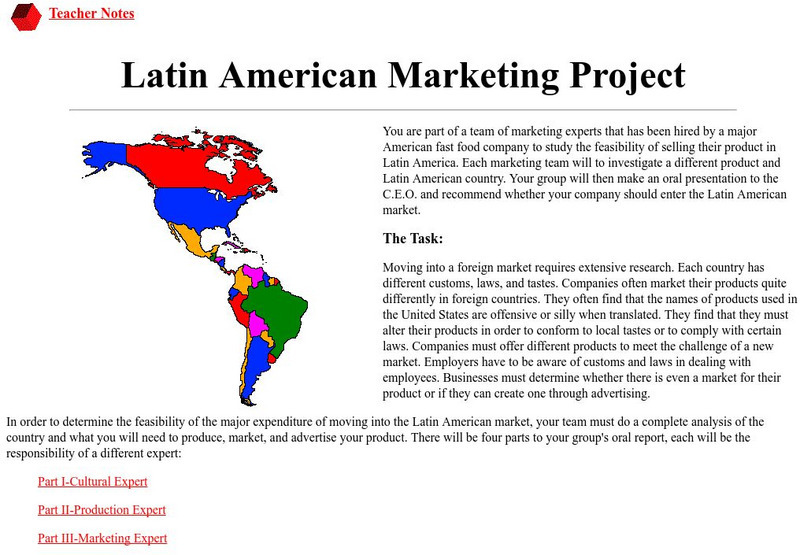
Score: Latin American Marketing Project
This site from Score provides information on the global marketplace. This is a unit where students are grouped to find out the best Latin American country to introduce a new fast food business. Site is very well outlined and includes...
Council for Economic Education
Econ Ed Link: Believe It or Not?
This lesson reveals to students how advertisers use words and images to make goods and services look their best. To protect consumers and make sure that competition among sellers is fair in the marketplace, the federal government...
Council for Economic Education
Econ Ed Link: Chevy Volt It's Electric!
The costs and benefits of owning an electric or hybrid car will be evaluated in this lesson plan. By reading and researching the history of the production of electric cars, the lesson plan allows students to understand how this market...
Council for Economic Education
Econ Ed Link: History of Monopolies in the United States
Monopolies in the United States have existed in many forms. When a business dominates a market, its market power makes it a monopoly. How these businesses use their market power will determine the legality of the monopoly.
Council for Economic Education
Econ Ed Link: What Happened to Railroads?
Between the Civil War and World War II, railroads were one of the nation's most important businesses and an integral part of people's lives. In this lesson, students assume the role of detectives investigating why the rail companies...