Hi, what do you want to do?






Physics Classroom
The Physics Classroom: Sound Waves & Music: Reflection, Refraction, Diffraction
In this illustrated physics tutorial, students learn about sound wave behaviors and apply them to the reflection, diffraction, and refraction of sound waves.
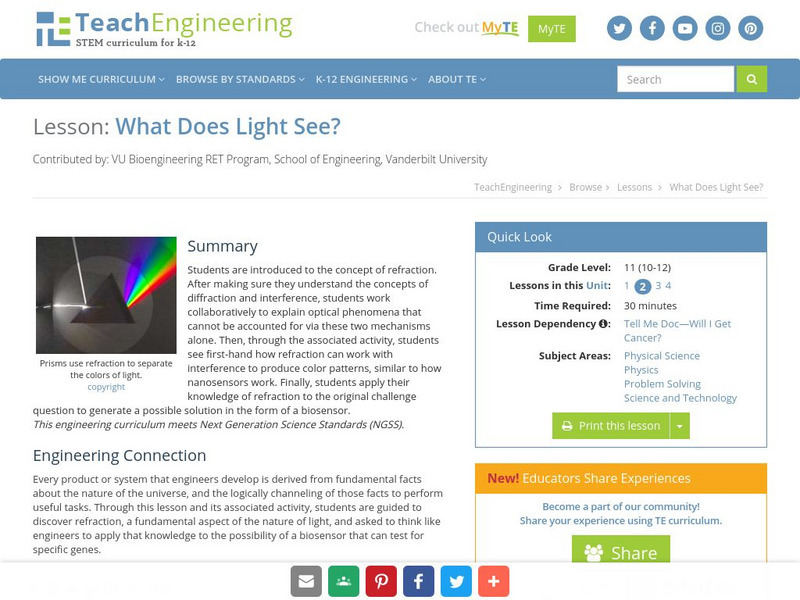
TeachEngineering
Teach Engineering: What Does Light See?
Students are introduced to the concept of refraction. After making sure they understand the concepts of diffraction and interference, students work collaboratively to explain optical phenomena that cannot be accounted for via these two...
Physics Classroom
The Physics Classroom: Light Waves and Color
The behavior of light waves is introduced and discussed. Also, polarization, color, diffraction, and interference are introduced and discussed thoroughly as supporting evidence of the wave nature of light.
Georgia Department of Education
Ga Virtual Learning: Physical Science: Light and Optics
Students will investigate the properties of light waves. They will learn about the different types of electromagnetic waves and mechanical waves, and investigate the phenomena of reflection, refraction, interference, and diffraction.
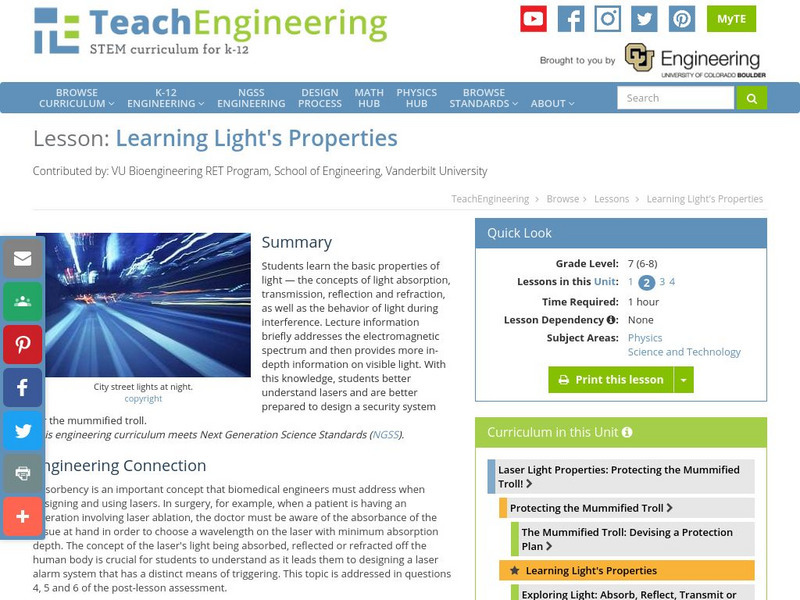
TeachEngineering
Teach Engineering: Learning Light's Properties
Students learn the basic properties of light--the concepts of light absorption, transmission, reflection and refraction, as well as the behavior of light during interference. Lecture information briefly addresses the electromagnetic...
Physics Classroom
The Physics Classroom: Refraction/ray Model of Light: Light Dispersion Prisms
A tutorial which introduces students to the dispersion of light in more detail, and investigates the reasons why different frequencies of light bend or refract different amounts when passing through the prism.

BBC
Bbc: Gcse Bitesize: Why Do Scientists Think That Light and Sound Are Waves?
Light travels as transverse waves and can travel through a vacuum. Sound travels as longitudinal waves and needs to travel through a solid, liquid or gas. Read about the properties of light and of sound, and learn the differences between...
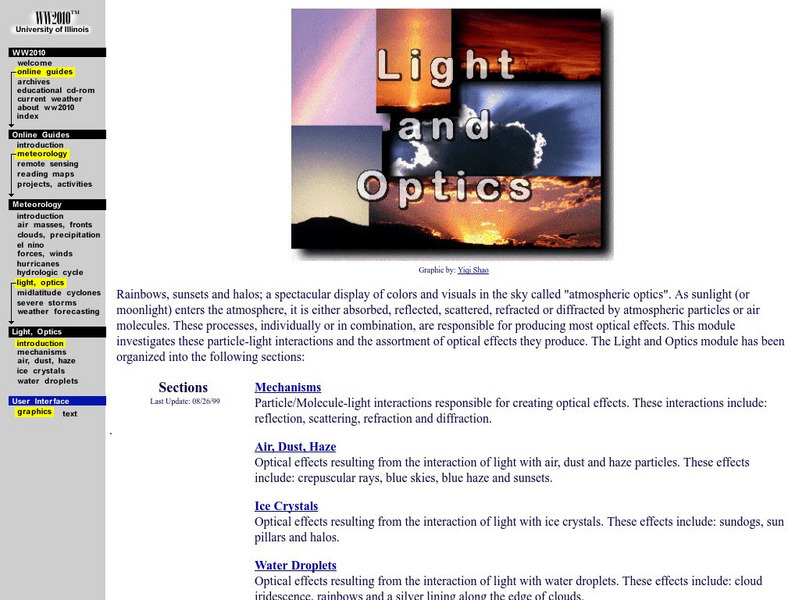
University of Illinois
University of Illinois Urbana Champaign: Light and Optics
Rainbows and sunsets are called "atmospheric optics". They can be caused by light being absorbed, reflected, scattered, refracted, or diffracted by particles in the atmosphere. Learn all about different atmospheric optics along with...
Cosmo Learning
Cosmo Learning: Physics Iii: Vibrations and Waves
A collection of video lectures from a physics course focusing on vibration and waves taught at the Massachusetts Institute of Technology. The course overviews topics dealing with mechanical vibration and waves with twenty-three lectures....
Physics Classroom
The Physics Classroom: Wavelike Behaviors of Light
How light waves demonstrate their wave nature by reflection, refraction, and diffraction.
Physics Classroom
The Physics Classroom: The Nature of a Wave
A very good introduction to the world of waves. Waves and wavelike motion, what is a wave, and categories of waves are the topics examined in this site. Many links to other wave sites.
Physics Classroom
The Physics Classroom: Light Waves and Color: Thin Film Interference
Students investigate an example of interference that provides further evidence in support of the wavelike behavior of light.
Physics Classroom
The Physics Classroom: Light Waves and Color: Wavelike Behaviors of Light
In this series of interactive physics tutorials, students will focus on the wavelike nature of light.

CK-12 Foundation
Ck 12: Wave Properties
[Free Registration/Login may be required to access all resource tools.] Students investigate behaviors of waves, including interference, reflection, refraction, and diffraction.
Walter Fendt
Walter Fendt: Apps Zur Physik
This site, in German, offers numerous apps that illustrate common physics principles. Apps are organized into categories: mechanics, oscillations and waves, electrodynamics, optics, thermodynamics, the theory of relativity, physics of...
Other
Siemens Science Day: Physical Science: Through the Looking Glass
Students will make their own spectroscope, learn how light is bent by a diffraction grating, and explore how various forms of light differ.

Vision Learning
Visionlearning: Physics: Light I: Particle or Wave
Instructional module focusing on light. Discussion includes historical development of particle versus wave theories and the scientific studies leading to the understanding of light waves today. Site also includes an interactive practice...
BBC
Bbc: Gcse Bitesize: General Properties of Waves
Light travels as waves. Waves can be described by their amplitude, wavelength and frequency. The speed of a wave can be calculated from its frequency and wavelength.

Georgia State University
Georgia State University: Hyper Physics: Sound Propagation
This page and the many pages which are indexed to focus on the behaviors of sound which characterize it as a wave. Reflection, refraction, interference, diffraction and more are clearly illustrated and explained.

Ducksters
Ducksters: Physics for Kids: Wave Behavior
Kids learn about the behavior of waves in the science of physics including reflection, refraction, diffraction, polarization, absorption, and interference.
Other
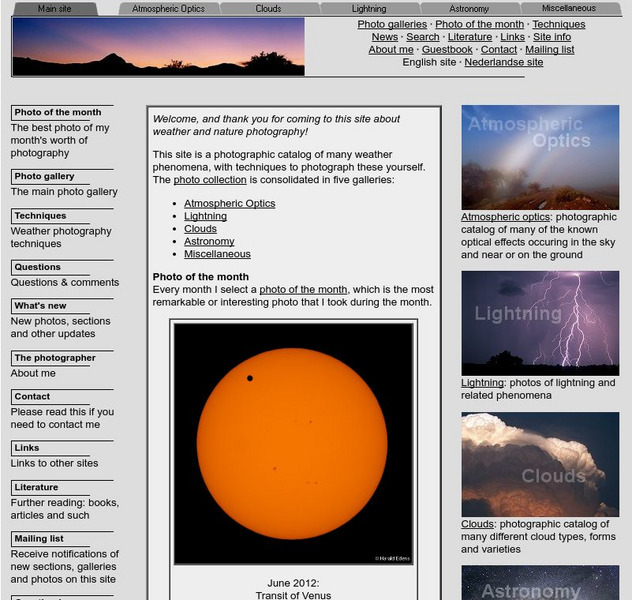
Weather Photography
Source of information on the subject of weather photography. There are great links, images and tips on equipment to use. For the intermediate to advanced photographer.
Pennsylvania State University
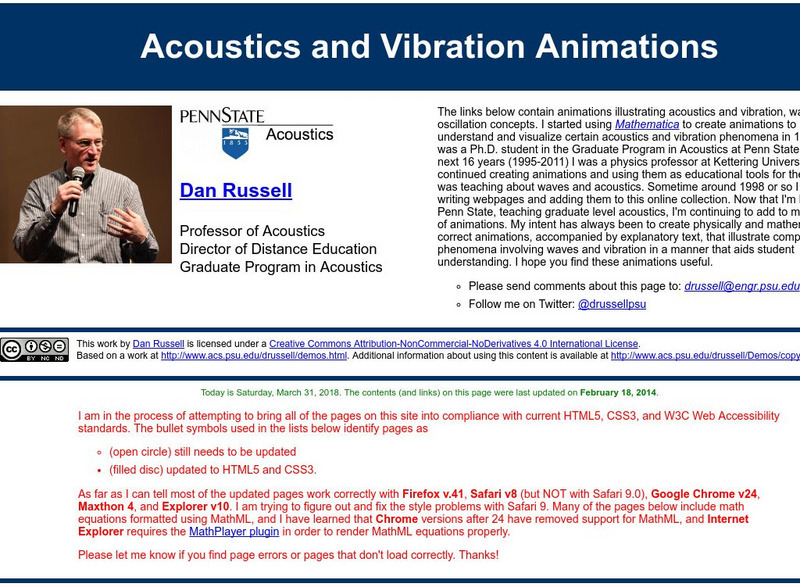
Kettering University: Vibration & Waves
A short tutorial providing general information about waves, their categories, properties and behaviors. Includes several animations and some practice questions with answers.
Wikimedia
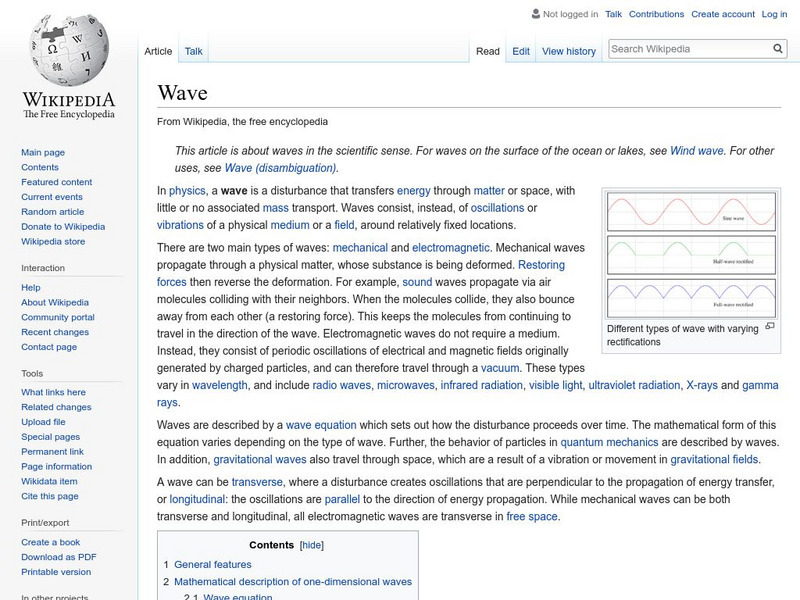
Wikipedia: Wave
An in-depth encyclopedia article from Wikipedia on waves gives a definition for what a wave is. Other content in the article includes a list of examples and characteristics of waves, information about the difference between transverse...
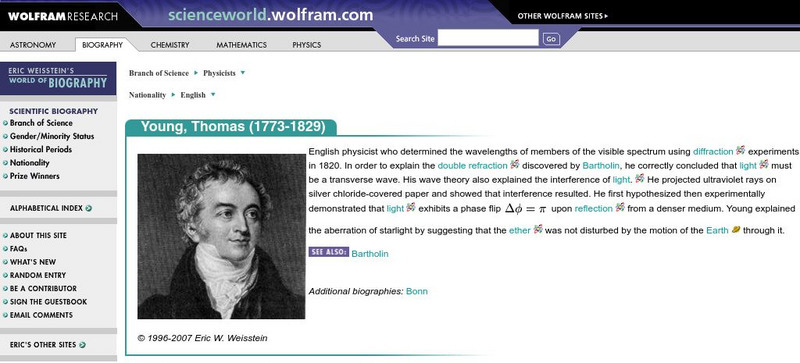
Wolfram Research
Wolfram Science World: Young, Thomas
This site from ScienceWorld provides a very short but factual biographical sketch of Thomas Young (1773-1829 CE) and describes his most notable scientific discoveries and contributions. Links are also provided throughout for additional...