Hi, what do you want to do?





DOGO Media
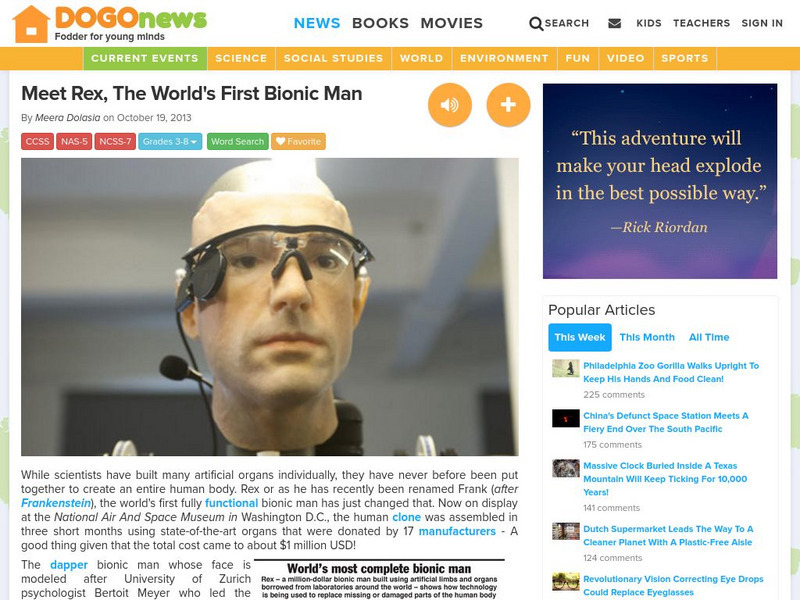
Dogo News: Week of 10 21 13: Meet Rex, the World's First Bionic Man
Article introduces readers to the world's first bionic man, a robot named Rex with approximately 60% - 70% of the functionality of a real human. Includes two brief videos.

Discovery Education
Discovery Education: The Real Bionic Man
Lesson plans for a classroom investigation into the field of bionics, with discussion suggestions and links to sites on bionics.

PBS
Pbs: Scientific American Frontiers: Artificial Alan
Provides an update on the primary areas of research in bioengineering and bionics: eyes, ears, liver, hands, skin, blood, cartilage, and tendons.

National Academy of Engineering
Greatest Engineering Achievements of the 20th Century: Health Technologies
Learners investigate health technologies in the 20th century. Some topics examined are the heart, bionics, and bioengineering. The resource consists of historical information, a timeline, and a personal essay by a key innovator.
Other
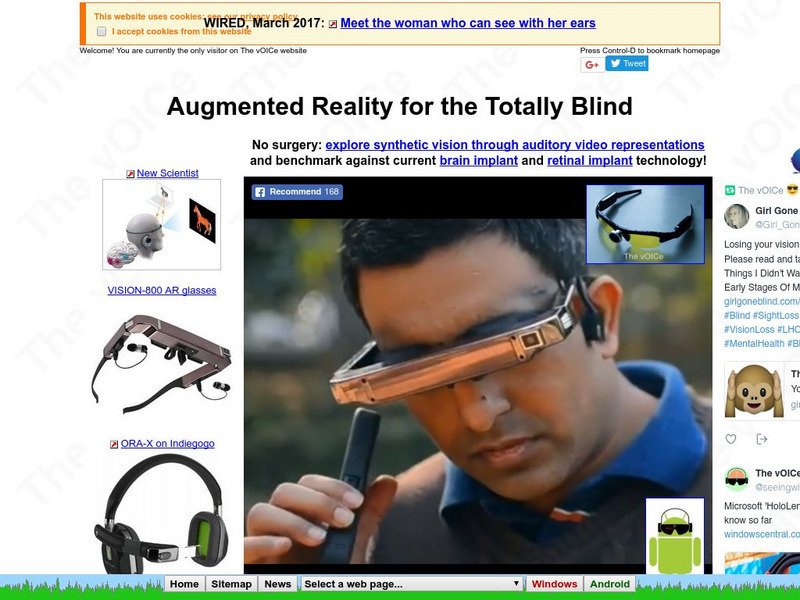
Vision Technology for the Totally Blind
An interesting application of wearable computing that is helping blind people "see". vOICe technology uses synthetic (bionic) vision through auditory video representations, combined with current brain implant and retinal implant...

PBS
Pbs: Scientific American: Uncovering a Signal
An activity in which students analyze simulated brain signals and attempt to determine which signals control which muscle activity, imitating the manner in which a computer attempts to decipher brain signals for use in bionics.
PBS
Pbs Teachers: Scientific American: Superhumans & Bionics: Electronic Eyes
Investigate scientists' use of models to understand more about an object, concept or relationship. Explore the difference between a healthy eye and an eye affected by macular degeneration by building two models.
PBS
Pbs Teachers: Scientific American: Superhumans & Bionics: Mind Over Machine
Investigate a unique project that uses brain waves to operate machines, and perform biofeedback experiments to control physiological processes. Control hiccups and regulate your body temperature with your mind.
PBS
Pbs Teachers: Scientific American: Superhumans and Bionics: A Heart of Titanium
Explore how to keep your heart healthy by exercising regularly, sticking to a low-fat diet and not smoking. Use mathematics to understand nutritional information about various foods.
![Biotechnology Institute: Your World: Plant Biotechnology [Pdf] Article](https://statictemp.lp.lexp.cloud/images/attachment_defaults/resource/large/FPO-knovation.png "Biotechnology Institute: Your World: Plant Biotechnology [Pdf] Article")
Biotechnology Institute
Biotechnology Institute: Your World: Plant Biotechnology [Pdf]
As humans try to reach the goal of growing enough food to feed all the people, find out how biotechnology is used to help.

PBS
Pbs: Scientific American Frontiers: Standing Tall
Experience FES or functional electrical stimulation, through the eyes of a patient who lives it. Learn how doctors gave a paralyzed patient control over her muscles.

PBS
Pbs: Scientific American: Coordinated Control Exercise
PBS's Scientific American series sponsors this learning exercise designed to simulate functional electrical stimulation (FES), a technology which allows the recovery of control of paralyzed muscles.

PBS
Pbs Teachers: Scientific American: Body Building: Modeling Breathing Action
Explore the use of Functional Electrical Stimulation (FES) as a breathing support strategy. Construct a working lung model that simulates the mechanics of breathing.

PBS
Pbs Teachers: Scientific American: Body Building: One Way Valves
Investigate biotechnology design by creating a model of a one-way valve from plastic tubing. Describe the mechanical action of the valve.

PBS
Pbs: Scientific American Frontiers: Searching for a Substitute
This article on the history and development of the artificial heart examines past attempts at artificial heart transplant and looks at future research and development.
Other popular searches
- Bionic Woman
- Bionic Arm
- Bionic Eye
- Bionic Man
- Bionic Body
- Bionic Trees
- Bionic Elements
- Bionic Elemwnts
- Bionic Hand
- Bionic Ear