Hi, what do you want to do?






Australian Museum
Structure and Composition of the Earth
What makes the Earth unique? What are the different parts of the Earth? What is the chemical make-up of the Earth? Get the answers to these questions and more on this site from the Australian Museum Online.

TED Talks
Ted: Ted Ed: A Guide to the Energy of the Earth
Energy is neither created nor destroyed - and yet the global demand for it continues to increase. But where does energy come from, and where does it go? This video examines the many ways in which energy cycles through our planet, from...
NOAA
Noaa: Structure of the Earth [Pdf]
Create a model to help learn the layers and structures within the Earth. Identify characteristics of each layer of the Earth.
Science Struck
Science Struck: The Layers of the Earth's Atmosphere
Find out about the five layers of the atmosphere in this resource which provides loads of information about the troposphere, stratosphere, mesosphere, thermosphere, and exosphere.

Read Works
Read Works: Passages: "The Rise of Oxygen in the Earth's Atmosphere"
[Free Registration/Login Required] The article "The Rise of Oxygen in the Earth's Atmosphere" from the American Museum of Natural History focuses on when the rise of oxygen in the earth's atmosphere began. A Step Read, a question set,...

Massachusetts Institute of Technology
Mit: Open Course Ware: Courses: Civil Environmental: Ecology I: The Earth System
College-level online course highlighting the fundamentals of ecology. Course topics include coevolution of the biosphere, geosphere, atmosphere, and hydrosphere; photosynthesis and respiration; and the carbon, nitrogen, and water cycles....
Vision Learning
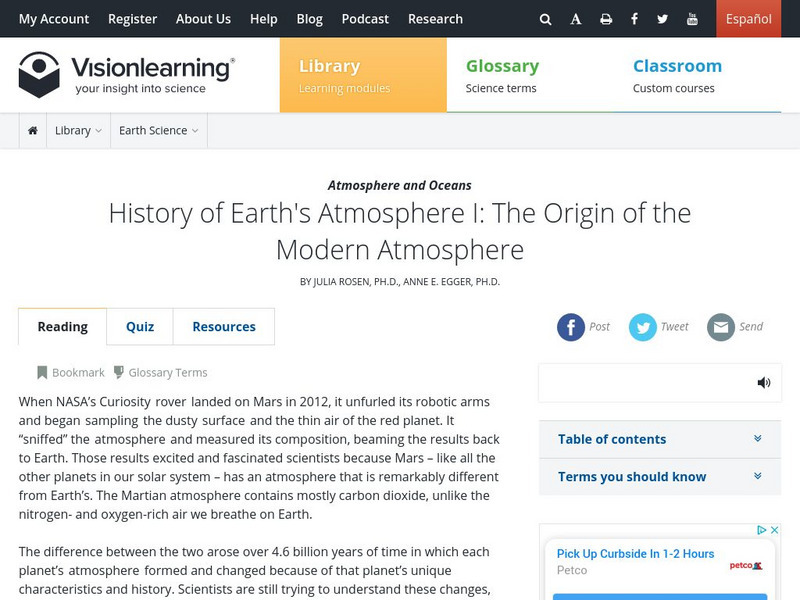
Visionlearning: Atmosphere and Oceans: The Origin of the Modern Atmosphere
An explanation of how the Earth's atmosphere has changed over time. Evidence that helped scientists understand these changes is presented.
University Corporation for Atmospheric Research
Ucar: Cycles of the Earth System: Make Convection Currents!
In this instructional activity, students will understand that temperature changes can cause density changes in water and in air.
Other
Moorland School: Earth Science Zone: The Origin of the Earth
A webpage reviewing the origin of the Earth. Learn what Earth was like during its first billion years with an atmosphere that contained no oxygen. Understand that oxygen levels built up once green plants became more abundant. At the end...
Simon Fraser University
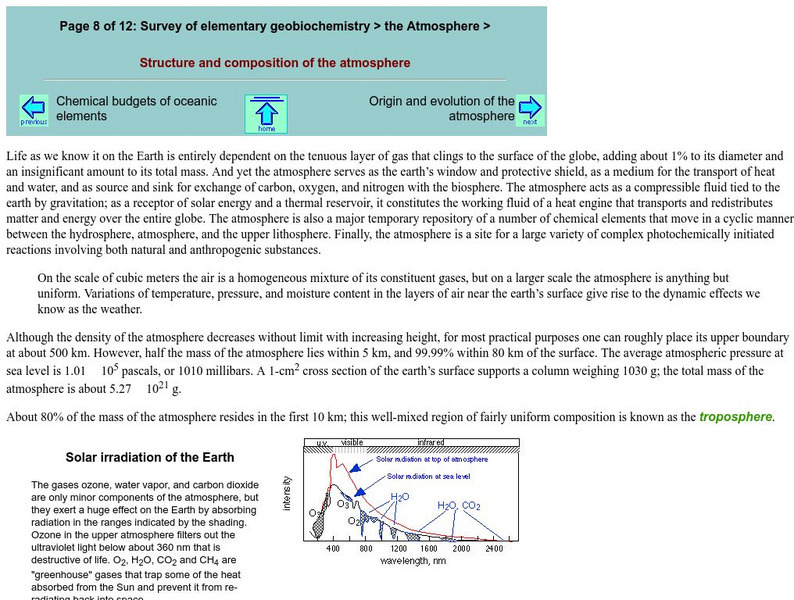
Chem1 Virtual Textbook: Structure and Composition of the Atmosphere
As part of the General Chemistry Virtual Textbook, this site examines a variety of topics related to Earth's atmosphere. Topics covered in the overview include structure of the atmosphere, composition of the atmosphere, energy balance of...

PBS
Skydive From the Stratosphere
This simulation allows you to experience Joe Kittinger's famous 1960 skydiving feat. As you ascend the troposphere and stratosphere you can view changes in several atmospheric conditions. The challenge will be surviving the leap once you...
NASA
Nasa: Mysteries of the Sun
Learn about the study of the Sun's influence on the solar system called Heliophysics. This site contains videos on topics like Space Weather, Solar Variability, the Heliosphere, Earth's Magnetosphere, and the Earth's Upper Atmosphere.
University of Wisconsin
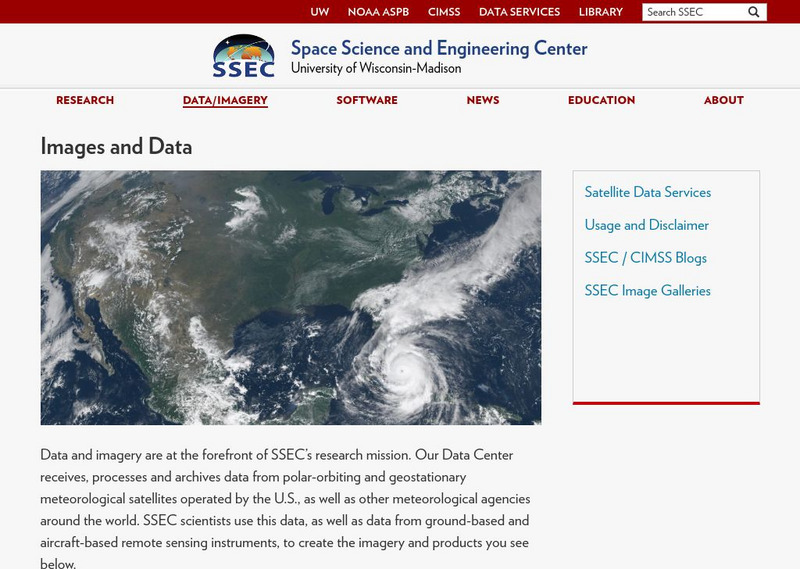
Ssec: Real Time Imagery and Data: Satellite Images of the Earth
Check out real-time satellite photos of the earth to study weather patterns.
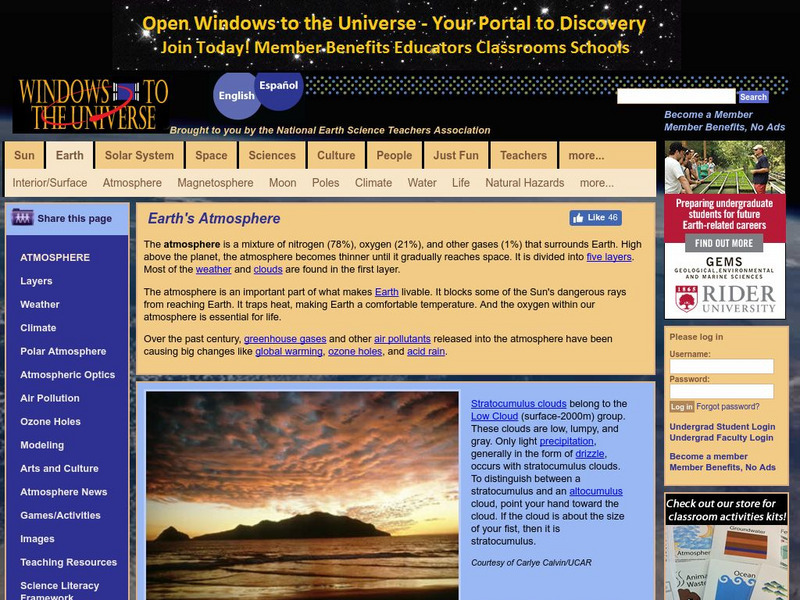
National Earth Science Teachers Association
Windows to the Universe: The Earth's Atmosphere
Windows to the Universe offers information on the Earth's atmosphere. The site contains links to a weather crossword puzzle and images.
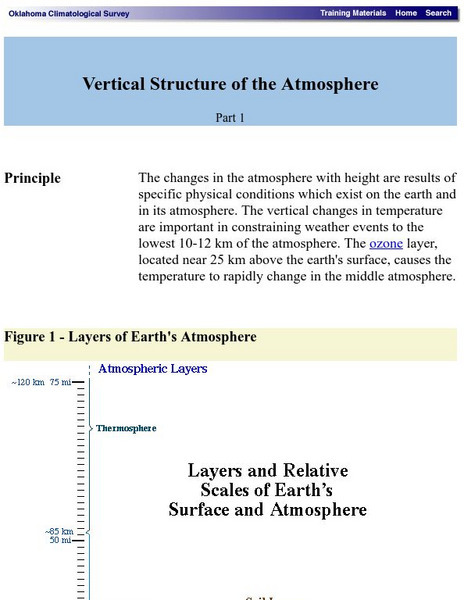
Oklahoma Mesonet
Oklahoma Climatological Survey: Vertical Structure of the Atmosphere
This two-part resource explores the vertical structure of Earth's atmosphere. Content details the atmospheric layers, and the relationship between pressure and height in the atmosphere.
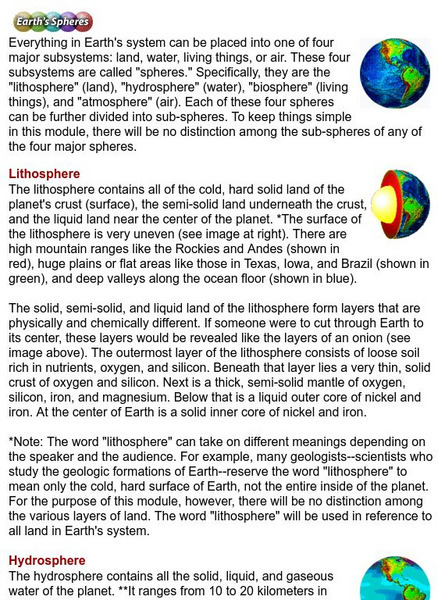
Center for Educational Technologies
Classroom of the Future: Earth Spheres
Everything in Earth's system can be placed into one of four major subsystems: land, water, living things, or air. These four subsystems are called "spheres." Specifically, they are the "lithosphere" (land), "hydrosphere" (water),...
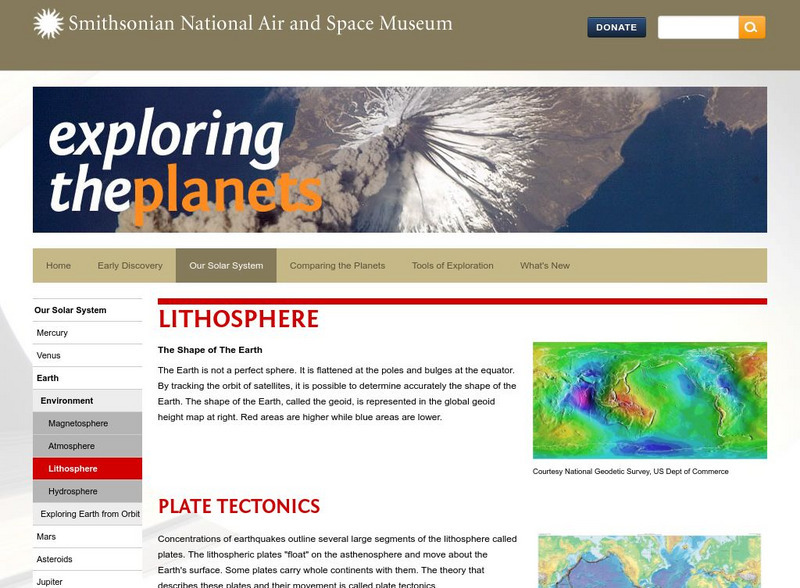
Smithsonian Institution
National Air and Space Museum: Exploring the Planets: Earth's Lithosphere
The plate tectonics and other features of the Earth's lithosphere are explained and illustrated. Has links to definitions of the magnetosphere, atmosphere, and hydrosphere.
California State University
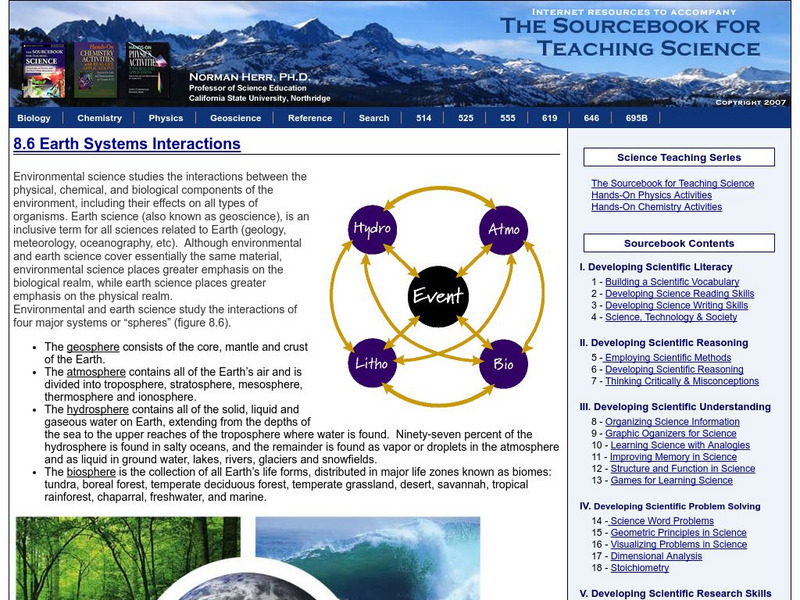
Csu: The Sourcebook for Teaching Science: Earth Systems Interactions
Explains what the four spheres of the Earth are and describes how volcanic eruptions affect the different spheres. Also provides a list of events that are examples of interactions.
Other
Interactions Between the Atmosphere & Hydrosphere [Pdf]
A discussion of the interactions between the four spheres of Earth and how they affect weather and climate. The slideshow is divided into two parts. The first deals with interactions between the atmosphere and the hydrosphere and the...
CK-12 Foundation
Ck 12: Earth Science: Importance of the Atmosphere Study Guide
Get the big-picture overview of the importance of Earth's atmosphere and the reactions that happen within it.
CK-12 Foundation
Ck 12: Earth Science: Composition of the Atmosphere Study Guide
This comprehensive study guide covers the main terms and concepts needed for an earth science unit on the composition of the atmosphere. Review questions are included at the bottom of the study guide.
CK-12 Foundation
Ck 12: Earth Science: Pressure and Density of the Atmosphere
[Free Registration/Login may be required to access all resource tools.] How the pressure and density of the atmosphere varies.
CK-12 Foundation
Ck 12: Earth Science: Pressure and Density of the Atmosphere
[Free Registration/Login may be required to access all resource tools.] How the pressure and density of the atmosphere varies.

Khan Academy
Khan Academy: Activity: Living in the Extremes of the Biosphere
In this activity, you'll describe what you think it might be like for humans to live in the extremes of the biosphere. Think about the challenges associated with living either underwater or in the upper atmosphere. Also, think about what...