Hi, what do you want to do?






Better Lesson
Better Lesson: Graphing January's Weather
First graders graph the weather in Vermont for the month of January.
Centers for Disease Control and Prevention
Centers for Disease Control: Shakespeare to Defoe: Malaria in England
Detailed analysis of the spread of malaria in England owing to changes in climate during the sixteenth and seventeenth centuries.
Center for Educational Technologies
Nasa Classroom of the Future: Earth on Fire
Information and activities looking at the impact of industrial and agricultural practices on global warming.

Other
University of East Anglia: Climatic Research Unit
This is a site from a university page of the University of East Anglia that is focused on climatic research. It offers links to information sheets, research areas, publications, and other climate links. Each of the information sheets...

NOAA
Noaa: National Climatic Data Center: Groundhog Day
Find background about Groundhog Day and the folklore involved. Look through the charts that show how closely Punxsutawney Phil's predicitions align with the actual weather.

Thinkport Education
Thinkport: Made Clear: How Are Humans Impacted by Extreme Weather?
The extremes in weather have an impact on businesses, communities, recreational activities and anything else that depends on the weather.

Scholastic
Scholastic: Study Jams! Science: Weather & Climate: Air Pressure and Wind
A video and a short multiple-choice quiz on the topic of air pressure and wind. It explains what makes air pressure change, how we measure it, how wind is created, and types of winds.

University of Illinois
University of Illinois Extension: Tree House Weather Kids: Seasons and Temperature: Greenhouse Effect
Animated resource helps young researchers understand what global warming and the greenhouse effect mean.
Woods Hole Oceanographic Institution
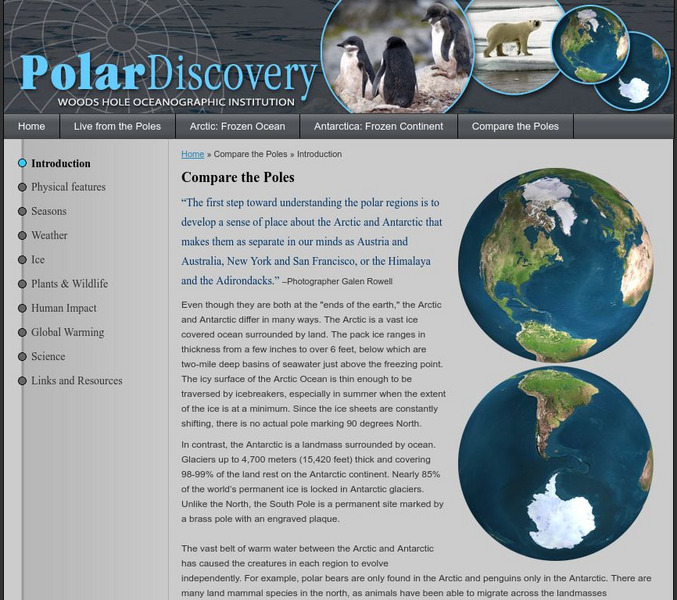
Polar Discovery: Compare the Poles
A detailed comparison of many aspects of the two polar regions. Includes physical features, seasons, weather, types of ice, plants and animals, human population, and climate change.
TeachEngineering
Teach Engineering: Distorted Disturbances
Students pass around and distort messages written on index cards to learn how we use signals from GPS occultations to study the atmosphere. The cards represent information sent from GPS satellites being distorted as they pass through...
The Environmental Literacy Council
Environmental Literacy Council: Temperature
The difference between heat and temperature is explained, followed by a discussion of temperature and its relation to global climate change. Gallileo Galilee, Daniel Gabriel Fahrenheit, Anders Celsius, and Carl Linnaeus are mentioned in...
University Corporation for Atmospheric Research
Ucar: Why the Polar Vortex Keeps Breaking Out of the Arctic
Why does the Polar Vortex keep breaking out of the Arctic? Surprisingly, warming global temperatures play a role.
Climate Literacy
Clean: Mauna Loa Co2 Collection Data
This data-intensive activity uses real world datasets to cover topics such as weather v. climate, air circulation around the globe, seasonal effects, and climate change.

Other
Geoscience Research Institute: The Little Ice Age
This very detailed article examines the long-term climate changes throughout the world. Discusses agriculture and provides graphs and illustrations. Includes lots of scientific discussion.
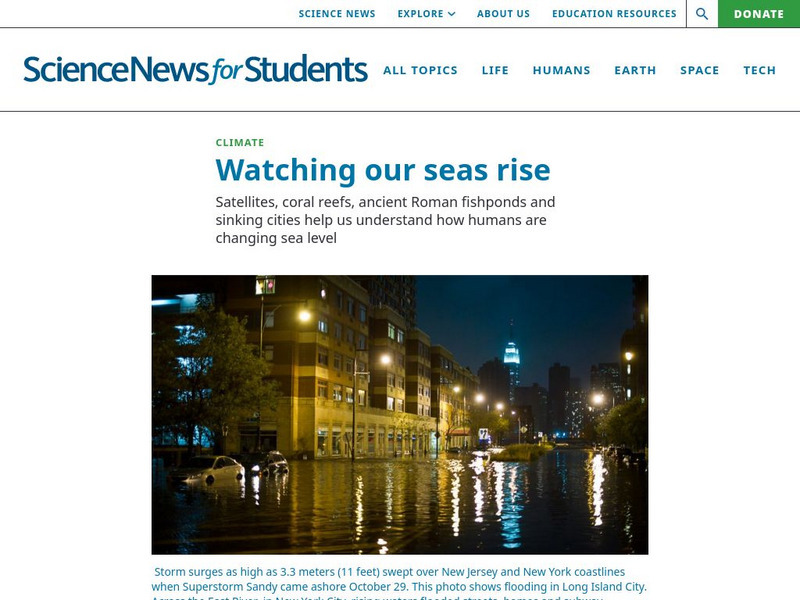
Society for Science and the Public
Science News for Students: Watching Our Seas Rise
Ocean levels are increasing around the world. Find out why this type of climate change has scientists concerned.

University Corporation for Atmospheric Research
Ucar: Bubbles on Bottles
Young scholars observe that a change in the temperature of air can impact the size of a bubble placed on a bottle that is cooled and/or heated.
University Corporation for Atmospheric Research
Ucar: Fact Sheet for El Nino
This site from the Univ. Corp. for Atmospheric Research provides detailed information on El Nino and its effects on the trade winds is offered at this site, with satellite photos.
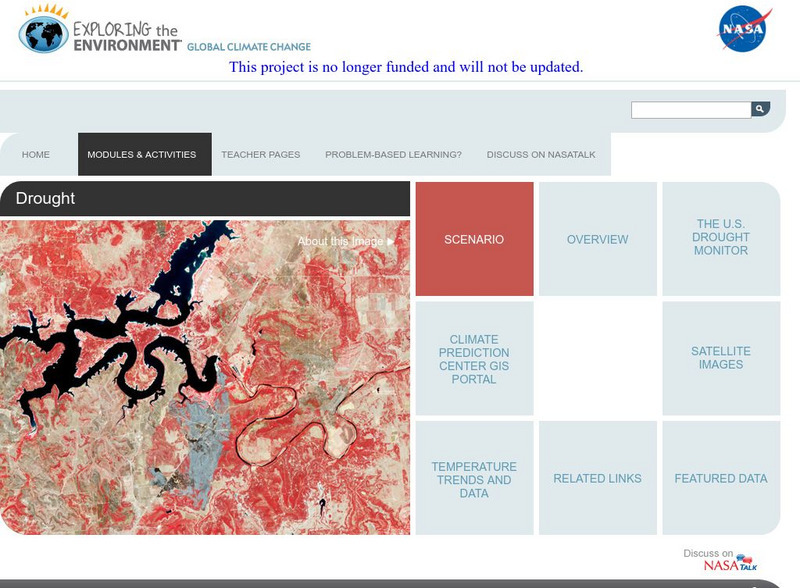
Center for Educational Technologies
Cet: Exploring the Environment: Drought
The U.S. National Park Service has asked students to advise it whether the drought that greatly impacted the Midwest and Southwest is a consequence of global climate change or just an abnormal weather pattern. In either case, they will...
NOAA
Noaa: Education Resources
Links to earth science sites, including safety tips, fun activities, general earth science information, and daily weather reports and more.
NOAA
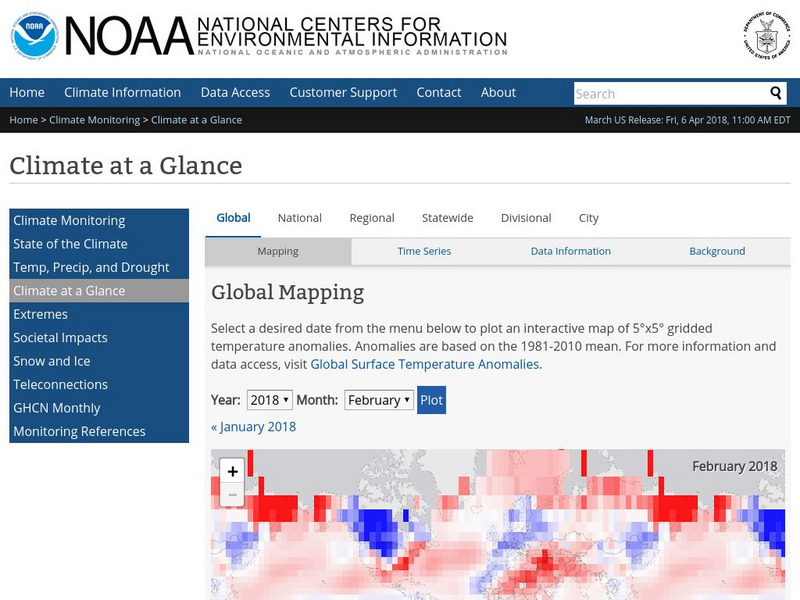
Noaa: National Climatic Data Center: u.s. Climate at a Glance
Allows you to search over 100 years of monthly climate data in maps, charts, etc. for the variables temperature and precipitation. See how the weather has changed over the years.
The Field Museum
Field Museum: Exhibits: Nature Unleashed: Inside Natural Disasters
Discover the true powers of Mother Nature through this vivid collection of research, which delves into the causes of natural disasters and the impacts on those affected.
PBS
Pbs Learning Media: Choosing Earth's Climate Future
Students focus on the three interconnected choices global society faces as Earth's climate continues to change -- suffer, adapt, and mitigate -- to analyze and predict current and future impacts to Earth's systems. Using videos excerpted...
NASA
Nasa Earth Observatory: The Color of El Nino
This article explains the effects El Nino has had on different climates and natural disasters throughout the world.
National Earth Science Teachers Association
Windows to the Universe: The Earth's Atmosphere
Windows to the Universe offers information on the Earth's atmosphere. The site contains links to a weather crossword puzzle and images.