
National Institute of Open Schooling
Radioactive Pollution
Radioactive pollutants can enter the body through ingestion, inhalation, absorption, or injection. The last lesson in a series of 36 introduces pupils to radioactive pollution. They study its sources, both natural and man-made, its...

Curated OER
Reflection and Refraction
What is a prism? A place for light waves that commit minor refractions! The thorough resource includes three hands-on investigations covering light reflection and refraction; mirrors, lenses, and images; and optical systems. Subject...
Nobel Media AB
The Nobel Prize: The Dual Nature of Light as Reflected in the Nobel Archives
This article discusses the historical figures who contributed to our understanding of the nature of light, x-rays, Quantum ElectroDynamic (QED) theory, and so on.

Physics Classroom
The Physics Classroom: Light Waves and Color
The behavior of light waves is introduced and discussed. Also, polarization, color, diffraction, and interference are introduced and discussed thoroughly as supporting evidence of the wave nature of light.

Georgia State University
Georgia State University: Hyper Physics: Wave Particle Duality
The dualistic nature of light is discussed. The photoelectric effect and the Davisson-Germer experiment are contrasted as empirical evidence supporting each of the two views - particle and wave - of the nature of light. The photoelectric...
Science Struck
Science Struck: How Does Light Travel Through Space and Other Media?
A detailed discussion of the nature of light, how it can travel through a vacuum, and how the speed of light is affected when light travels through a medium.
American Museum of Natural History
American Museum of Natural History: Ole Roemer and the Speed of Light
This resource provides a concise overview of the speed of light and the Ole Roemer, the first man to measure it.
Globio
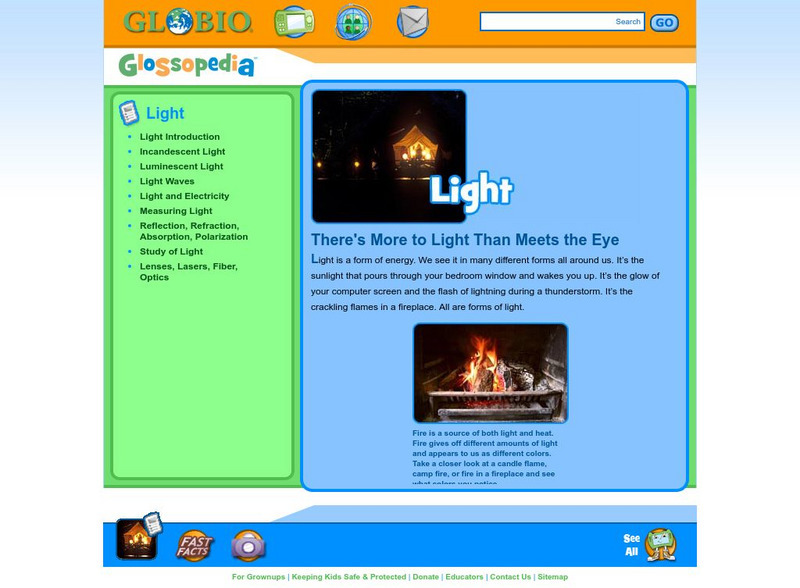
Glossopedia: Light
Light is a form of energy. We see it in many different forms all around us. It's the sunlight that pours through your bedroom window and wakes you up. Images and in-depth information on light can all be accessed in this article.
Synopsys
Synopsys: Optics: A Gentle Intro to Optical Design: Wave Particle Duality
Discusses the manner in which light behaves as both wave and particle. This dualistic nature of light is one topic of many on the page.
National High Magnetic Field Laboratory
Magnet Academy: Timeline of Electricity and Magnetism: 1900 1909
Albert Einstein publishes his special theory of relativity and his theory on the quantum nature of light, which he identified as both a particle and a wave. With ever new appliances, electricity begins to transform everyday life.
Oklahoma Mesonet
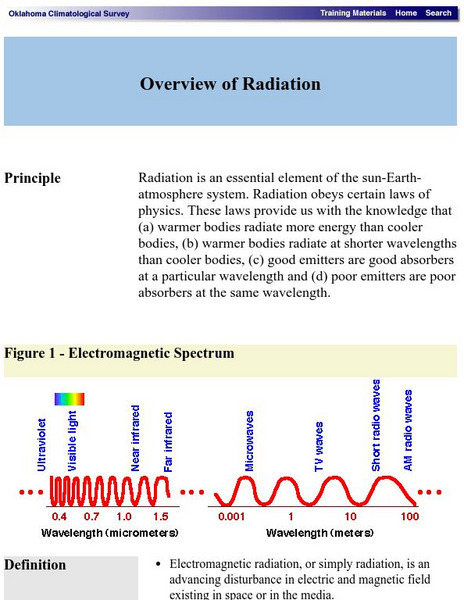
Oklahoma Climatological Survey: Overview of Radiation
This site details what radiation is, the physics of radiation, and radiative transfer as it occurs in nature. Content explores the electromagnetic spectrum, electromagnetic waves, properties of radiation, and solar radiation.
American Museum of Natural History
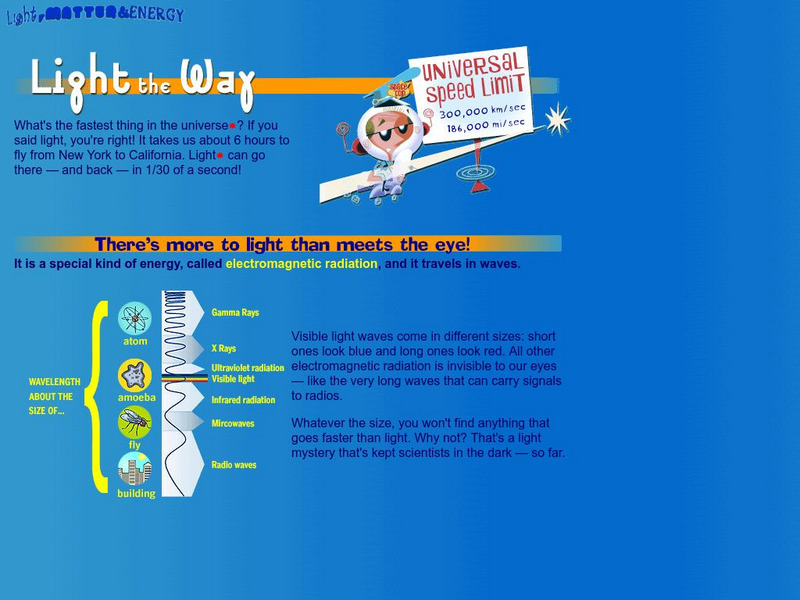
American Museum of Natural History: O Logy: Light, Matter, Energy: Light the Way
What is electromagnetic radiation and how does it work? Review a captioned graphic that explains electromagnetic radiation and the visible and invisible types of radiation on the electromagnetic spectrum.
Florida State University
Florida State University: Molecular Expressions: Electromagnetic Radiation
This Florida State University page introduces light as an electromagnetic wave and discusses the frequency and wavelength range of the various regions of the electromagnetic spectrum. Includes links to some interactive Java applets.