
Curated OER
A Solution for Precipitation
Students predict the product of chemical reaction using the solubility rules. For this chemistry lesson, students balance ionic equation. They perform a lab to check if their predicted products are correct.

Curated OER
A Solution for Moles
Students calculate the concentration of different solutions. In this chemistry lesson, students explain what a solution is. They explain ways to change the concentration of a solution.

CK-12 Foundation
Ck 12: Life Science: 2.1 Elements and Compounds
Learn how basic elements form molecules to support life.
CK-12 Foundation
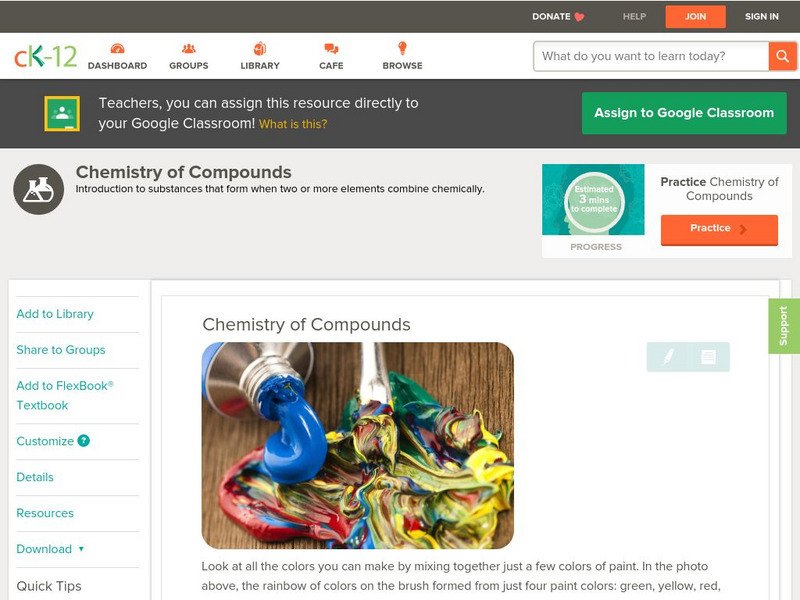
Ck 12: Physical Science: Chemistry of Compounds
[Free Registration/Login may be required to access all resource tools.] Explores chemical compounds and how elements form different compounds.
Scholastic
Scholastic: Study Jams! Science: Matter: Elements & Compounds
A video and a short quiz on elements, how they combine through chemical reactions to make compounds, and how to write the chemical formulas for water and salt.
CK-12 Foundation
Ck 12: Fifth Grade Science: Physical Science: Types of Matter
[Free Registration/Login may be required to access all resource tools.] Discusses elements, atoms, compounds, molecules, and crystals. Looks at mixture and different types of them.
Scholastic
Scholastic: Study Jams! Science: Matter: Periodic Table
A video and a short quiz on the periodic table of elements and how it is organized.
Science Buddies
Science Buddies: Are There Dangerous Levels of Lead in Local Soil?
The element lead is a neurotoxin that is particularly dangerous to young children. Among other uses, lead compounds were common paint additives until being phased out for safer titanium-based additives beginning in the 1960's. Lead...
Museum of Science
The Museum of Science: Gadget Anatomy
This site from The Museum of Science presents some compound machines and asks students to identify which simple machines they are composed of. Students provide their answer and receive immediate feedback.
Other
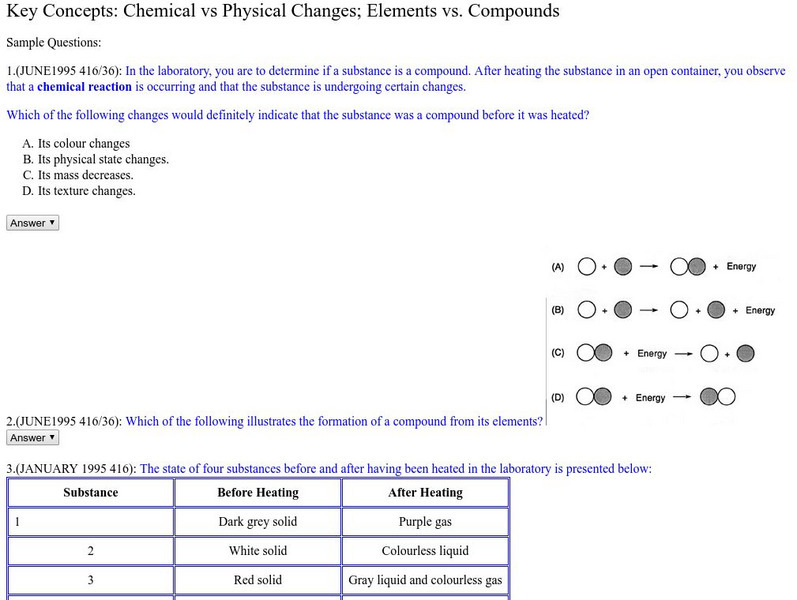
English Montreal School: Chemical vs. Physical Changes: Elements vs. Compounds
A laboratory experiment where students classify matter into a homogenous mixture, heterogeneous mixture, solution, or pure substance. Also students will test for physical and chemical changes.
CK-12 Foundation
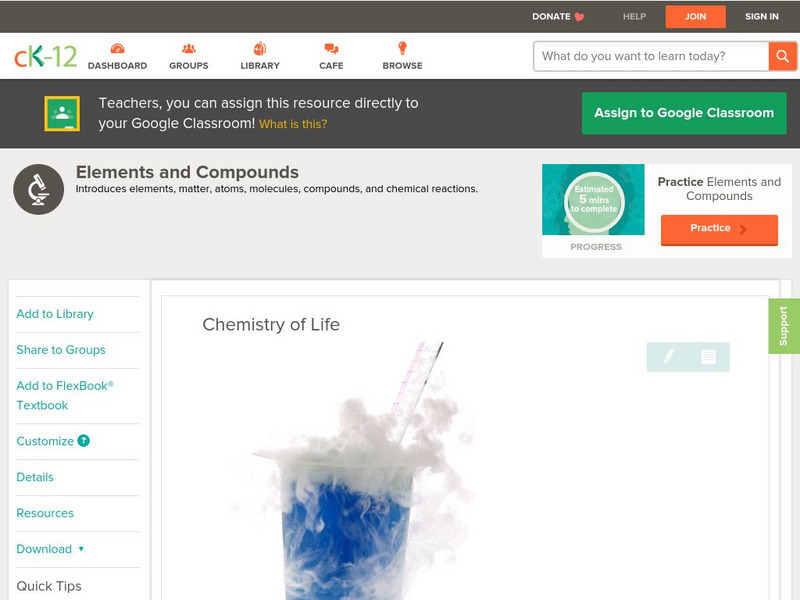
Ck 12: Life Science: Chemistry of Life
[Free Registration/Login may be required to access all resource tools.] Many chemical reactions are going on constantly inside your body. In fact, there are probably thousands of chemical reactions occurring every second in every one of...

Open Curriculum
Open Curriculum: Matter
Students will be able to describe elements and compounds, and explain how mixtures differ from compounds.
Read Works
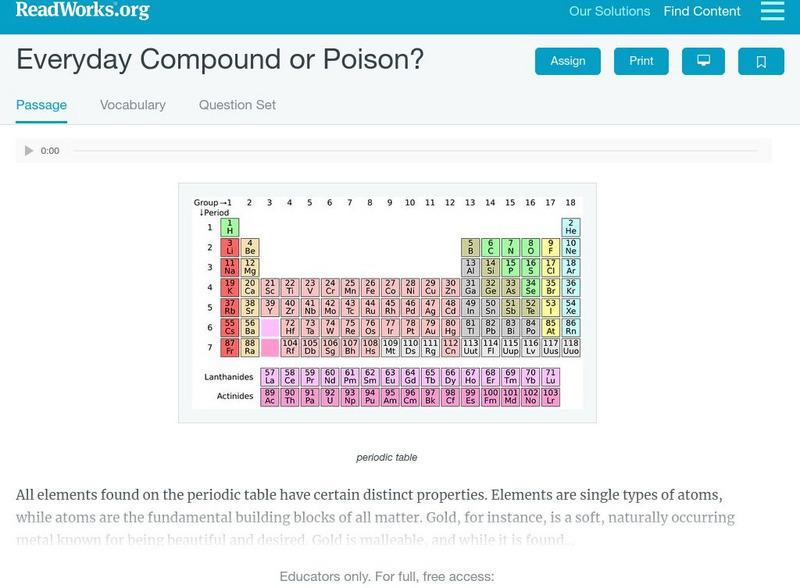
Read Works: Everyday Compound or Poison?
[Free Registration/Login Required] An informational text about how chemicals can be combined to form safe or unsafe compounds. A question sheet is available to help students build skills in reading comprehension.
CK-12 Foundation
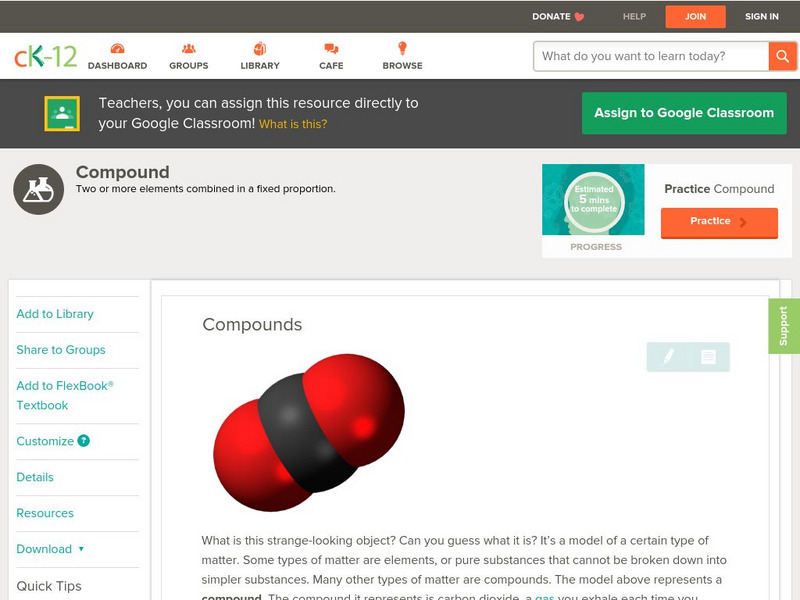
Ck 12: Physical Science: Compounds
[Free Registration/Login may be required to access all resource tools.] Investigates compounds and their properties, the elements that form them, and their structure.
CK-12 Foundation
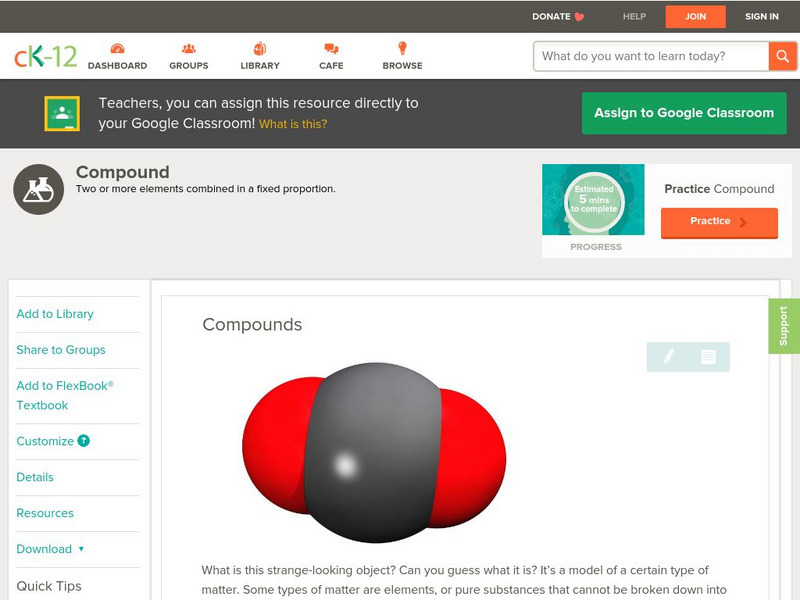
Ck 12: Physical Science: Compounds
[Free Registration/Login may be required to access all resource tools.] Explores compounds and their properties, the elements that form them, and their structure.
CK-12 Foundation
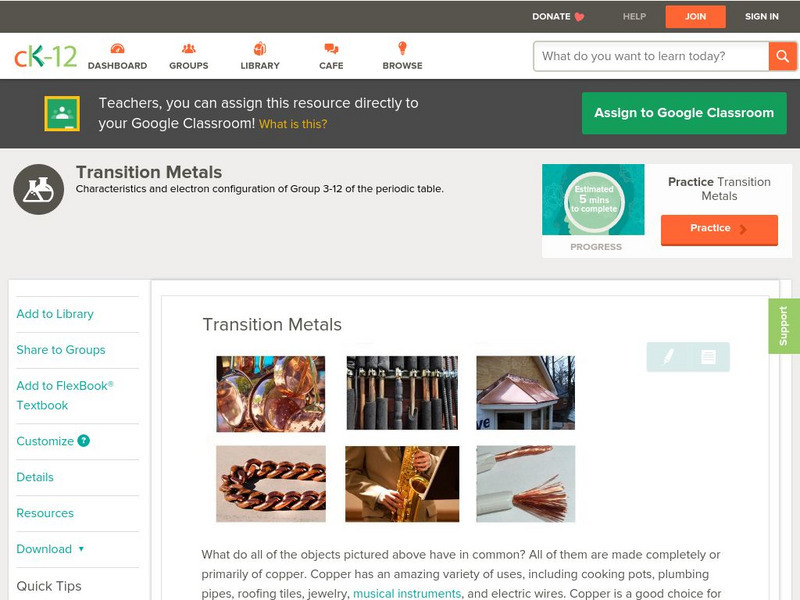
Ck 12: Physical Science: Transition Metals
[Free Registration/Login may be required to access all resource tools.] Group 3-12 elements and their properties.

CK-12 Foundation
Ck 12: Life Science: Organic Compounds
[Free Registration/Login may be required to access all resource tools.] The main chemical components of living organisms are known as organic compounds and are built around the element carbon. Living things are made up of very large...
Other
Science Alive: Synthetic vs. Natural: What's the Difference?
Through this reading, learners will learn that a substance's properties arise from its molecular structure, not from how it's made (i.e., synthesized by people or found in nature). There is no fundamental difference between natural and...
Other
Science Alive: The Many Faces of Steroids
This reading is an introduction to the great variety of steroids and their many different uses.
Ducksters
Ducksters: Kids Science: Molecules
Kid's learn about the science of the molecules. Tiny chemistry and compounds of atoms and elements make up all matter.

ClassFlow
Class Flow: Comparing and Contrasting Matter
[Free Registration/Login Required] This flipchart is a guided activity to help students compare different types of matter: atoms and molecules, elements and compounds, mixtures and solutions. It corresponds to Virginia science SOL 5.4.
Ducksters
Ducksters: Chemistry for Kids: Naming Chemical Compounds
Learn about naming chemical compounds in chemistry including conventions, the order of the elements, metals, non-metals, acids, and examples on naming on this site.
CK-12 Foundation
Ck 12: Physical Science: Covalent Bonding
[Free Registration/Login may be required to access all resource tools.] Definition of covalent bond, the compounds and elements they make up, and why they form.
BBC
Bbc: Gcse Bitesize: Chemistry (Single Science)
This site lists the topics and lessons available for Chemistry. The topics include Particles; Elements, compounds and mixtures; Chemical reactions, Predicting and identifying reactions and products, organic chemistry, and more.