American Institute of Biological Sciences
Action Bioscience: The State of Ecosystems
Christian Samper details The Millennium Ecosystem Assessment, a report highlighting the detrimental impact of human life on the ecosystems of Earth over the past fifty years. Ecosystems have been deteriorating from a variety of waste and...

PBS
Pbs Learning Media: Grassland Elephants
This video segment from Nature features a greeting ceremony by grassland elephants in Kenya.

TeachEngineering
Teach Engineering: Got Energy? Spinning a Food Web
Students learn about energy flow in food webs, including the roles of the sun, producers, consumers and decomposers in the energy cycle. They model a food web and create diagrams of food webs using their own drawings and/or images from...

PBS
Pbs: Nature: Born to Be Wild, Polar Bears
Research the diet, habitat and behavior of polar bears, and compare and contrast the issues surrounding polar bears in their environment with those of bears in the U.S. Rocky Mountains. Rewrite a human/bear encounter from the bear's...
Canadian Museum of Nature
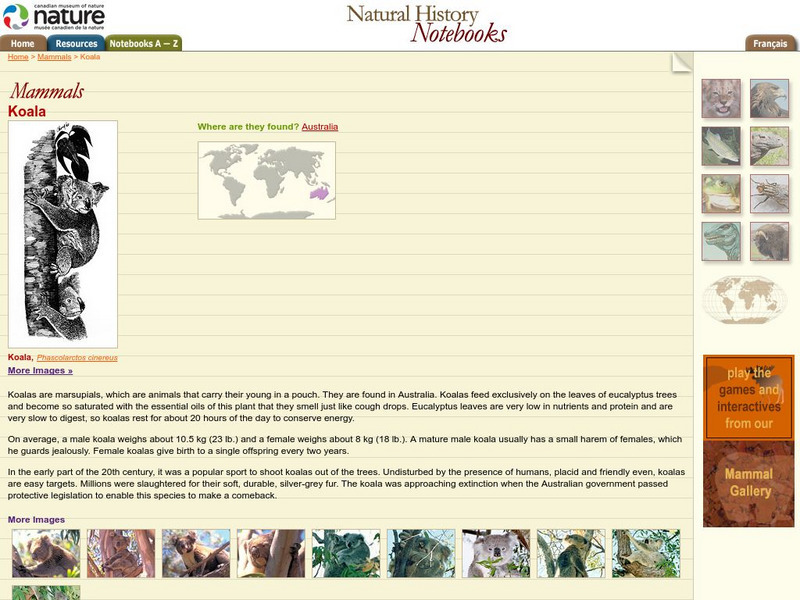
Canadian Museum of Nature: Koala
Get to know the Koala.. colored photos, description, life cycle, map of habitat, food. Only the basic details of this marsupial are given, making this site perfect for younger researchers.
Canadian Museum of Nature
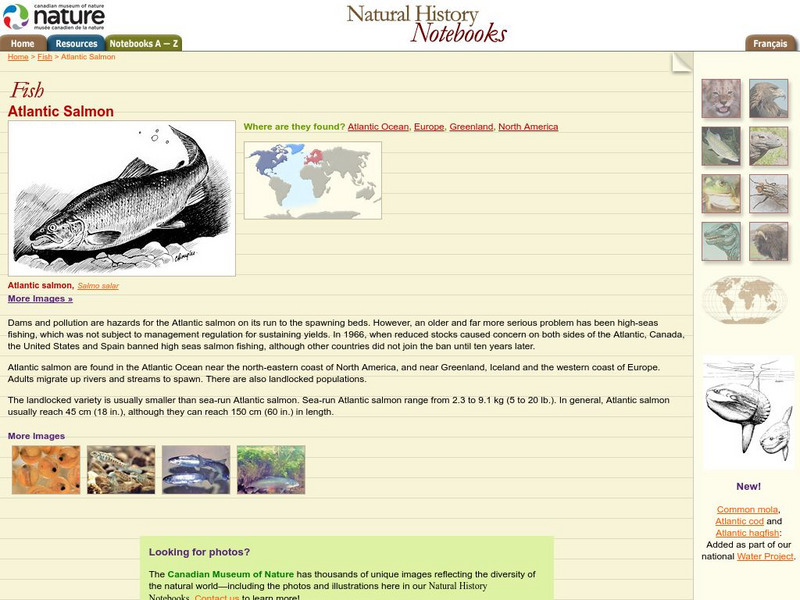
Canadian Museum of Nature: Atlantic Salmon
Learn more about the Atlantic Salmon from this concise, informative site.
Canadian Museum of Nature
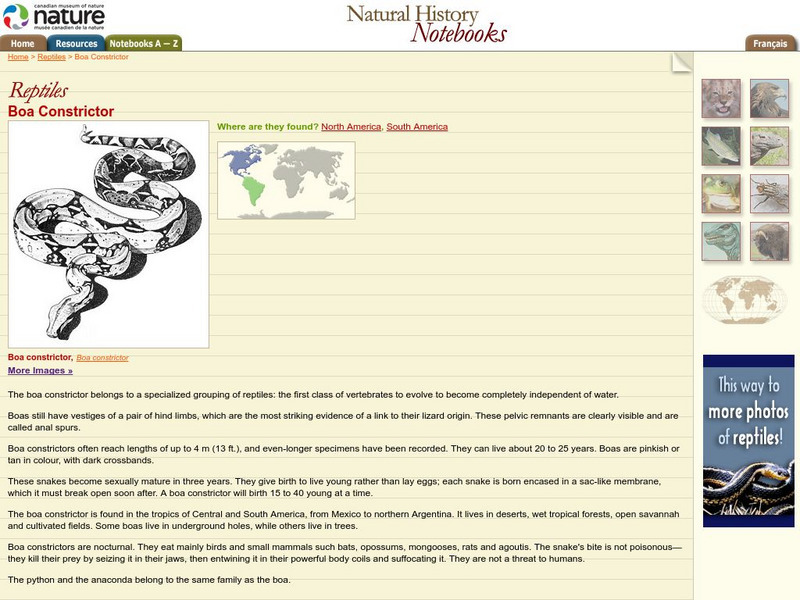
Canadian Museum of Nature: Boa Constrictor
The boa constrictor is not venomous, but kills its pray by constriction. Described at the boa constrictor's characteristics, young, habitat and pray. Included is one close up image.
Canadian Museum of Nature
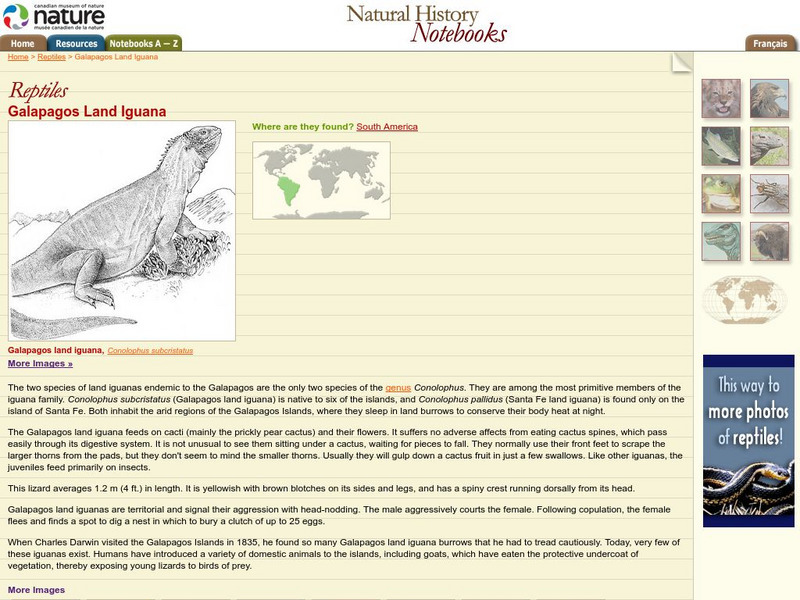
Canadian Museum of Nature: Galapagos Land Inguana
Today, very few of the Galapagos land iguanas exist. Described are their characteristics, food, and reproduction. Eight photographs show this iguana close up in its habitat.
Canadian Museum of Nature
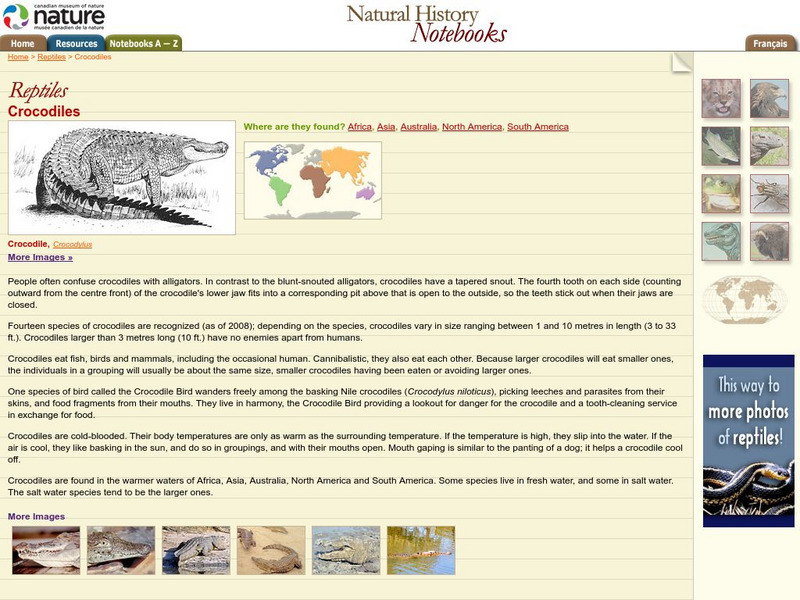
Canadian Museum of Nature: Crocodiles
Do you know the difference between a crocodile and an alligator? Find out how they differ, the number of species, what they eat, their characteristics and location. Six pictures show this reptile in its habitat.

PBS
Pbs Nature: Sharks
How many species of sharks are there in the world of water? Students will discover how and where sharks live, what they eat and how they socialize through the exploration of this resource.

Discovery Education
Discovery Education: Make It a Habitat
This lesson plan explores the adaptation of life forms through natural selection to fill various niches and accommodate changing environmental conditions.
Other
Indiana.gov: Indiana State Division of Fish and Wildlife
Home of the State of Indiana's Division of Wildlife. This resource is small, but does offer a photo gallery and some information about the animals that can be found in Indiana. It also gives information about three current restoration...

Smithsonian Institution
National Museum of Natural History: American Mammals: Ord's Kangaroo Rat
By occupying the short grass prairie of the Great Plains, and a variety of habitats where there are fine-textured, sandy soils, Ord's Kangaroo Rat has managed a truly enormous geographic distribution. The varied habitats that it occupies...
Smithsonian Institution
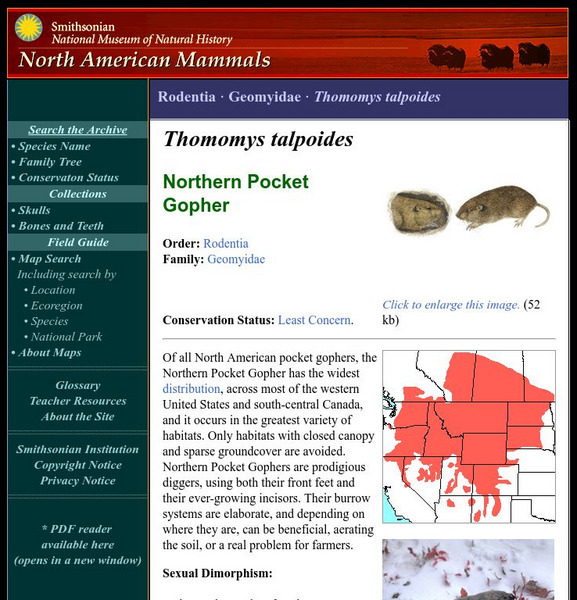
National Museum of Natural History: American Mammals: Northern Pocket Gopher
Of all North American pocket gophers, the Northern Pocket Gopher has the widest distribution, across most of the western United States and south-central Canada, and it occurs in the greatest variety of habitats. Only habitats with a...
Smithsonian Institution
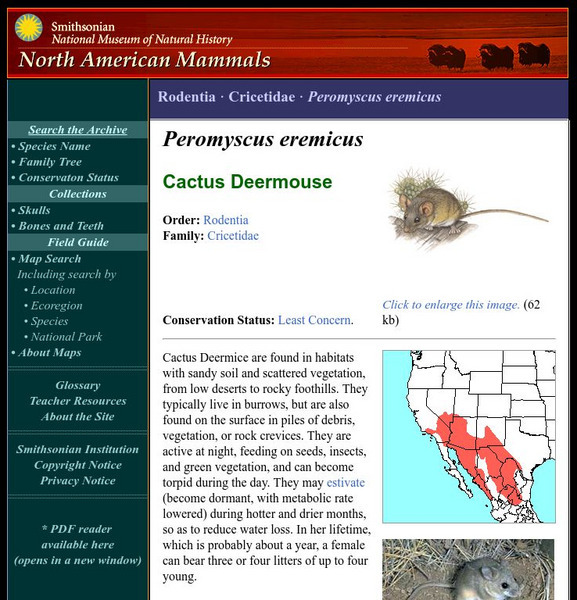
National Museum of Natural History: American Mammals: Cactus Deermouse
Cactus Deermice are found in habitats with sandy soil and scattered vegetation, from low deserts to rocky foothills. They typically live in burrows but are also found on the surface in piles of debris, vegetation, or rock crevices. Learn...
Smithsonian Institution
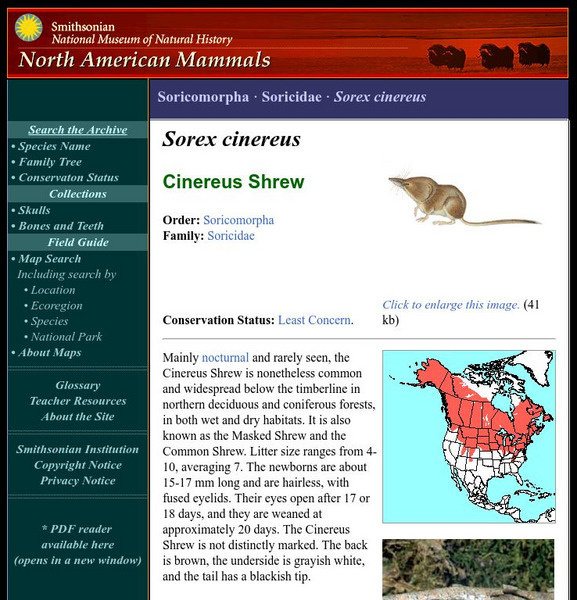
National Museum of Natural History: American Mammals: Cinereus Shrew
Mainly nocturnal and rarely seen, the Cinereus Shrew is nonetheless common and widespread below the timberline in northern deciduous and coniferous forests, in both wet and dry habitats. It is also known as the Masked Shrew and the...
Smithsonian Institution
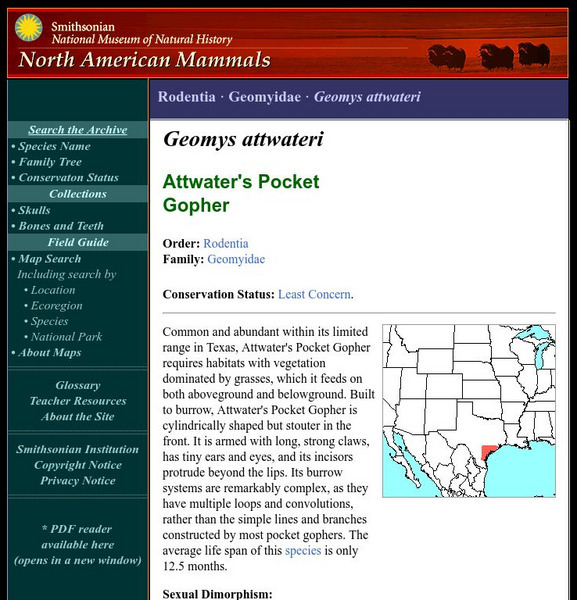
National Museum of Natural History: American Mammals: Attwater's Pocket Gopher
Common and abundant within its limited range in Texas, Attwater's Pocket Gopher requires habitats with vegetation dominated by grasses, which it feeds on both aboveground and belowground. Built to burrow, Attwater's Pocket Gopher is...
Smithsonian Institution
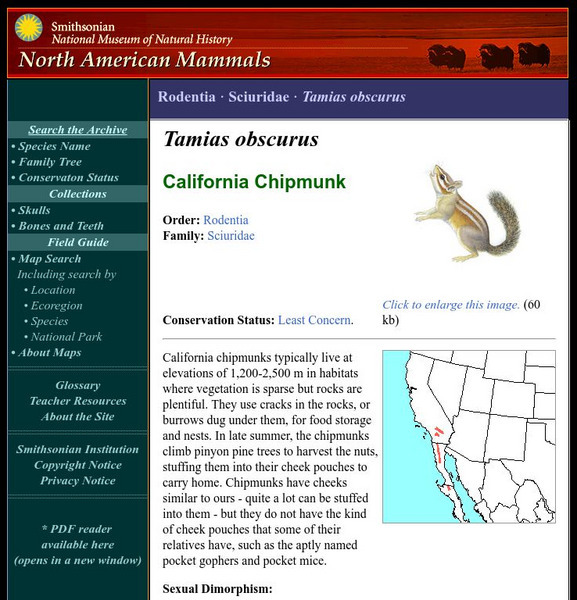
National Museum of Natural History: American Mammals: California Chipmunk
California chipmunks typically live at elevations of 1,200-2,500 m in habitats where vegetation is sparse but rocks are plentiful. They use cracks in the rocks, or burrows dug under them, for food storage and nests. Learn more about the...
Smithsonian Institution
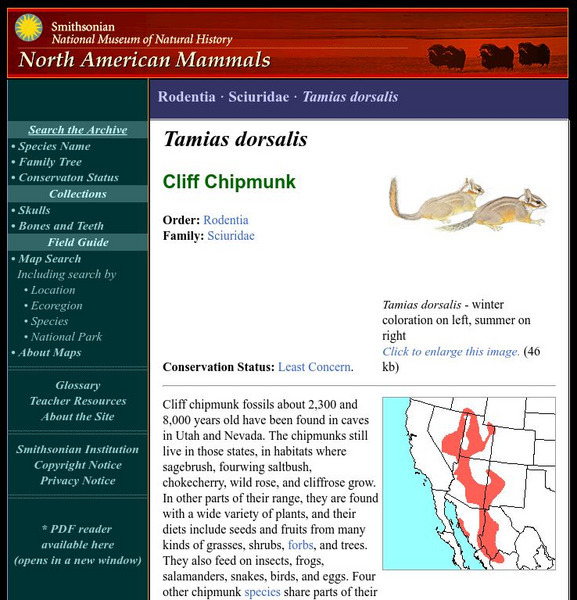
National Museum of Natural History: American Mammals: Cliff Chipmunk
Cliff chipmunk fossils about 2,300 and 8,000 years old have been found in caves in Utah and Nevada. The chipmunks still live in those states, in habitats where sagebrush, fourwing saltbush, chokecherry, wild rose, and cliffrose grow....
Smithsonian Institution
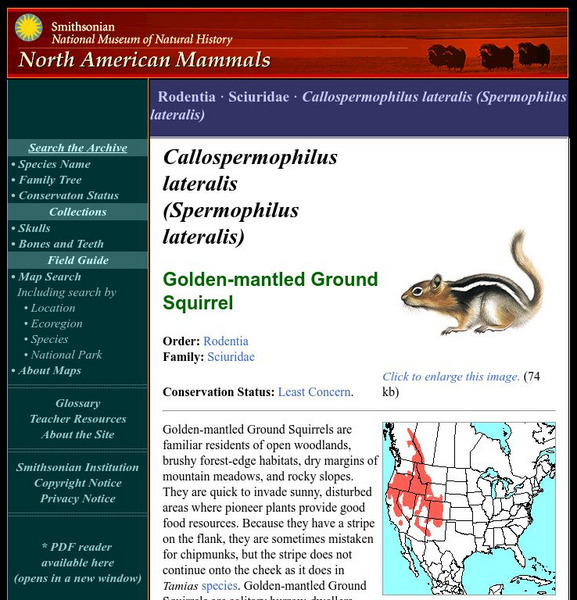
National Museum of Natural History: American Mammals: Golden Mantled Ground Squirrel
Golden-mantled Ground Squirrels are familiar residents of open woodlands, brushy forest-edge habitats, dry margins of mountain meadows, and rocky slopes. They are quick to invade sunny, disturbed areas where pioneer plants provide good...
Smithsonian Institution
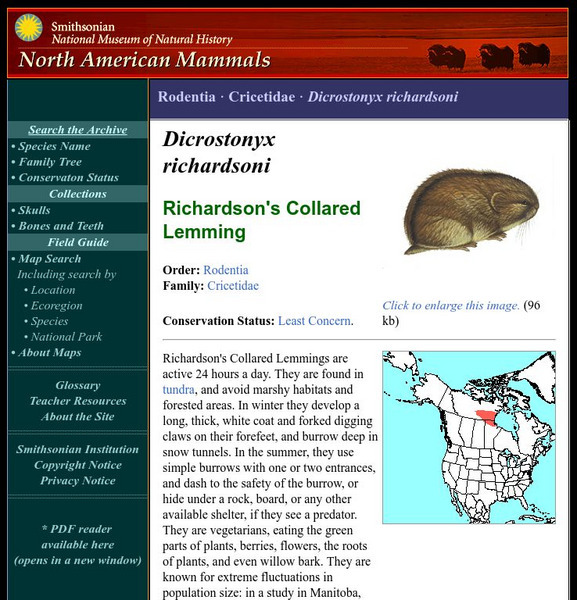
National Museum of Natural History: American Mammals: Richardson's Collared Lemming
Richardson's Collared Lemmings are active 24 hours a day. They are found in tundra, and avoid marshy habitats and forested areas. Learn more about the Dicrostonyx richardsoni, more commonly known as a Richardson's Collared Lemming, in...
Smithsonian Institution
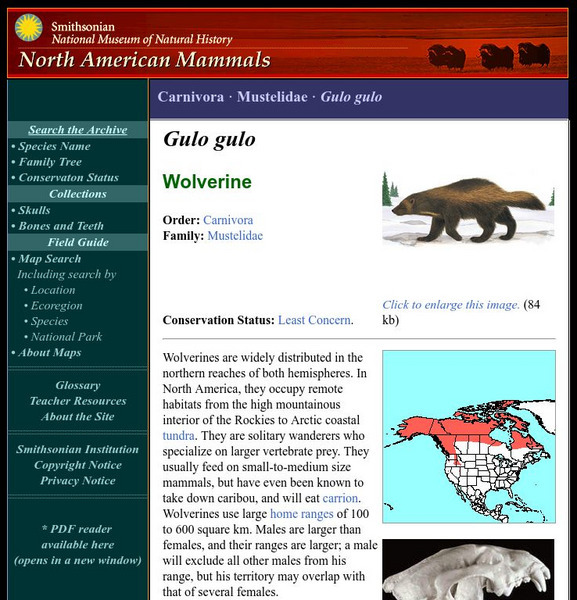
National Museum of Natural History: American Mammals: Wolverine
Wolverines are widely distributed in the northern reaches of both hemispheres. In North America, they occupy remote habitats from the high mountainous interior of the Rockies to Arctic coastal tundra. Learn more about the Gulo gulo, more...
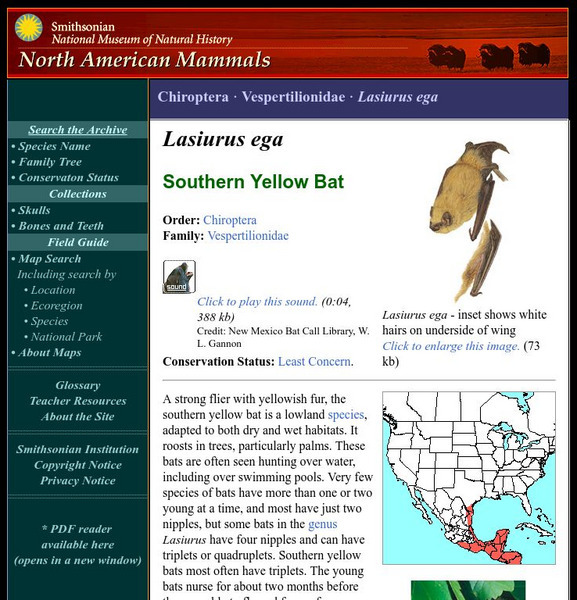
Smithsonian Institution
National Museum of Natural History: American Mammals: Southern Yellow Bat
A strong flier with yellowish fur, the southern yellow bat is a lowland species, adapted to both dry and wet habitats. It roosts in trees, particularly palms. Learn more about the Lasiurus ega, more commonly known as a Southern Yellow...
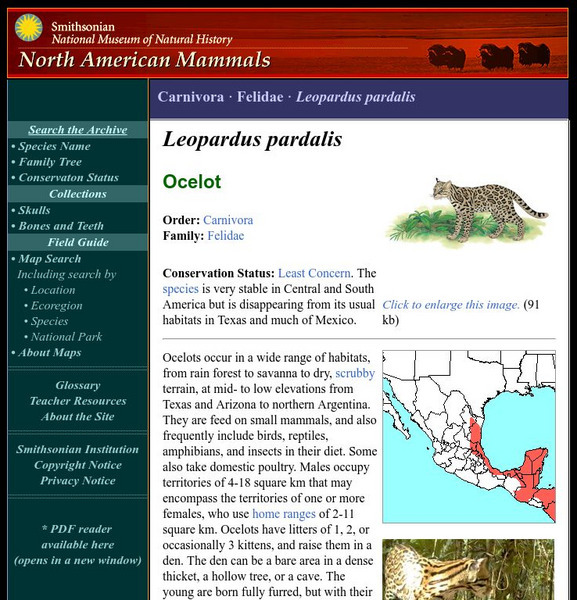
Smithsonian Institution
National Museum of Natural History: American Mammals: Ocelot
Ocelots occur in a wide range of habitats, from rainforest to savanna to dry, scrubby terrain, at mid- to low elevations from Texas and Arizona to northern Argentina. They are feed on small mammals, and also frequently include birds,...
Other popular searches
- Natural Habitats Animals
- Manmade or Natural Habitats
- Natural Habitats of Nyc
- Man Made or Natural Habitats