
Virginia Middle School Engineering Education Initiative
Save the Penguins: An Introduction to Thermodynamics and Heat Transfer
Heat things up in your physical science class with this interactive lesson series on thermodynamics. Through a series of class demonstrations and experiments, young scientists learn how heat is transferred through conduction,...

Curated OER
Cool and Not-So-Cool Materials
Why do some materials feel cool to the touch, but not others? Learn about thermal conductors and thermal insulators with a fun science experiment. First, kids read the results of an experiment with spoons and hot water. They then try...

Curated OER
Heat and Matter
Young scholars explore liquids and solids by conducting in class experiments. In this matter lesson, students define the properties of matter and how heat can change those properties. Young scholars experiment with heating objects such...

Perkins School for the Blind
Conductors of Heat - Hot Spoons
Why is the end of a spoon hot when it's not all the way in the hot water? A great question deserves a great answer, and learners with visual impairments will use their auditory and tactile senses to get that answer. A talking...

Mr. E. Science
Thermal Energy and Heat
The presentation covers Fahrenheit, Celsius, and Kelvin scales for temperature as well as conduction, convection, and radiation.

Curated OER
Changes in Heat
A thorough PowerPoint provides information related to changes in heat. The contrast between day and night temperatures is included. The concepts of boiling and freezing are also covered. Insulators and conductors are presented as well.

Curated OER
Elementary Concepts in Heat
Third graders read a thermometer with accuracy, record observations and data, and infer conceptual meaning. They integrate mathematical charting and graphing skills to organize their data. They explore what happens when they touch or use...

Curated OER
Insulators, Conductors, and Energy Transfer
Third graders conduct experiments to determine what types of material make good insulators. They prepare a graph of time vs. temperature for their sample. They choose a graph using each kind of material to display for class analysis and...

Curated OER
Thermal Energy and Heat Unit
Young scholars explain that heat energy in a material consists of the disordered motions of its atoms or molecules. They know and explain that transformations of energy usually transform some energy into the form of heat, which...

Curated OER
IPC Textbook Guided Reading-Chapter 27-Heat
In this heat activity, learners answer 21 short answer questions about heat transfer through conduction and convection, thermal conduction and conductors.

Curated OER
Heat Misconceptions
Third graders determine that gloves do not provide heat, but rather, they insulate or hold in any heat that is in their hand. They discuss the different temperatures found in ecosystems around the world. What do animals that live in...

Curated OER
Thermodynamics
In this thermodynamics worksheet, high schoolers learn about insulators and conductors. Students compare the three ways thermal energy is transferred: conduction, convection, and radiation. This worksheet has 22 matching, 1 multiple...

Curated OER
What is the Best Insulator: Air, Styrofoam, Foil, or Cotton?
Students investigate the properties of insulators by attempting to keep a cup of water from freezing, and once it is frozen, to keep it from melting. They conduct the experiment, record and analyze the results, and answer discussion...

Polar Trec
Staying Warm in Antarctica!
Has your class ever wondered how animals and scientists stay warm in the Polar Regions? Kids will investigate to understand the three types of heat transfer and how heat transfer affects those trying to stay toasty in sub-zero...

Curated OER
Adobe
In this adobe activity, students read about adobe soil and how it was used for building because of its insulating properties. Students complete 3 short answer questions.

Curated OER
Window Treatments for Energy Savings
Students investigate energy-saving window treatments. In this environmental lesson, students research how energy-saving windows work by conducting an experiment using a thermometer and graphing data. Students identify why energy-saving...

Curated OER
Keeping Warm
Fifth graders measure the temperature of water using a thermometer. They record the temperatures of water on a chart. Students use the temperature data to determine which materials are the best conductors of heat. They discuss their...

Curated OER
Thermodynamics
In this thermodynamics worksheet, students read about conduction, convection and radiation. They answer 47 questions about heat transfer, thermal equilibrium, insulators, conductors and the states of matter.

Curated OER
Atmospheric Processes - Conduction
Students explain the process of conduction using a molecular explanation, and explain how different materials conduct at different rates.

Curated OER
Transfer of Thermal Energy
In this thermal energy instructional activity, students will explore different ways heat is transferred including conduction and convection. Students will look at how insulators work and how room temperature can affect heat transfer....

Curated OER
Third Grade Science Multiple Choice Practice
In this 3rd grade science activity, 3rd graders complete a total of 25 multiple choice questions related to grade 3 concepts. An answer key is given.

Concord Consortium
Concord Consortium: Heat and Temperature
Learn that temperature measures average kinetic energy, and heat is the transfer of energy from hot systems to cold systems. Consider what makes a good conductor. (Requires Java)
TeachEngineering
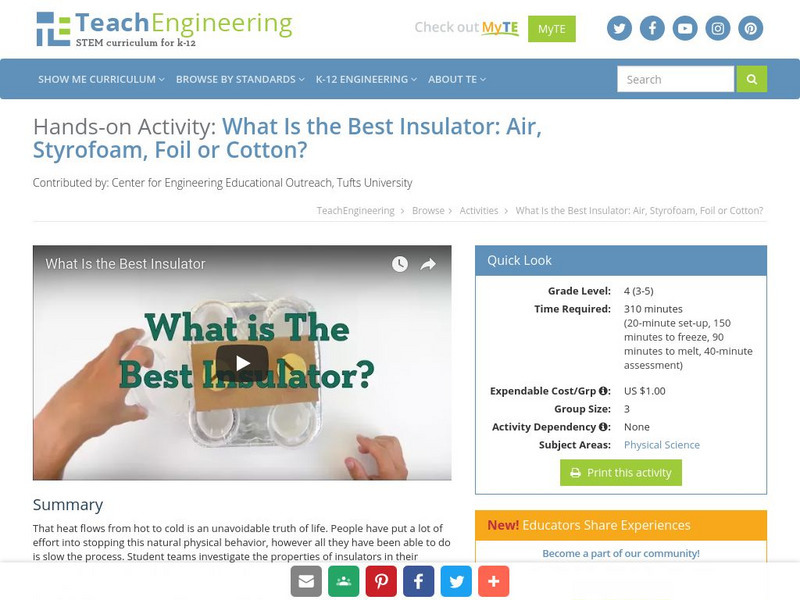
Teach Engineering: What Is the Best Insulator: Air, Styrofoam, Foil, or Cotton?
That heat flows from hot to cold is an unfortunate truth of life. People have put a lot of effort into stopping this fact, however all they have been able to do is slow the process. Working in groups of three to four, students will...

ClassFlow
Class Flow: Keeping Warm
[Free Registration/Login Required] Through this unit children build their ideas about temperature as a measure of how hot or cold objects are and learn about thermal insulators as materials that can help to keep things warm or cool.