Science Museum, London
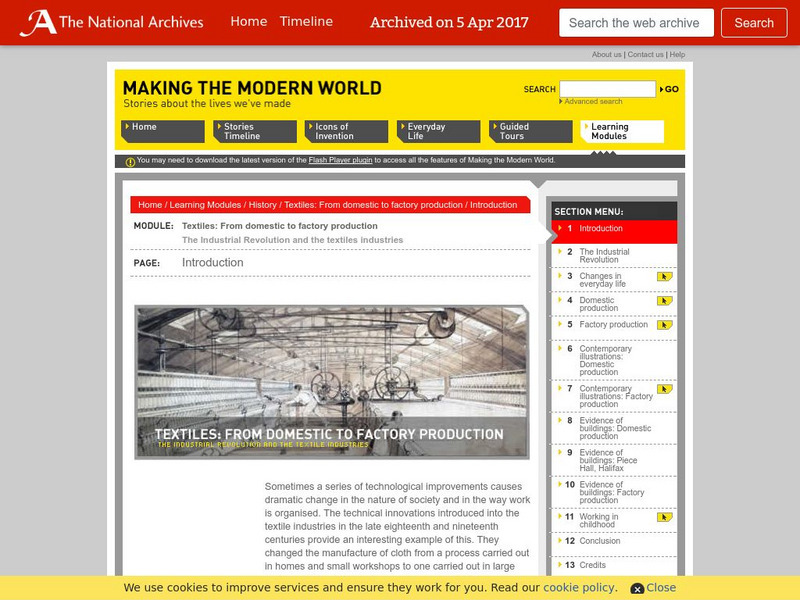
Science Museum: Making the Modern World: Textiles: Domestic v Factory Production
Twelve-part learning module uses text-based overviews and rich media cut-away scenes to explain the role of the textile industry in driving the Industrial Revolution forward in Britain.

Library of Congress
Loc: America at the Turn of the Century
A short report on America by 1900: "..the American nation had established itself as a world power. The West was Won. The frontier -- the great fact of 300 years of American history -- was no more."

ClassFlow
Class Flow: Industrial Revolution & Immigration
[Free Registration/Login Required] This lesson has notes covering the American Industrial Revolution and famous leaders of the industrial age. Also includes the need for immigrants to supply the factories with workers.
University of Georgia
University of Georgia: History of Work Ethic: Work Ethic and Industrial Revolution
This article from The University of Georgia examines the effect of the Industrial Revolution on the general work ethics of people.
Digital History
Digital History: The Eve of the Industrial Revolution
A brief review of how the nation changed from 1790 to the 1820s. See how the production of goods moved from the home to factories and read about the change in the way workers were compensated.

Library of Congress
Loc: Teachers: America at the Centennial
A lesson plan requiring student to analyze primary documents from the Philadelphia Centennial Exposition of 1876. Students interpret what these historical artifacts say "about the lives and values of Americans in 1876" among other things.

CommonLit
Common Lit: Text Sets: Workers' Rights
As America grew, so did its production of agriculture and manufacturing, leading to a rise in workers and their demands. Study the history of worker's rights in America from the Industrial Revolution to today. This collection includes 13...
Digital History
Digital History: The Introduction of the Factory System
The factory system revolutionized manufacturing and the employment of unskilled workers to man the factories. Read about the young children, women, and, later, immigrants who provided the labor to the textile mills and other...
My Hero Project
My Hero: Mary Harris
Mary Harris, better known as "Mother Jones," was an activist for the reform of laber laws. Read about her long life, which she dedicated to the working class and labor movement.

PBS
Wnet: Thirteen: Freedom: A History of Us: Wake Up, America!
This resource covers the changing of America due to the Industrial Revolution which brought in not only new technology but also opened the door to reform movements. From the series by Joy Hakim, "A History of Us." Includes a teacher's...

Annenberg Foundation
Annenberg Learner: Primary Sources: The Lowell System
An hour-long professional development video on teaching how the Lowell System was a departure from traditional labor practices. Features experienced classroom teachers. Materials and a complete lesson plan are also provided.
Mocomi & Anibrain Digital Technologies
Mocomi: What Is Child Labour?
Delves into the history of child labor, the causes, and child labor laws.

Other
Woonsocket Connection: Samuel Slater: Rhode Island's Mill Villages
Pictures and text describing the conditions and what it was like working in the Rhode Island mill villages.
Other
Red Mountain High School: The Growing u.s. In the Late 1800's/early 1900's [Pdf]
A PowerPoint presentation covering American history during the second Industrial Revolution. Learn the forces behind monopolies, the growth of cities, and the development of labor unions among other aspects of progression at this time in...
Digital History
Digital History: Social Mobility in the North
Read about the ideal of social equality in the North in the early and mid-1800s and determine if upward mobility was really a possibility for even unskilled laborers.
PBS
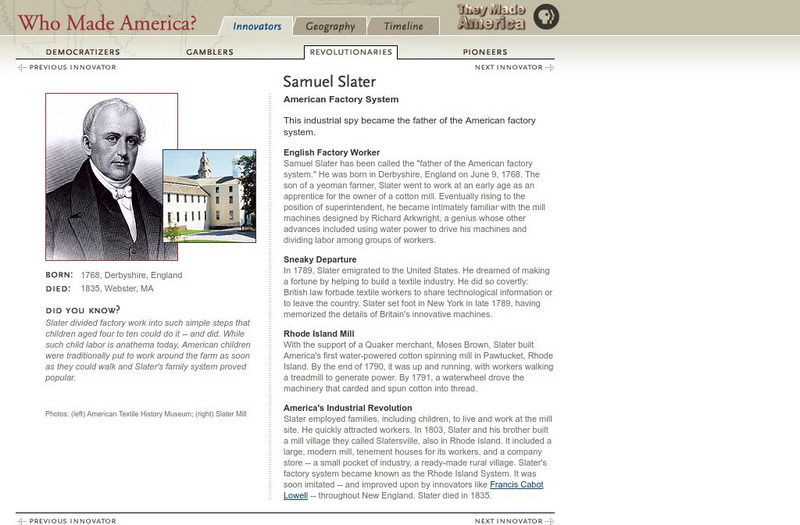
Pbs: Who Made America? Samuel Slater
Slater divided factory work into such simple steps that children aged four to ten could do it -- and did. While such child labor is anathema today, American children were traditionally put to work around the farm as soon as they could...
Curated OER
Girls Aged 10, 13 and 13 Working in a Canning Factory, June of 1910
Girls working in a factory.
Other
Spartacus Educational: British History: Child Labour: Andrew Ure
A scientist who studied many things is best known for two particular studies, one peculiar and the other focused on the conditions of factories for the employees during the Industrial Revolution in Great Britain.