
Curated OER
The Power of Compounding
Sixth graders examine the concept of compounding interest on invested money. They explore how much interest their money would earn through compounded interest. Students conclude that they should invest early and often.

Curated OER
Volatile Volcanoes
Students have fun with graphics, graphs and money, simultaneously learning with up-to-the-minute information.

Curated OER
Motion Capture and Analysis
Students investigate the concepts and relationships of speed, displacement and time. They capture the serve motion of a tennis player via video or digital camera and analyze the speed of the ball and racquet head.


Curated OER
Calculate Your Contribution
Young scholars assess the environmental impact of their transportation choices. They keep a transportation journal and use a website to calculate vehicle emissions for themselves and their class. They evaluate their transportation choices.

Curated OER
Impossible Graphs
Students distinguish between possible and impossible graphs of functions, and to learn why some graphs are impossible. They have practiced plotting functions on the Cartesian coordinate plane

Curated OER
Eggs'ceptional Experiments
Young scholars see evidence of chemical reaction and follow the scientific method to hypothesize, observe, and reach conclusions. They conduct a series of egg based experiments such as forming crystals and complete journal activities as...

Curated OER
Nurturing Green Thumbs at School
Incorporating a school garden into the curriculum cultivates many benefits.

Curated OER
The Many, Varied, and Unusual Places and Things on Earth
Students discover how energy flows through communities because of the relationship between producers, consumers and decomposers. Examining various ecosystems, they identify the materials that cycle continuously through them. They label...

Curated OER
Through the Looking Glass: Recognizing Developing and Industrialized Countries
Students examine the regions of the world, and identify the basic characteristics of industrialized and developing countries. They conduct Internet research on the economic and population characteristics of industrialized and developing...

Curated OER
Salt: White Gold
Students examine the importance of salt for trade routes and the economy of a community.

Curated OER
Warm Up to Weaving With the Right Lesson Plans
Explore the process of creating the fabrics, cloths, blankets, and rugs that warm the chilly months of winter with weaving lesson plans.

Curated OER
Side by Side: Butterfly Wings and Symmetry
Young scholars observe butterfly images and then draw and paint their own design. They use this activity to explain symmetry.

Curated OER
Facial Tattoos or Face Painting
Students use a grid-like method to create a life-size self-portrait from a 3X5 black and white photo. They explore the different customs and rituals surrounding face painting from ancient through modern civilizations. Students create a...

Curated OER
Rubber Band
Eighth graders investigate what would happen to the length of a rubber band as more and more rings were hung on it. They base their explanation on what they observed, and as they develop cognitive skills, they should be able to...

Curated OER
Language Arts: Five Senses Walk
First graders take a discovery walk around the school. They use their observations to compose a class book about their school.

PBS
Pbs Learning Media: Patterns in Nature
In this video segment [3:25] from Cyberchase, a plant expert shows Bianca the patterns and symmetry found in nature.
Better Lesson
Better Lesson: Patterns in Nature
Are there patterns in nature that can be described by numbers? That is what we will find out here.
Better Lesson
Better Lesson: Math With Maples
Patterns in division and multiplication can be found in nature, and an understanding of these patterns enables scientists to conduct systematic research.
Other
The Actuarial Foundation: Math Academy: Can You See It in Nature? [Pdf]
Students will build, extend, describe, predict, graph and generate rules for patterns and functions designed to help students understand the connection between geometric and numerical patterns (younger students) as well as between...
Math Is Fun
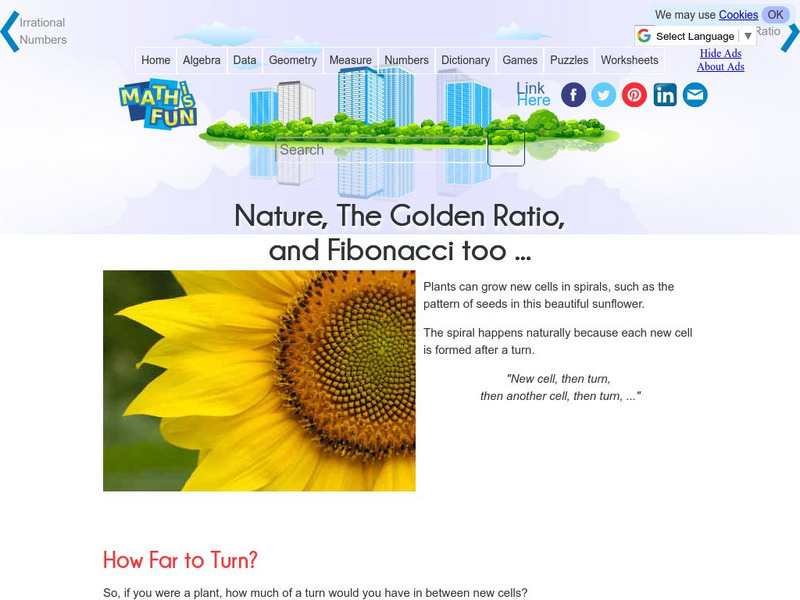
Math Is Fun: Nature, the Golden Ratio, and Fibonacci, Too
Looks at how spirals form in nature when cells reproduce in a flower, for example. An interactive lets students try entering different values to see if they can make a spiral pattern with no gaps. The correct figure would be the Golden...
Other
The Math Learning Center: Pattern Shapes
Students use pattern shapes to explore geometry and fractions, creating their own designs, or filling in outlines. As they work with the shapes students explore geometric relationships, think about angles, investigate symmetry, and...
Utah Education Network
Uen: 1st Grade Act. 12: The Little House
This instructional activity introduces students to cycles and patterns. Students will engage in shared reading. Students will learn word patterns and repetition in language cycles. Students will learn that time in math and cycles of...
PBS
Pbs Learning Media: Everyday Learning
Learning does not take place only in the classroom. Learning occurs naturally, every day! This KET collection uses original animation and wonderful, visual images to introduce basic concepts of math, science, social studies, art, and...